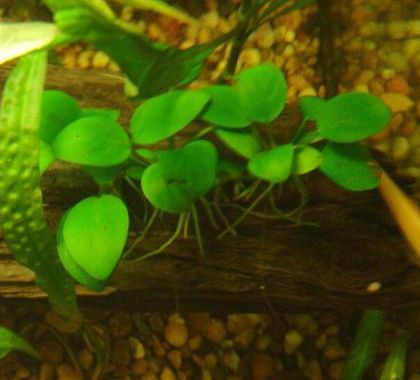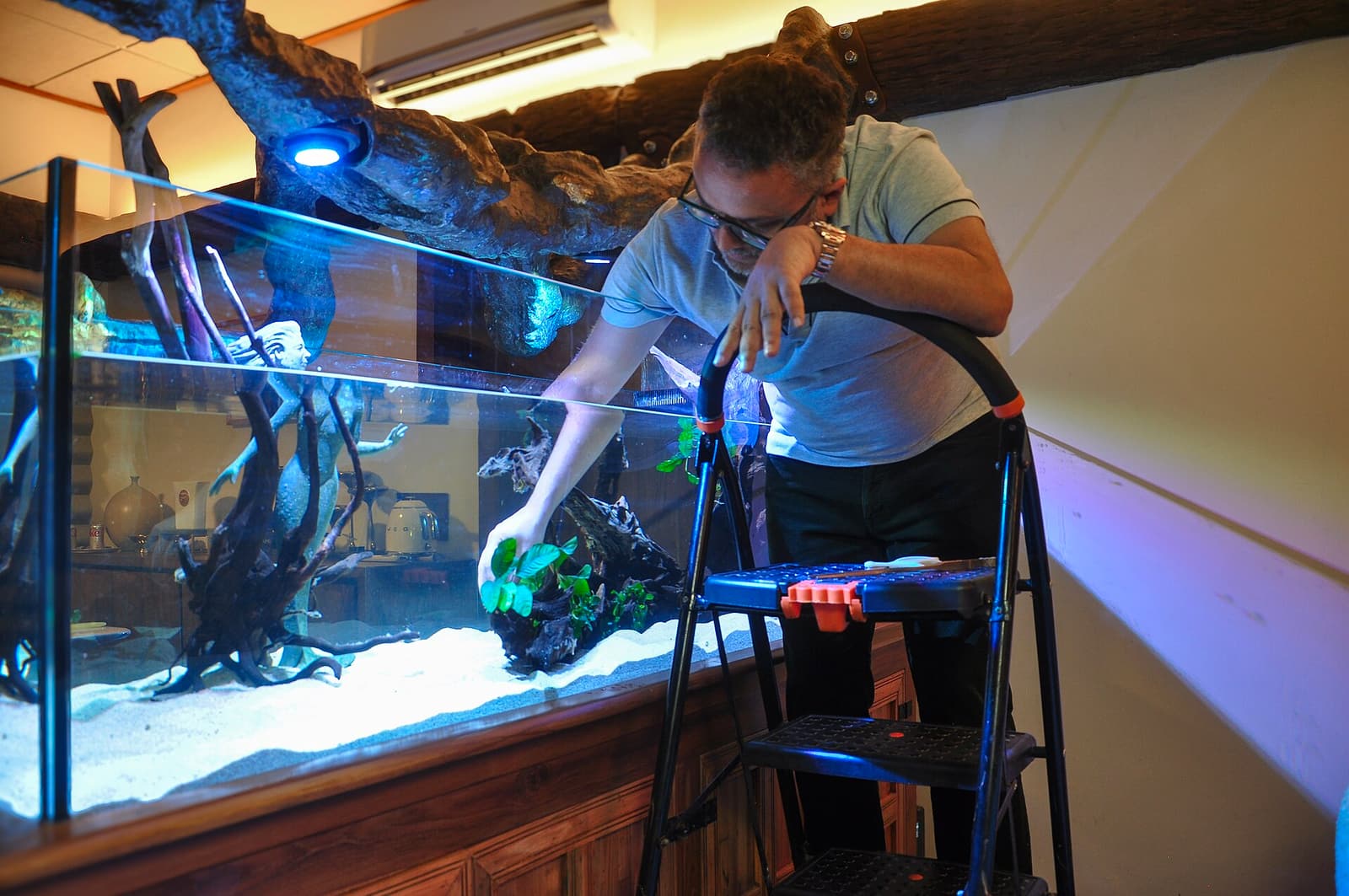
Five plants that work in a 5-gallon betta tank without CO2, with low-light LEDs, and without much experience. Plant selection reflects Seriously Fish on Betta splendens habitat.
This page has affiliate links. See our affiliate disclosure.
Live plants aren’t strictly required to keep a betta well. Silk plants are a legitimate substitute if live is more commitment than you want right now. What live plants add that decor alone doesn’t: they consume ammonia between water changes, and they give a stressed or resting fish real cover and surface-level shelter. That cover is close to what the species evolved with. Wild Betta splendens live in rice paddies, swamps, roadside ditches and ponds that, in Seriously Fish’s words, “are often shaded by submerged, surface or marginal vegetation.” A bare tank under a bright light is the opposite of that. Bettas won’t eat them either. They’re insectivores, not herbivores, and while a fish will rest on a broad leaf or nip at one out of curiosity, plants aren’t on the menu.
Quick recommendations
| Plant | Light need | Mount | Difficulty | Buy |
|---|---|---|---|---|
| Anubias nana | Very low | Attach to wood/rock | Easy | Amazon |
| Java fern | Low | Attach to wood/rock | Easy | Amazon |
| Cryptocoryne wendtii | Low | Substrate | Easy | Amazon |
| Java moss | Any | Attach or free-float | Easy | Amazon |
| Amazon frogbit | Low to moderate | Floating | Easy | Amazon |
1. Anubias nana (and petite)
The default betta plant.
Why:
- Nearly zero light requirement.
- Tolerates pH 5-8.
- Thick hard leaves don’t shred.
- Slow growth means no constant trimming.
- Bettas love to rest on the broad leaves.
How to plant:
- Tie or superglue to driftwood or rock.
- NEVER bury the rhizome (the thick horizontal stem). It rots.
- Roots can extend into substrate; rhizome stays exposed.
Check price on Amazon Affiliate link. See our disclosure.
2. Java fern (Microsorum pteropus)
The tall background plant.
Why:
- Low light, no CO2.
- Tall leaves give vertical structure.
- Multiple varieties: narrow leaf, trident, windeløv (lace).
- Hardy across water parameters.
How to plant:
- Same as Anubias: attach to wood or rock.
- NEVER bury the rhizome.
- Propagates by plantlets forming on leaves; snap them off and attach elsewhere.
Check price on Amazon Affiliate link. See our disclosure.
3. Cryptocoryne wendtii
The substrate-rooted plant.
Why:
- Colors range from green to bronze to red.
- Tolerates low light.
- Good midground plant.
- Spreads through runners over time.
How to plant:
- Plant in substrate (sand or gravel).
- Warning: transplant melt. Cryptocorynes often lose all leaves after transplant and regrow over 4-6 weeks. This is normal.
Check price on Amazon Affiliate link. See our disclosure.
4. Java moss (Taxiphyllum barbieri)
The carpet and accent plant.
Why:
- Grows on anything. Attach with thread, wedge into crevices, or let float.
- Fry love hiding in it.
- Bettas enjoy resting in or on it.
- Easy propagation; break off a chunk, it grows.
How to plant:
- Tie to driftwood with cotton thread (degrades), or superglue.
- Or wedge in between rocks.
- Or let free-float; it forms mats.
Check price on Amazon Affiliate link. See our disclosure.
5. Amazon frogbit (Limnobium laevigatum)
The floating plant.
Why:
- Covers part of the surface for shade.
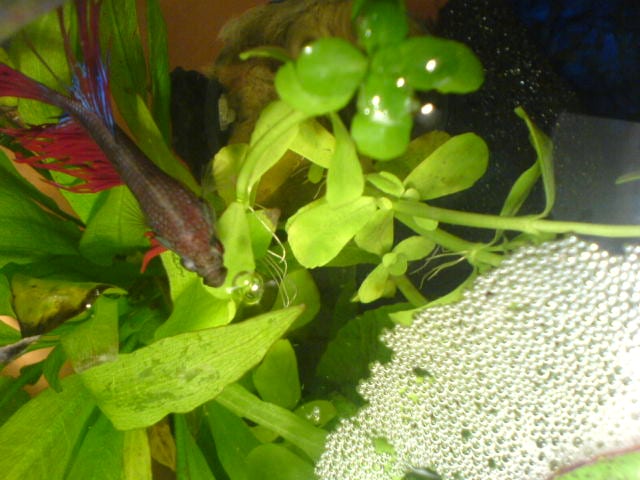
- Bettas build bubble nests in its roots.
- Absorbs excess nutrients.
- Multiplies quickly.
How to plant:
- Float. That’s it.
- Keep away from filter outflow; frogbit doesn’t like current splashing leaves.
- Thin out when it covers 60%+ of surface (blocks light for other plants).
Check price on Amazon Affiliate link. See our disclosure.
Bonus: additional easy plants
- Water lettuce (Pistia stratiotes). Larger floating alternative to frogbit.
- Duckweed (Lemna minor). Grows everywhere; hard to eradicate once introduced. Avoid unless you want it forever.
- Marimo moss balls (Aegagropila linnaei). A filamentous algae, not strictly a plant. Decorative, zero care.
- Red root floaters (Phyllanthus fluitans). Pretty red floaters for lower-flow tanks.
What the grower says about each one
Tropica, the Danish aquarium-plant nursery, publishes a care note on each plant’s page. A few lines from those notes answer the questions betta owners ask most:
- Anubias nana “will thrive in shady places, where other plants will not,” and “is not eaten by herbivorous fish.” Its leaves last for years, which Tropica notes gives “slow-growing algae the chance to become established.” (Tropica) So a little algae on the oldest leaves comes with the plant, not with a problem in your tank.
- Java fern grows 15 to 30 cm tall, so it’s a back-of-tank plant in a 5-gallon. The black spots that appear under its leaves “are sporangia (reproductive organs), not signs of disease, as many believe.” (Tropica)
- Cryptocoryne wendtii ‘Green’ reaches 10 to 30 cm with rosettes 8 to 15 cm wide, and “grows well in hard water,” which makes it a good substrate pick if your tap water is hard. (Tropica)
- Java moss, sold by Tropica as Taxiphyllum barbieri, “makes few demands on the water or light,” forms a layer 3 to 10 cm thick, and “offers a wonderful hiding place for the young fish” in a breeding tank. (Tropica)
- Amazon frogbit (Limnobium laevigatum) has “fine, long and decorative roots” that shelter surface fish, which is exactly where a betta spends its day. It also works as a gauge: “when the nutrient level in the water decreases, it will grow much slower.” (Tropica)
What’s normal, and what isn’t
New planted tanks generate the same handful of worries. Here’s how to read them.
Crypt leaves melting a week after planting. Normal. Cryptocorynes often drop their leaves after a move and regrow over 4 to 6 weeks. Don’t pull the plant up.
Black dots under Java fern leaves. Normal. Those are spore cases, not rot or disease.
A soft, brown, mushy Anubias or Java fern stem. Not normal. That’s rhizome rot, and a buried rhizome is the cause Tropica warns about for both plants. On Anubias the rhizome “must not be covered because it tends to rot”; on Java fern, “do not cover the rhizome because it will rot.” Cut away the soft section and reattach the healthy part to wood or stone.
Frogbit stops spreading. Often a nutrient signal rather than a dying plant. Tropica treats frogbit’s growth rate as a gauge of available nutrients, so check your fertilizing before you blame the plant; the dosing under Fertilization below is a starting point.
Brown film or spots on old Anubias leaves. Expected on a slow plant. Remove the oldest leaf if it bothers you; the plant grows new ones from the rhizome.
What to skip
Tissue-cultured tropica carpet plants. Require CO2 and high light to carpet. Not a low-tech betta plant.
Dwarf hairgrass. Same issue.
Red plants marketed as “low-light.” Most reds need CO2 to color up properly. Expect weak color in a low-tech tank.
Plastic plants with sharp edges. Shred fins. Not a plant; skip.
Bamboo. Often sold at pet stores as “lucky bamboo” or “aquarium bamboo.” Terrestrial plant. Rots underwater over months.
Substrate
For planted tanks:
- Aquarium sand. CaribSea Super Naturals, Black Diamond Blasting Sand. Fine-grain. Easy to plant in.
- Fluval Stratum. Planted-tank-specific substrate with nutrients. Better for demanding plants; overkill for this list.
Don’t use:
- Large gravel (over 5 mm). Hard to plant in, food falls between pieces.
- White gravel. Reflects light unnaturally.
- Crushed coral. Hardens water; usable but hardness-altering.
Fertilization
Low-tech tanks with the plants above don’t strictly need fertilizer. Fish waste provides enough. Optional:
- Seachem Flourish Comprehensive. All-in-one fertilizer. 2-3 drops per 5 gallons once a week.
- Root tabs. Seachem Flourish Tabs under cryptocoryne for extra root feeding. Once every 3 months.
The planted 5-gallon layout
Recommended starter layout:
- 1-inch sand substrate.
- Piece of Mopani driftwood, off-center.
- Anubias nana attached to driftwood (2 pieces).
- Java fern attached to driftwood (1 piece).
- Cryptocoryne wendtii in substrate at back (3 plants).
- Java moss clumps wedged in crevices.
- Amazon frogbit covering 30-40% of surface.
The tank looks naturalistic, bettas have cover and surface shelter, plants consume nitrates.
Live plants are the single biggest improvement a betta owner can make after getting tank size right. Start with Anubias and Java moss; add from there.