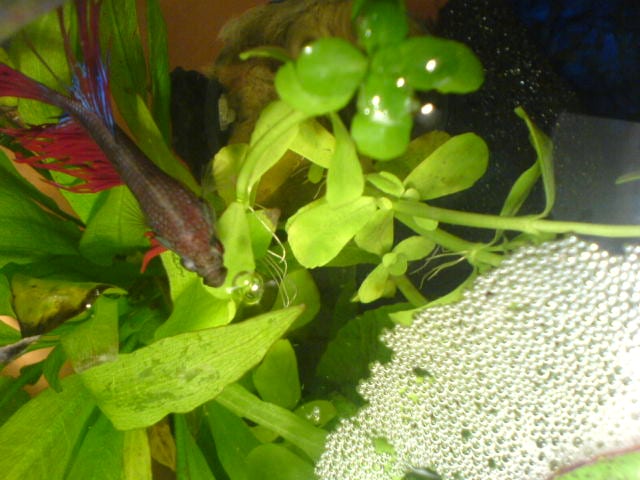
A male betta building a bubble nest is one of the best signs the tank is working. He is blowing mucus-coated air bubbles at the water surface, arranging them into a cluster, and periodically adding to it. No female is required. This happens because the fish is healthy and well-conditioned, not because he needs a mate.
What a bubble nest is
Male bettas are paternal mouthbrooders. After spawning, the male collects fertilized eggs in his mouth, deposits them in the bubble nest, and guards them until the fry are free-swimming (typically 3–4 days). The bubbles hold the eggs at the surface where dissolved oxygen is highest and temperature is most stable.
In captivity, the behavior does not require an actual spawn to proceed. The nest is built because the fish’s hormonal state drives it, not because eggs are present. A solo male building an elaborate nest in a tank with no female is not confused. He is just healthy.
Is that the same as happy? Not quite. A nest is a physical-condition signal, not an emotional one; it tells you the biology is working, not that the fish has feelings about it in any complex sense. Individual males vary in how often they build even when everything checks out, so one quiet week isn’t a crisis on its own. A male that never builds anything at all in an otherwise normal setup is the one worth investigating.
What triggers nest building
Research on wild Betta splendens nest-building behavior (Jaroensutasinee & Jaroensutasinee, 2001) documented that nest size and construction rate correlate with male condition, not with female availability. The 2022 laboratory-care review (PMC9334006) similarly notes nest-building frequency as one of the practical well-being indicators used by researchers to confirm male bettas are thriving in captive conditions. The triggers are:
- Correct temperature. Cold water suppresses nest building reliably. A male that has never built a nest in a tank kept at 72°F will start building within days of the temperature reaching 78°F.
- Adequate feeding. Underfed males build smaller, less persistent nests. Regular feeding with high-protein food produces the best nest-building behavior.
- Low stress. A male constantly fighting his reflection or agitated by activity around the tank directs energy toward threat display rather than nest building. Reduced reflection exposure and calm tank surroundings correlate with more building.
- Female visibility (optional, increases frequency). A conditioned female visible through the tank glass or divider significantly increases nest-building activity and size. This is the conditioning signal used by breeders; it is additive to existing building behavior, not the trigger for it.
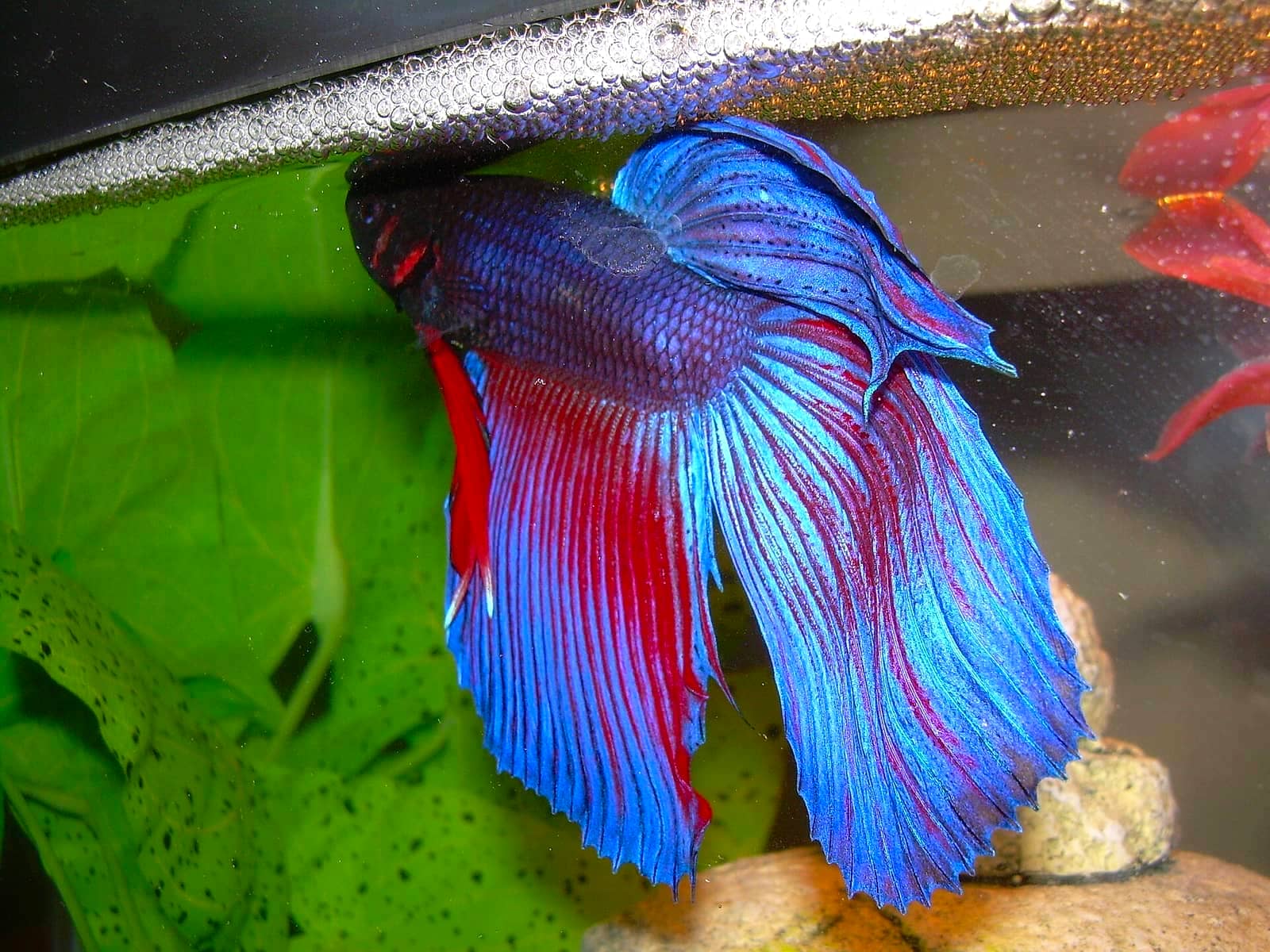
Nest size varies
Wild bettas build nests from a few centimeters to nearly a meter in diameter in habitat with abundant cover and stable surface. Captive nests are much smaller, constrained by tank dimensions, flow from the filter, and available surface area. A nest the size of a 50-cent coin in a 5-gallon tank is completely normal. A nest covering half the surface is a sign of a very healthy, motivated male.
Flow disrupts nest building. A filter outlet that creates significant surface agitation will prevent persistent nest construction even in a healthy fish. Reducing surface agitation (by pointing the filter outlet below the waterline or using a sponge filter that produces minimal surface disturbance) allows nests to accumulate.
Water changes and nests
The most common question: “I just did a water change and destroyed his nest. Did I hurt him?”
No. The nest is not critical to the male’s health. He will rebuild, usually within 24 hours. If you want to preserve the nest during maintenance, use a small cup to scoop the nest along with the surface water, do your water change, and float the cup back afterward. The nest will often survive this process.
When a male won’t build: troubleshooting
A male that has never built, or that stopped building after a period of regular construction, is usually reacting to one of four things.
Temperature. This is the most common cause. Nest building is most reliable between 76 and 82°F, and activity drops sharply below 76°F. Confirm with a thermometer in the actual tank water, not by trusting the heater dial. A 2°F discrepancy between heater setpoint and actual water temperature is common. The simplest fix: a Fluval P25 preset heater (affiliate) at 78 °F and an independent thermometer to confirm it’s holding.
Feeding. An underfed male lacks the energy surplus that drives nest-building behavior. If you’re feeding the minimum (3–4 pellets daily with no supplement days), try adding 2–3 frozen bloodworm or brine shrimp twice a week for two weeks and observe. Most underfed males respond within 10–14 days.
Stress. Constant reflection from an adjacent mirror or highly reflective surface redirects the male’s energy toward threat display rather than nest construction. Reduce environmental stressors: back the tank with dark paper on three sides, minimize external movement, and confirm no other betta is visible. A male that spends most of his day flaring will rarely build.
Tank disruption. A recent full aquascape rearrangement, a filter cleaning, or the addition of new tank mates resets the male’s territorial establishment, which typically precedes nest-building. Give the fish 7–10 days after any major disturbance before expecting nest activity to resume.
If temperature, feeding, and stress are all in range and the male still hasn’t built within three to four weeks, verify there is no chemical contamination (recently treated with medication, new substrate off-gassing, undissolved dechlorinator). A clean water change and a few days of observation usually resolves it.
Nest building and breeding
If you are planning to breed bettas, a male with an active bubble nest is approximately ready for introduction to a conditioned female. See pair selection and spawning setup for the full conditioning and introduction protocol. Do not introduce a female to a male with no nest or minimal nest; he is not ready.
Without a female present, a male won’t spawn on his own. He may flare and display at his own reflection, but full spawning, the embrace, the egg release, the male catching and placing the eggs, requires a receptive female physically in the tank. There’s no harm in a solo male maintaining a nest indefinitely with nothing ever happening to it; the drive isn’t a need that goes unmet.
The single product most reliably associated with increased bubble-nest activity: Indian almond leaves (affiliate). Their tannins lower pH slightly and simulate the blackwater conditions that trigger spawning behavior. Drop one leaf per 5 gallons and replace every 2 to 3 weeks.