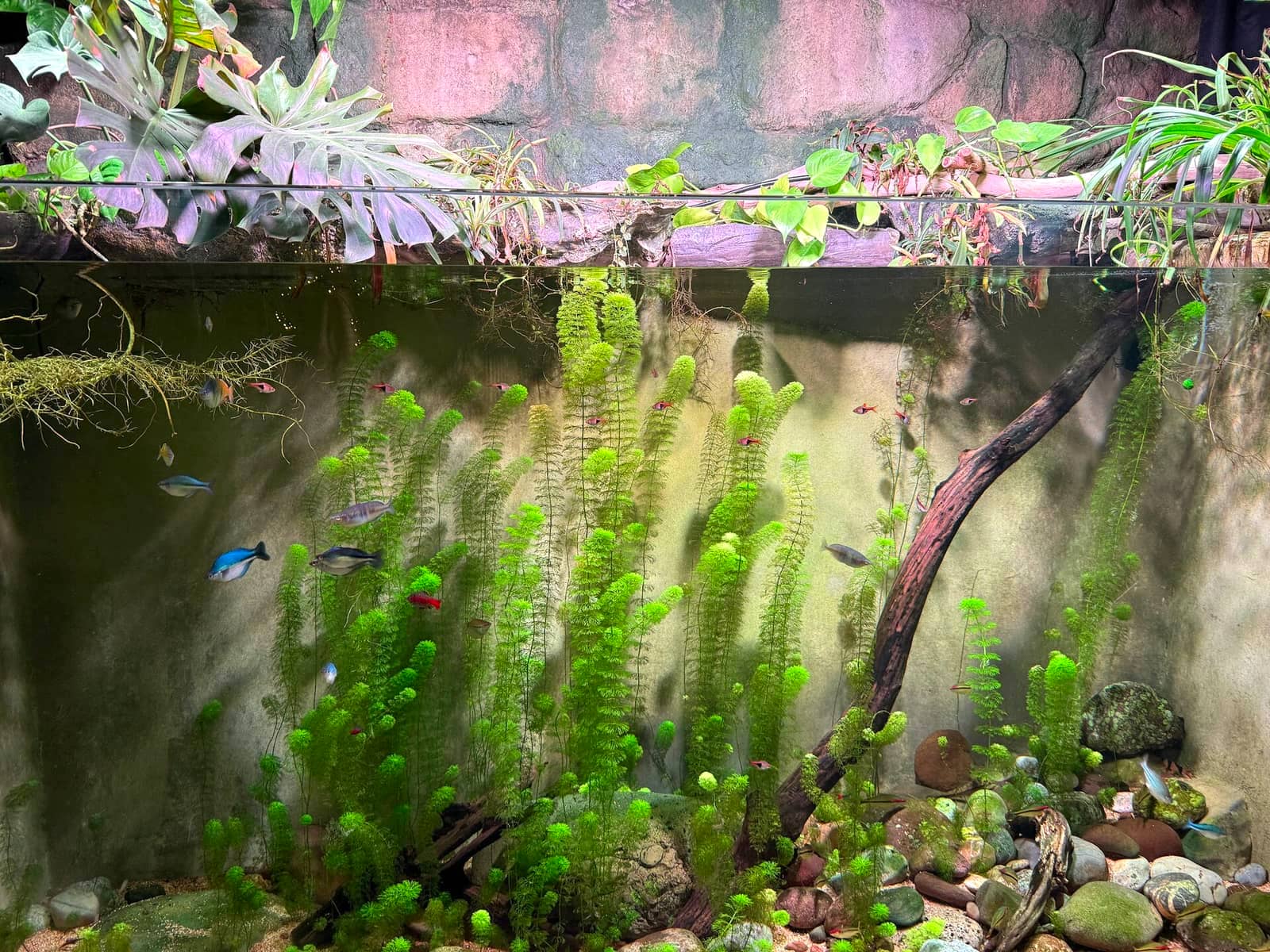
Cycling a new tank establishes two populations of bacteria. The first converts ammonia to nitrite. The second converts nitrite to nitrate. Without them, fish waste produces ammonia that accumulates to toxic levels within days. With them, the tank processes waste continuously and the fish lives in stable chemistry.
This is the most important setup step in betta keeping. Skipping it kills fish. Doing it correctly takes 4–6 weeks, or as little as 24–48 hours if you have access to established media.
Understand the nitrogen cycle first
Before the how-to: the nitrogen cycle explains what is happening biologically. This page is the step-by-step procedure assuming you already understand why.
Method 1: Fishless cycling with pure ammonia (recommended)
This is the fastest and least harmful method. No fish suffer. Bacteria establish faster at the ammonia concentrations used.
What you need
- New tank fully set up (heater running at 78–80°F, filter running, dechlorinated water)
- Pure ammonia: unscented, clear household ammonia. Check the label. Ingredients should be “ammonium hydroxide” and nothing else. No surfactants (shake the bottle; if it foams, it has surfactants, do not use it). Dr. Tim’s Ammonium Chloride (aquarium-grade) on Amazon (affiliate)
- API Freshwater Master Test Kit on Amazon (affiliate), tests ammonia, nitrite, nitrate, pH
- Patience
The procedure
Day 1: Add ammonia to bring the tank to 2–4 ppm. Shake the bottle of tank water after adding to mix. Test immediately to confirm the reading. Record it.
The dose varies by bottle concentration; start with 5 drops per 10 gallons, test, and adjust. Your target is 2–4 ppm ammonia. At 4 ppm you will see a solid reading on the test kit.
Every 2–3 days: Test ammonia and nitrite. Log the results.
Week 1–2: Ammonia remains elevated. Nitrite has not yet appeared (no bacteria to produce it yet). The first population of bacteria (Nitrosomonas and related genera) is just beginning to establish. Hovanec & DeLong (1996) identified Nitrospira rather than Nitrobacter as the dominant nitrite-oxidizing genus in most freshwater aquaria, a finding referenced in the Merck Veterinary Manual environmental requirements section; the 2022 betta care review (PMC9334006) applies the same bacterial ecology framework to captive betta husbandry.
Week 2–4: Nitrite appears and starts climbing. This is confirmation that the first bacteria are active. Keep dosing ammonia every 2–3 days when it drops to maintain bacterial food supply. Nitrite may spike to high levels; this is normal for a fishless cycle. Do not do water changes.
Week 4–6: Nitrite begins to drop as the second bacterial population (Nitrospira) establishes. Nitrate starts rising. Ammonia is being processed faster.
Completion test:
- Dose ammonia to 2 ppm
- Test 24 hours later
- If ammonia = 0 ppm AND nitrite = 0 ppm AND nitrate has risen slightly: the tank is cycled
If ammonia or nitrite is still detectable at 24 hours, the cycle is not complete. Continue dosing and testing.
After cycling
Do a 50% water change to dilute accumulated nitrate. Test once more. Then add the fish using proper acclimation protocol (see acclimation).
Method 2: Fish-in cycling (only if you already have the fish)
If you already have the fish and cannot wait 6 weeks, fish-in cycling is the option. It requires daily management.
The procedure
- Set up the tank fully and add the fish
- Test ammonia and nitrite daily
- Whenever ammonia exceeds 0.5 ppm OR nitrite exceeds 0.25 ppm: do a 25–50% water change with dechlorinated temperature-matched water
- Add Seachem Prime at double dose after each water change; it detoxifies ammonia for 24–48 hours between changes, buying the bacteria time to catch up. It doesn’t make the cycle itself go faster, it just keeps the ammonia from poisoning the fish while the bacteria do the actual work
- Continue daily testing and water changes for 4–8 weeks until ammonia and nitrite consistently read zero without water changes
This is more work than fishless cycling, and it stresses the fish. It is the procedure for “I have a fish and no choice,” not a preferred approach.
Method 3: Instant cycling with established media
The fastest method, requiring access to an established tank.
What to get: Any of the following from a tank that has been running for at least 4 weeks:
- A used sponge filter (most effective, with the highest bacterial density)
- A handful of substrate from a cycled tank
- A used HOB filter cartridge
- A small amount of gravel or ceramic bio media
Place the established media in your new tank’s filter. The bacteria transfer to the new tank. Test ammonia after 24 hours; if it reads zero or near-zero, the cycle may have transferred successfully. Add a small ammonia dose to feed the transferred bacteria.
If the fish is already present, run the standard fish-in testing protocol for the first week to confirm the transfer was complete.
Speeding up a fishless cycle
These legitimately help:
- Temperature: Bacteria grow faster at 78–80°F. Do not exceed 82°F.
- Seachem Stability or API QuickStart: Commercial bacterial supplements. They add live bacteria that help seed the filter. They do not replace the 4–6 week timeline reliably, but combined with good conditions, they can reduce it to 2–4 weeks. Seachem Stability on Amazon (affiliate)
- Higher ammonia dose (4 ppm rather than 2): More food for bacteria = faster growth, up to a point. Do not exceed 4–5 ppm; very high ammonia inhibits bacterial growth.
These do not help:
- Cycling tablets or additives that are not bacteria: marketed but ineffective
- “Cycle” brand (not the same as Seachem Stability): check the product; some contain no live bacteria
Maintaining the cycle long-term
A cycled tank is an active biological system. It can be disrupted by:
- Antibiotic treatment in the main tank (kills bacteria; use a hospital tank for medication)
- Tap water directly on the filter sponge during cleaning (chlorine kills bacteria; clean filter media in old tank water only)
- Extended power outage (bacteria need oxygenated flow; 24 hours without a filter running begins to reduce the colony)
- Extreme temperature events
After any of the above, test ammonia and nitrite for 1 week to confirm the cycle is still intact.