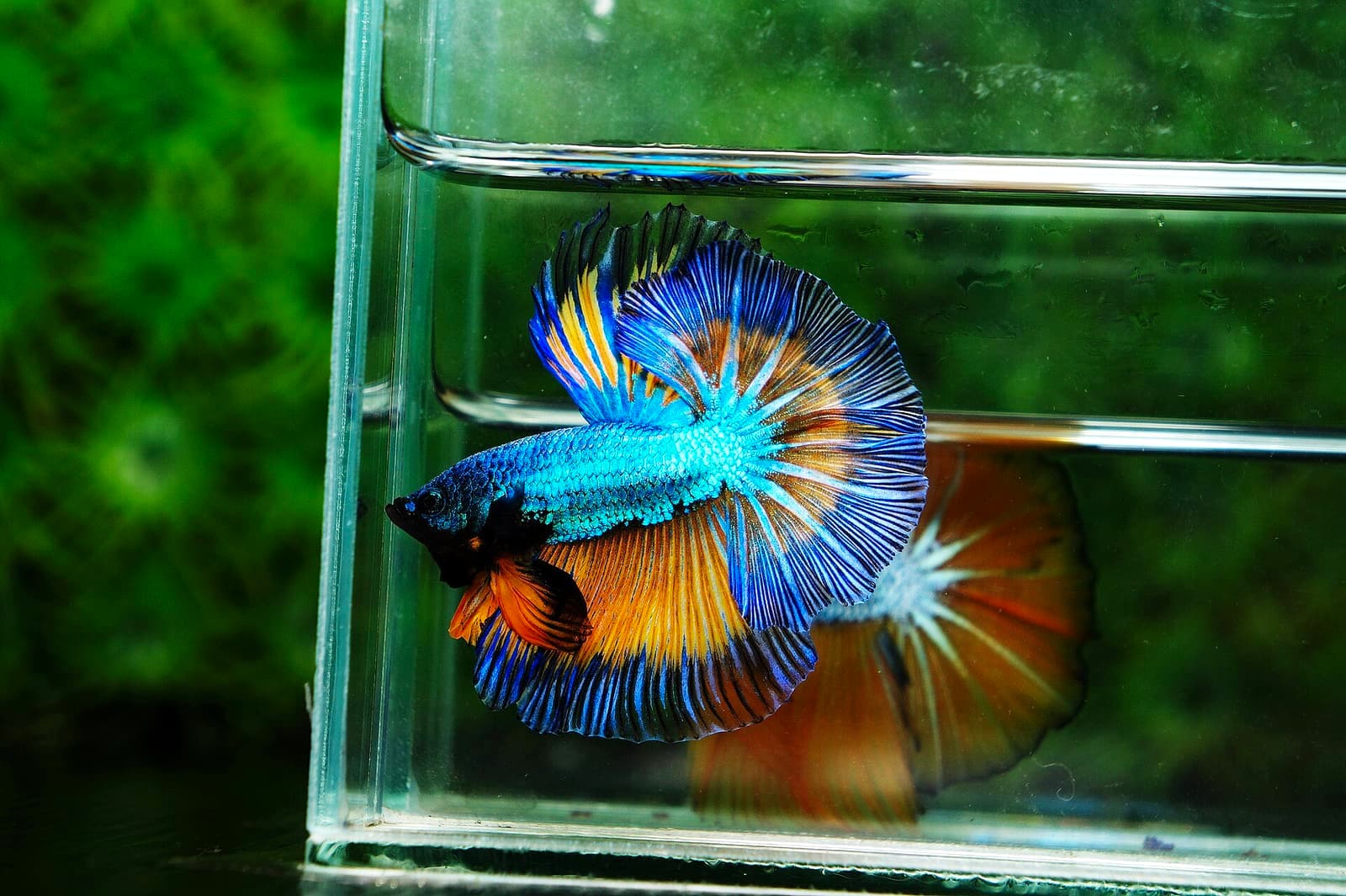
A well-kept captive Betta splendens lives 2 to 4 years. Some reach 5 or 6. Most pet-store bettas are already 9 to 12 months old at point of sale because that’s how long it takes the fins to reach show condition, so a three-year life after purchase is a good run. Selectively bred show strains (giants, heavily finned halfmoons, double tails) live shorter lives than simpler veiltails and wild-types.
The honest average
A betta bought from PetSmart in May, kept in a 5-gallon cycled tank with weekly water changes, fed a varied diet, reaches December of year three most of the time. The older Reddit and forum posts of bettas dying “suddenly” at 18 months reflect undersized-tank husbandry, not the species’ real ceiling.
The 2022 laboratory-care review (PMC9334006) records mean captive lifespans of 2 to 3 years in research colonies, where animals are housed individually in 1 to 2 L containers. Those containers are below the 5-gallon hobbyist minimum. Research colony lifespan is the lower bound.
Well-run hobbyist tanks produce 3 to 4 years as the typical range, with 4 to 5 years not unusual for careful keepers. Five years is good. Six is notable. Anything beyond is outlier territory. Hobbyist forums have documented confirmed fish past 6 years, and one widely cited case past 9, but treat those as the tail of the distribution, not a target. They’re the result of exceptional conditions, not a realistic plan.
Why show strains die younger
The genetic-architecture paper published in 2022 (PubMed 36129976) documented significant inbreeding signatures in the modern show strains. Halfmoon, double tail, giant, and elaborate fin types derive from narrow founder pools, often fewer than 20 fish in each lineage. The recessive load that comes with narrow breeding shows up as shorter lifespans and higher rates of swim-bladder problems, spinal deformities, and chronic tumors.
Expect:
- Veiltail: ~3 to 4 years typical.
- Crowntail: ~3 years typical.
- Halfmoon: ~2 to 3 years typical. Heavy fins are physically taxing.
- Giant: ~2 years typical. Growth-driven internal organ stress.
- Double tail: ~2 to 3 years typical. Spinal issues common.
- Wild-type splendens: ~4 years typical, with the caveat that pure wild-type is rare in the pet trade.
That “wild-type” row describes genetics, not habitat. A betta actually living wild in a Thai or Cambodian rice paddy faces a different set of numbers: field estimates put natural lifespan at 2 to 5 years, though the sampling behind that range is thin. Predation and seasonal drought kill most wild fish long before old age would, so a wild betta’s lifespan is set by what eats it or dries out its pool, not by how long its body could otherwise last.
What shortens the life
Undersized tank. 1-gallon bowls produce chronic ammonia stress. The fish lives; the fish doesn’t thrive. Expect 18 to 24 months instead of 36 to 48.
Cold water. Sub-24 °C tanks suppress immunity and increase susceptibility to fin rot, columnaris, and mycobacteriosis. Heaters are not optional.
Overfeeding. Obesity in bettas shows up as a sagging ventral line, chronic constipation, recurring swim-bladder episodes, and fatty liver disease that progressively reduces energy and immune function. Once a day, four to six pellets, one fast day per week. See betta feeding.
Chronic low-grade parameter issues. A tank that reads 0.25 ppm ammonia constantly, or nitrates running 60+ ppm between water changes, kills in slow motion. Test, log, correct.
Breeding stress. A male used for repeated breeding loses condition. Breeders rest males between spawns; pet fish that aren’t bred don’t face this factor. See conditioning.
Tank mate aggression. Fin damage from nippers (tiger barbs, serpae tetras) opens the fish to secondary infections. Nipped fins rarely cause direct death but contribute to cumulative stress load.
The pet-store age problem
A male betta reaches full fin extension at 8 to 10 months. Fish farms don’t ship immature fish; the color and fin shape is what sells. By the time the fish leaves the farm, arrives at a distributor, sits in a retailer cup, and comes home with you, it’s usually 9 to 12 months old. Females typically ship younger, 6 to 9 months, since sororities and breeding stock don’t need the same fin development to sell.
This reframes every “my betta only lived a year and a half” story. A fish purchased at 10 months and dying at 28 months lived 18 months with you and 28 months total. That’s within the normal range. Online breeders and shows occasionally sell younger fish (5 to 7 months); for those the from-purchase lifespan is longer.
What a long-lived betta looks like
Years one and two: fin extension peaks, color deepens, fish is active, feeds aggressively, claims territory.
Year two to three: first subtle aging. Slightly slower to rise at feeding time. Color retains intensity. Fins may start to show minor edge wear that doesn’t heal back fully.
Year three to four: visible aging. Fins thin, especially on heavily finned types. Eats less per feeding. Spends more time resting on leaves or the substrate. Still responsive to tap on the glass.
Year four onward: slow decline. Reduced swimming, possible minor balance issues, occasional skipped meals. Quality of life remains good until a clear decline point.
Year five and beyond (outlier): very old fish can develop lumps, cysts, or opacity in the eyes. Senior care means smaller tanks (easier for a weakening fish to navigate), warmer temperatures (28 °C to keep metabolism up), softer food.
Setting the clock fairly
The 2-to-4-year range is not a failure to meet some higher potential. It’s a small tropical labyrinth fish’s normal lifespan. Comparing bettas to goldfish (15+ years) or koi (40+) is a category error. The right comparison is other small tropical fish: tetras (2 to 4 years), guppies (2 to 3 years), gouramis (4 to 6 years). Bettas sit in the middle of that distribution.
A well-kept betta that dies at three years is not a failure of care. It’s a success. The failure is the bowled pet-store fish that dies at fourteen months of preventable ammonia poisoning. Set the goal there.
Diet quality is one of the strongest predictors of reaching the upper end of the lifespan range. The pellets that consistently produce the best outcomes: New Life Spectrum Betta Formula (affiliate) and Hikari Betta Bio-Gold (affiliate). Both have protein levels above 40% from fish or insect meal sources, which is the minimum for a species that evolved eating live invertebrates.
Related on this site
- Betta Fish Care: The Evidence-Based Guide
- Betta Mycobacteriosis: Fish TB, the Untreatable Chronic Disease
- Betta Genetics: Color, Fin, and Pattern Inheritance
- Betta Anatomy: What You’re Looking At When You Look at a Betta
- The Betta Vase Myth: Why Peace-Lily Setups Are Animal Cruelty
- Betta Not Eating: What It Often Signals
- Humane Betta Euthanasia