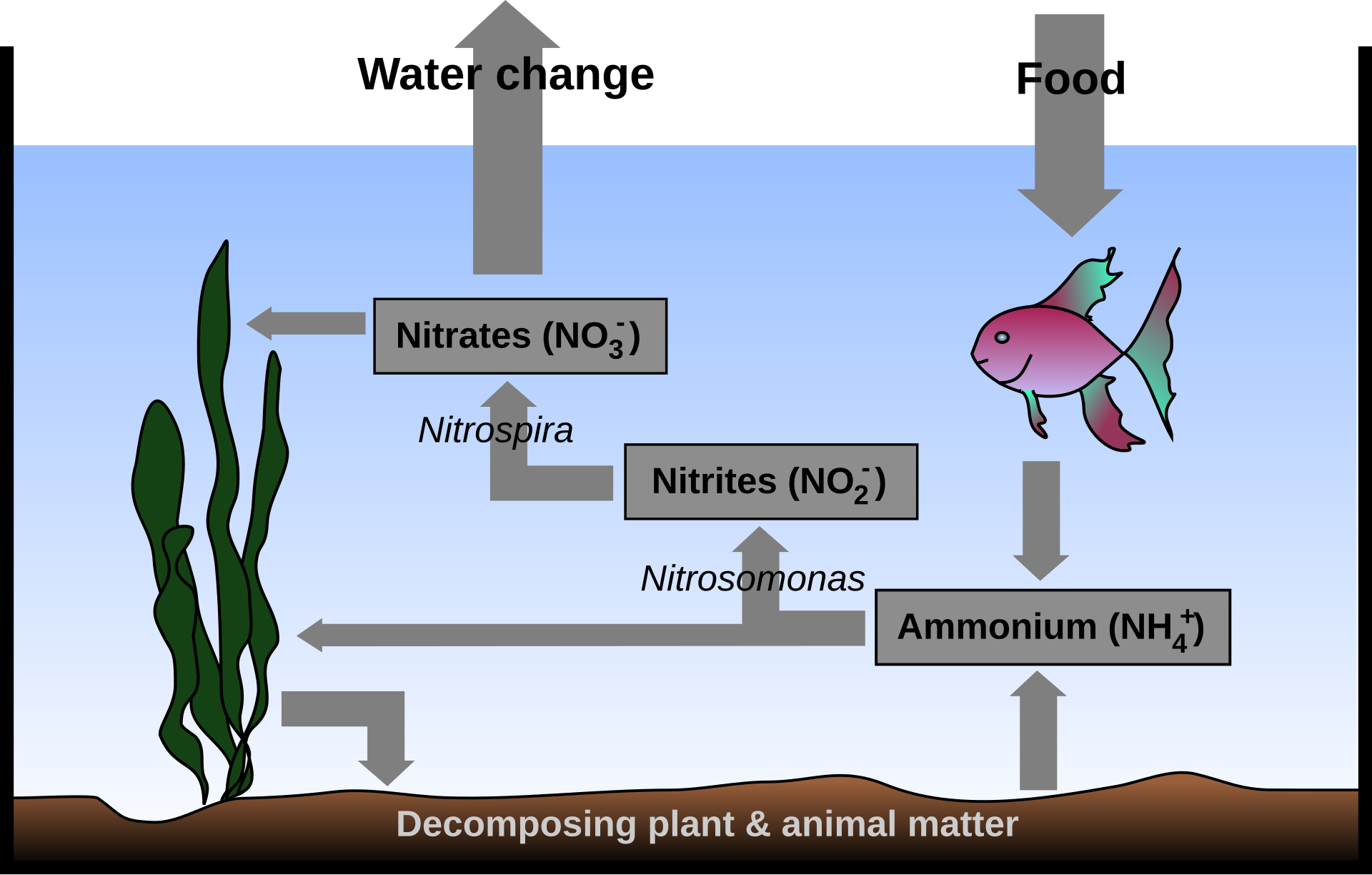
Fish produce ammonia. In a new tank, nothing consumes it, so the ammonia climbs until the fish dies. The nitrogen cycle is the biological process that establishes ammonia-eating and nitrite-eating bacteria on every surface of the tank, turning those toxic compounds into much less toxic nitrate. You can cycle a tank fishless in 3 to 6 weeks, and seeding with media from an established tank cuts that to under two weeks (FAO technical guidance on nitrification in aquaculture).
The chemistry in one paragraph
Fish excrete ammonia (NH3) through their gills and in urine. Uneaten food and plant decay also produce ammonia. Ammonia is acutely toxic; anything above 0.5 ppm stresses a betta, anything above 2 ppm kills fast. Two families of bacteria do the work: Nitrosomonas converts ammonia into nitrite (NO2-), which is also acutely toxic. Nitrobacter and Nitrospira convert nitrite into nitrate (NO3-), which is far less toxic. The 2022 laboratory-care review (PMC9334006) cites this bacterial chemistry as the core rationale for cycled-tank requirements in captive betta husbandry. Nitrate stays in the water and is removed by weekly water changes.
A cycled tank has enough of these bacteria living on filter media, substrate, and every solid surface to process all ammonia produced by the fish’s bioload in real time. You never see ammonia or nitrite on a test. Nitrate slowly climbs between water changes.
Why the pet-store bowl fails
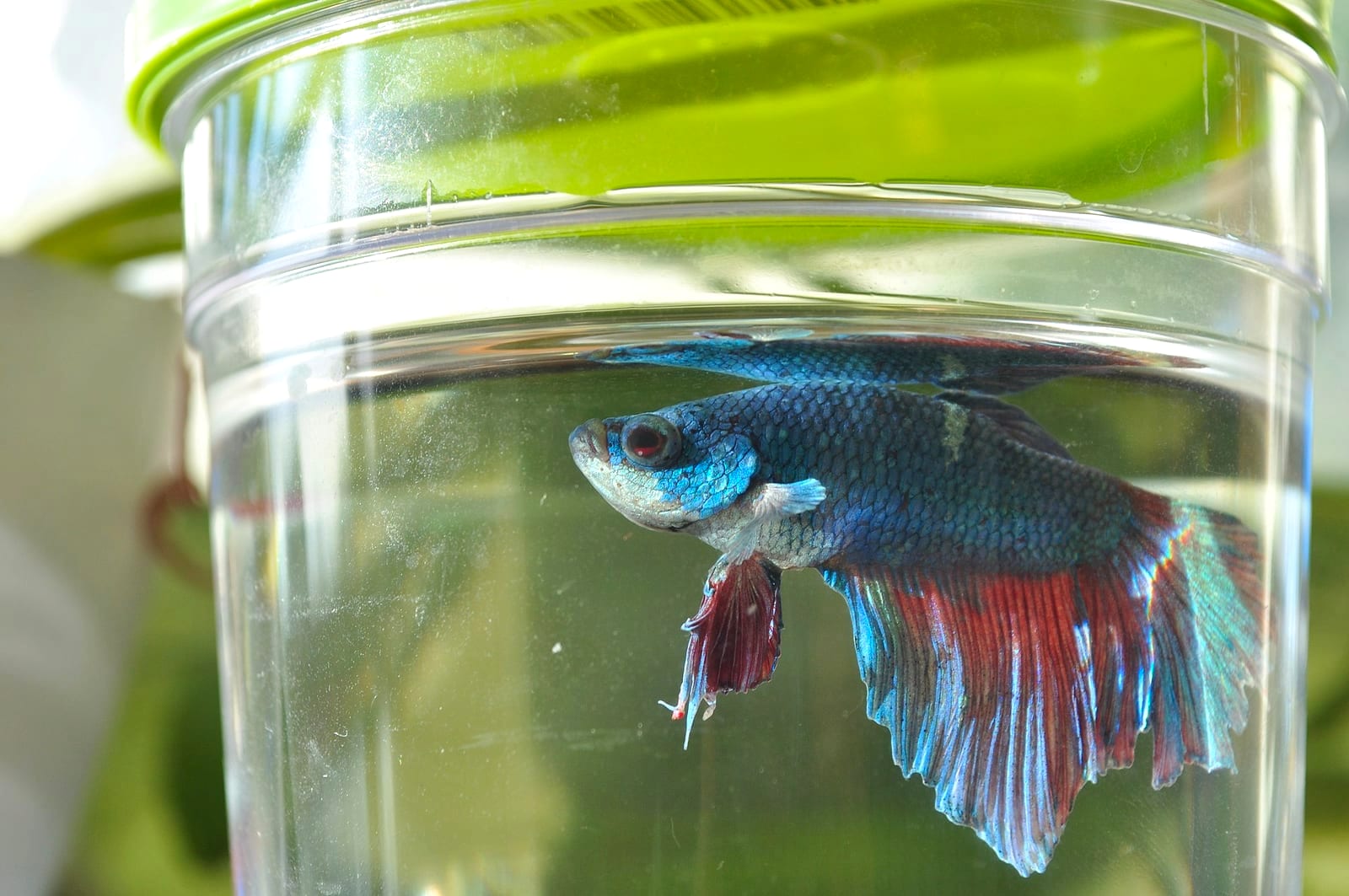
The bowl has no filter, no cycled biofilm, no way to convert ammonia. A betta in a 1-gallon bowl produces roughly 1.5 to 2 ppm of ammonia per day. Without processing, that’s a slow-motion poisoning. The fish survives for 18 to 24 months because bettas are breath-of-air tolerant and because partial water changes dilute peaks, but every day of that life is subacute ammonia exposure. The “they live 2 years because that’s their lifespan” line is a cover story for a preventable cause of death.
A 5-gallon cycled tank produces the same ammonia and processes all of it. That’s the whole difference.
Fishless cycling, step by step
Day 0.
- Fill tank with dechlorinated water. Seachem Prime, 2 drops per gallon. Note that thiosulfate dechlorination of chloramine releases ammonia into a tank with no biofilter yet, which is why the conditioner you pick matters during cycling.
Seachem Prime on Amazon Affiliate link. See our disclosure.
- Heater on, set to 27 °C. Warmer than normal; bacteria colonize faster.
- Filter running 24/7.
- Dose ammonia (Dr. Tim’s Ammonium Chloride, or janitorial ammonia without surfactants; read the label, no foam means no surfactants) to 2 ppm. Test to confirm.
Dr. Tim’s Ammonium Chloride on Amazon Affiliate link. See our disclosure.
Day 3 to day 10.
- Test ammonia and nitrite every 48 hours.
- Ammonia stays at 2 ppm for several days, then starts to drop. That’s Nitrosomonas establishing.
- Nitrite will start reading above zero, climbing.
Day 10 to day 21.
- Ammonia drops to near zero within 24 hours of dosing. Redose to 2 ppm whenever it hits 0.5 ppm.
- Nitrite peaks, sometimes off the chart (above 5 ppm). That’s fine for a fishless cycle; the nitrite doesn’t hurt anything without a fish present.
- Nitrate starts appearing on tests.
Day 21 to day 42.
- Nitrite slowly drops. This is the slow phase; nitrite-consuming bacteria grow at a fraction of the speed of ammonia-consuming bacteria.
- Eventually nitrite reads zero within 24 hours.
Cycle complete.
- Dose 2 ppm ammonia. If ammonia and nitrite both read zero 24 hours later, the tank is cycled.
- Do a 50% water change to drop nitrate to under 20 ppm.
- Add the fish.
The seeding shortcut
A used sponge from an established, healthy tank is the best cycle accelerator. Squeeze it into your new filter. The bacteria live for hours to days out of water and seed your tank immediately.
Live plants help too, though less dramatically. They take up some ammonia on their own as they grow, and adding them typically shaves about a week off a fishless cycle. Worth doing regardless, since they’ll be in the finished tank anyway.
Sources for seed media:
- A local fishkeeper you trust. Post in a hobbyist Facebook group or ask at a meet-up.
- A local fish store that runs centralized sump-filtered display tanks. Ask for a small piece of sponge filter. Reputable shops say yes.
- Not from a petco/petsmart. Their tanks often carry ich or columnaris. Seeding risk exceeds seeding benefit.
With good seed media, a tank cycles in 7 to 10 days. Test daily to confirm.
Bottled bacteria: what works, what doesn’t
Dr. Tim’s One and Only has independent data showing true live Nitrosomonas and Nitrobacter. Refrigerated, good for about a year. Works. Cuts cycling to 10 to 14 days on its own.
Tetra SafeStart Plus similar claim, similar data, similar result. Works.
API Quick Start, Seachem Stability, and most store-brand “cycle starters” contain heterotrophic bacteria that consume organic waste but do not meaningfully establish nitrification. Use them and the cycle will still take 4 to 6 weeks. Marketing, not a shortcut.
Do not use bottled bacteria as a substitute for testing. Dose, then verify by testing. Trust but verify.
Fish-in cycling (emergency only)
Sometimes you inherit a betta in a bowl and can’t do fishless cycling. Fish-in is survivable with vigilance:
- Day 1: set up tank, add fish, test every 12 hours.
- Any ammonia or nitrite above 0.25 ppm: immediate 50% water change.
- Dose Seachem Prime at full dose on every water change; Prime binds ammonia for 24 hours.
- Expect 4 to 6 weeks of daily or every-other-day testing and water changes.
Fish-in cycling is legal but taxing. The fish’s long-term lifespan is shortened by the early ammonia exposure. Don’t do it unless the alternative is leaving the fish in the cup.
The stuck-cycle troubleshooting list
- Temperature too low. Raise to 28 °C. Cycling at 22 °C takes twice as long.
- pH too low. Nitrobacter activity slows below pH 6.8, stops below 6.0. If your pH is 6.5, add one teaspoon of crushed coral to the filter to buffer up.
- No ammonia source. Bacteria starve and the colony dies back. Keep dosing.
- Chlorine contamination. You accidentally used untreated tap water during a top-up. Dose Prime, wait 48 hours, continue.
- No oxygen. Nitrifying bacteria are strict aerobes. Make sure the filter is actually running and surface agitation is present.
A cycled tank is the foundation of every other care decision. You cannot feed well, dose medication well, or house a fish well without it. The 3-to-6-week wait is the price of entry, and it’s non-negotiable in 2026 the same way it was in 1996.
Related on this site
- Betta Fish Care: The Evidence-Based Guide
- Betta Water Chemistry: pH, Hardness, Ammonia, and What Actually Matters
- Betta Tank Setup: A 5-Gallon Minimum Build, Step by Step
- Betta Anatomy: What You’re Looking At When You Look at a Betta
- The Betta Vase Myth: Why Peace-Lily Setups Are Animal Cruelty
- How to Cycle a Betta Tank: Step by Step
- Water Parameters Reference
- Best Water Test Kits