This page is a reference. Bookmark it and come back when you need a number. Every parameter below has a context section explaining what it affects and why the range matters, not just the number.
The complete parameter table
| Parameter | Ideal | Acceptable | Emergency threshold |
|---|---|---|---|
| Temperature | 78–80°F (25–27°C) | 76–82°F (24–28°C) | Below 72°F or above 86°F |
| pH | 7.0–7.2 | 6.5–7.5 | Below 6.0 or above 8.0 |
| Ammonia (NH₃/NH₄⁺) | 0.00 ppm | 0.00 ppm | Any detectable level |
| Nitrite (NO₂⁻) | 0.00 ppm | 0.00 ppm | Any detectable level |
| Nitrate (NO₃⁻) | < 10 ppm | < 40 ppm | > 80 ppm (chronic damage) |
| GH (general hardness) | 100–200 ppm | 50–250 ppm | Below 30 or above 350 ppm |
| KH (carbonate hardness) | 60–120 ppm | 40–160 ppm | Below 20 ppm (pH instability) |
| TDS (total dissolved solids) | 100–250 ppm | 50–400 ppm | Not a primary indicator. Use GH/KH/pH. |
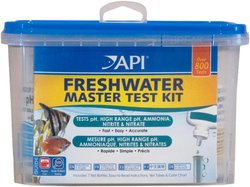
Every number in this table comes from a test, not a guess. The API Freshwater Master Test Kit (affiliate) covers four of the rows, pH, ammonia, nitrite and nitrate, with liquid reagents that read far more reliably than strips. The trade-off is time: liquid tests mean counting drops, shaking, and waiting a few minutes for the color to develop, and GH and KH need a separate kit. More on what to test with, and how often, further down.
Temperature
The single most important parameter to monitor daily. Temperature determines the fish’s metabolic rate, immune function, and pathogen growth rates. A 10-degree drop overnight suppresses immune function for 24 hours even after temperature is restored.
See temperature for the full explanation and heater guidance. The Merck Veterinary Manual environmental requirements section and the 2022 laboratory-care review (PMC9334006) both identify temperature as the single most critical environmental variable in captive betta welfare.
pH
Betta splendens wild habitat spans pH 5.5 (deep peat swamps) to 7.5 (drainage channels connecting to larger rivers). In captivity, the fish performs best at near-neutral pH because the bacterial colony in the filter (the nitrogen cycle) also operates most efficiently near neutral.
Critical principle: stability over precision. A tank held at a steady pH of 7.6 is safer than one that swings between 6.8 and 7.4 within 24 hours. pH swings stress osmoregulation; the fish constantly adjusts its ion balance against the water. Swings happen when KH is very low (poor buffering capacity) or when CO2 fluctuates significantly.
How to stabilize: Maintain adequate KH (40+ ppm). Avoid adding pH-adjusting chemicals unless you also understand and control buffering. Natural tannins (Indian almond leaves, peat filtration) slowly lower pH in soft water; monitor if using them.
Ammonia
Ammonia is toxic at any detectable concentration in aquarium terms. It is produced continuously by fish waste and decomposing food. In a cycled tank, nitrifying bacteria convert it to nitrite within hours. There’s no meaningfully “safe” low reading, either: even 0.25 ppm suppresses immune function and damages gill tissue with sustained exposure. A cycled, established tank should read 0.00 ppm, full stop. Anything above that is a problem to correct immediately, not a number to watch.
NH₃ vs NH₄⁺: At pH below 7.0 and lower temperatures, ammonia exists mostly as ammonium (NH₄⁺), which is much less toxic. At higher pH (above 7.5) and higher temperatures, more shifts to NH₃ (free ammonia), which is acutely toxic. The API test kit measures total ammonia nitrogen (both forms combined); if your pH is 7.8 and ammonia reads 0.5 ppm, the actual free-ammonia fraction is dangerously elevated.
Emergency response: Water change immediately, with dechlorinated water matched to tank temperature. A 30 to 50% change dilutes ammonia by roughly that same fraction right away. Dose Seachem Prime as you do it; it temporarily detoxifies ammonia for 24 to 48 hours, which buys time while you repeat the water change daily until the reading hits zero. See the nitrogen cycle for how to establish a cycle that keeps ammonia at zero permanently.
Nitrite
Nitrite is produced when bacteria oxidize ammonia. In a fully cycled tank, a second population of bacteria converts nitrite to nitrate quickly enough that nitrite never accumulates. In a partially cycled or crashed tank, nitrite spikes.
Nitrite binds to hemoglobin in fish blood, reducing oxygen-carrying capacity (methemoglobinemia). A betta in high nitrite water may appear to be “gasping” or show abnormal gill movement despite normal dissolved oxygen. The gills may appear brown instead of bright red.
Emergency response: Water change plus confirm the nitrogen cycle is functioning. See the nitrogen cycle.
Nitrate
Nitrate is the end product of the nitrogen cycle. It does not acutely poison fish at concentrations below 80–100 ppm, but chronic elevated nitrate (above 40 ppm) suppresses immune function over weeks and months, contributes to hole-in-the-head disease in susceptible fish, and degrades overall water quality.
How to reduce: Regular partial water changes. A 25% weekly water change is sufficient to maintain nitrate below 20 ppm in a moderately stocked tank. For a heavily stocked tank or a tank with significant organic load, more frequent changes may be needed.
Live plants consume nitrate; a planted tank generally maintains lower nitrate levels than a bare tank with equivalent stocking.
General hardness (GH)
GH measures the concentration of calcium (Ca²⁺) and magnesium (Mg²⁺) ions. These are essential for fish health: calcium for bone development, nervous system function, and osmoregulation; magnesium for enzyme function.
Very soft water (GH below 50 ppm): Creates osmotic stress; the fish works harder to maintain ion balance. Bettas from heavily tannin-stained blackwater habitats (B. imbellis, B. mahachaiensis, some wild bettas) naturally encounter soft water, but captive bettas bred for generations in tap water may not be adapted to it.
Very hard water (GH above 300 ppm): Rarely a problem for bettas at realistic tap water hardness levels. At extreme hardness, calcium deposits in tissue become a concern over long timescales.
Most municipal tap water: 100–250 ppm GH. Compatible with bettas without modification. What that water still needs is dechlorinating, and whether your utility uses chlorine or chloramine decides which bottle works, compared in the water conditioner guide.
Carbonate hardness (KH)
KH measures the concentration of carbonates (CO₃²⁻) and bicarbonates (HCO₃⁻). These act as a pH buffer; they react with acids to prevent pH from dropping.
Low KH (below 40 ppm): pH instability. The tank’s pH can crash rapidly when acid is produced (from CO₂ dissolved from breathing, decomposition, or added chemicals). A pH crash from 7.0 to 5.5 overnight can kill all fish in a tank before morning.
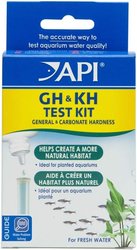
KH testing: Use the API GH and KH Test Kit (a separate kit from the Master Test Kit).
What to test with
The API Freshwater Master Test Kit (affiliate) tests pH, ammonia, nitrite, and nitrate using liquid reagent drop tests. It is accurate, economical per test, and the standard recommendation for betta keepers. Test strips are inaccurate enough to produce false negatives on ammonia. Do not rely on them as your primary test method.
Testing frequency isn’t a one-size number. Weekly is enough for an established, running tank with no symptoms. Test daily through the first six weeks while the tank is cycling, during any disease treatment, after every medication dose, and after anything that could disrupt the cycle, like a filter cleaning or a power outage. If a fish shows illness symptoms, test before you do anything else.
For GH and KH: the API GH & KH Test Kit (affiliate) (sold separately).
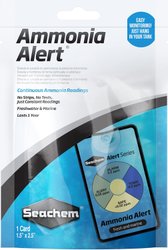
For continuous ammonia monitoring: the Seachem Ammonia Alert (affiliate) badge (a passive chemical sensor that sits in the tank and changes color if free ammonia exceeds the threshold) supplements the liquid test by providing a continuous visual indicator between test days. See best test kits for the full comparison.