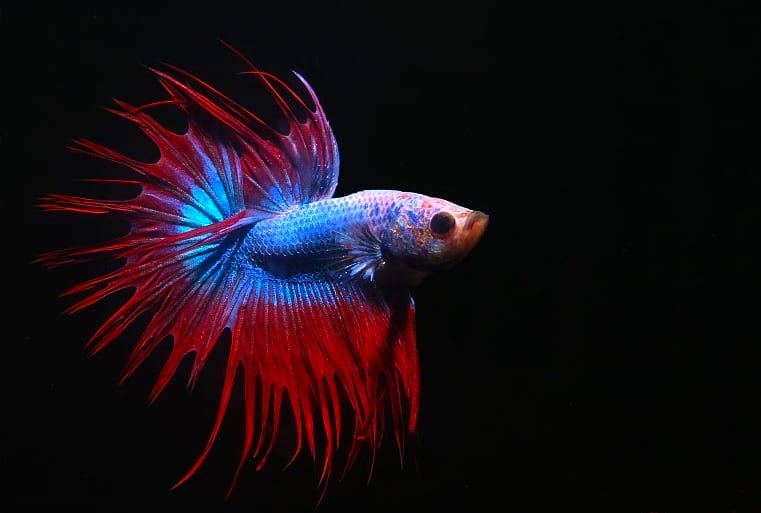
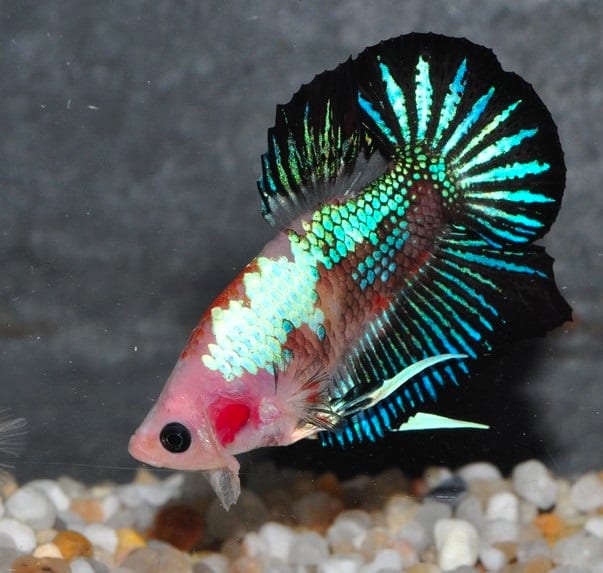
Betta coloration comes from four pigment layers stacked in the skin: black (melanophores), red (erythrophores), yellow (xanthophores), and iridescent blue-green (iridophores, which produce structural color from crystalline platelets, not a pigment). Visible color is the net result of which layers are expressed, at what density, and in what pattern. The 2020 chromosome-level genome assembly (PubMed 32385046) and the 2022 phenotypic-diversity paper (PubMed 36129976) mapped the principal genes. Mosaic or marble pattern was mapped as polygenic, and that paper states its underlying molecular basis has not been investigated. This page is the map.
The four layers
Melanophores (black/brown). Express the black pigment eumelanin. Controlled at the b (blond) locus and the bl (melano) locus. Melano homozygous (bl/bl) produces maximal black but also infertile females.
Erythrophores (red). Express red pigment. Controlled by the non-red locus (nr): NR/NR or NR/nr gives red, nr/nr gives cambodian (red-less). Extended red alleles produce deeper spread.
Xanthophores (yellow). Usually underlies reddish colors; in the absence of erythrophores produces yellow fish.
Iridophores (iridescent blue, green, steel). Structural color from layered purine crystals. Royal blue, steel blue and turquoise-green are three forms of one locus, with royal the in-between form: two royals produce turquoise, royal and steel at 1:2:1 (Zhang et al. 2021). Opaque gene (Op) produces the metallic intensified look (dragon scale, etc.), though full dragon-scale intensity is likely polygenic rather than a single clean Mendelian trait. Op contributes, but stabilizing a strong dragon line still takes multiple generations of selection on top of it. See dragon scale for the breeding approach.
Major gene loci, summary
| Locus | Alleles | Effect |
|---|---|---|
| Steel | ST, st | Iridophore color (blue/steel/green) |
| Non-red | NR, nr | Red presence (red/cambodian) |
| Melano | BL, bl | Full black when bl/bl (infertile females) |
| Blond | B, b | Reduced melanophore density |
| Opaque | Op | Intensified iridophore (dragon) |
| Marble | Mb | Unstable pattern (transposable element) |
| Crowntail | CT | Reduced fin webbing |
| Double tail | DT | Split caudal (single allele: broader dorsal) |
Articles in this section
- black melano, the infertile-female problem, why it happens, how to breed around it.
- iridescence, blue, steel, green, dragon, opaque; the structural color system.
- dragon scale, intensified iridophore, selective breeding approach.
- marble gene, what the research actually established and why marble pattern shifts during the fish’s lifetime.
- color morphs, catalog of common color morphs with genotype notes.
The 2020 genome
The 2020 chromosome-level genome assembly resolved 21 linkage groups and catalogued 27,000+ protein-coding genes. Critical findings:
- Sex chromosomes are not well-differentiated; sex determination is polygenic or environmental influence matters.
- Color-related loci cluster in a few linkage groups.
- Mosaic or marble pattern associates with variants across multiple chromosomes rather than one locus, and no causal variant has been published.
Before 2020, betta genetics was largely hobbyist linkage mapping from breeding crosses. The genome assembly made formal mapping possible.
The 2022 phenotypic architecture paper
Genome-wide association mapped many visible traits to specific loci. Notable:
- Body color variation maps to a smaller number of major loci than hobbyists had assumed. A handful of genes explain most of the visible variation.
- Tail shape variation is highly heritable but polygenic; no single “halfmoon gene.”
- Aggression variation is weakly heritable (much more environmental than genetic).
- Fighting-line bettas show signatures of strong artificial selection over centuries.
Practical implications for breeders
Predict what you can. Single-locus traits (crowntail, double tail, melano) have predictable Mendelian ratios. Plan crosses accordingly.
Track what you can’t. Multi-locus traits (halfmoon tail geometry, dragon intensity, specific color hues) require long-term selection across generations. One spawn doesn’t tell you genotype; 3-5 spawns from the same pair do. This is also why a red fish can throw blue fry: what a fish looks like and what it can pass on are two different questions, and the parent may be carrying a hidden non-red allele at the red-spread or iridophore locus that its own coloring never revealed.
Keep records. Note the parents, the fry outcomes, the best fish retained. Over generations the pattern emerges.
Stabilize lines. A “halfmoon yellow dragon” line takes 5 to 10 generations of selection to fix. Most hobbyist breeders never reach the stable point; they buy stable lines from established breeders and work within them, a named line’s known pedigree predicts fry outcomes far better than a random pet-store pairing ever will.
The genetic weight of selective breeding
The genetic-architecture paper documented inbreeding signatures in modern show strains. Narrow founding populations plus decades of selection produce:
- Reduced heterozygosity (genetic diversity loss).
- Accumulated recessive load (higher deformity rates).
- Shorter lifespans in heavily selected strains (compared to wild-type).
- Compromised immune function in some lines.
This is a real cost. Hobbyists who value animal welfare should prefer simpler strains (veiltail, plakat) over extreme elaborations (rosetail, king crowntail).
What color is my fish?
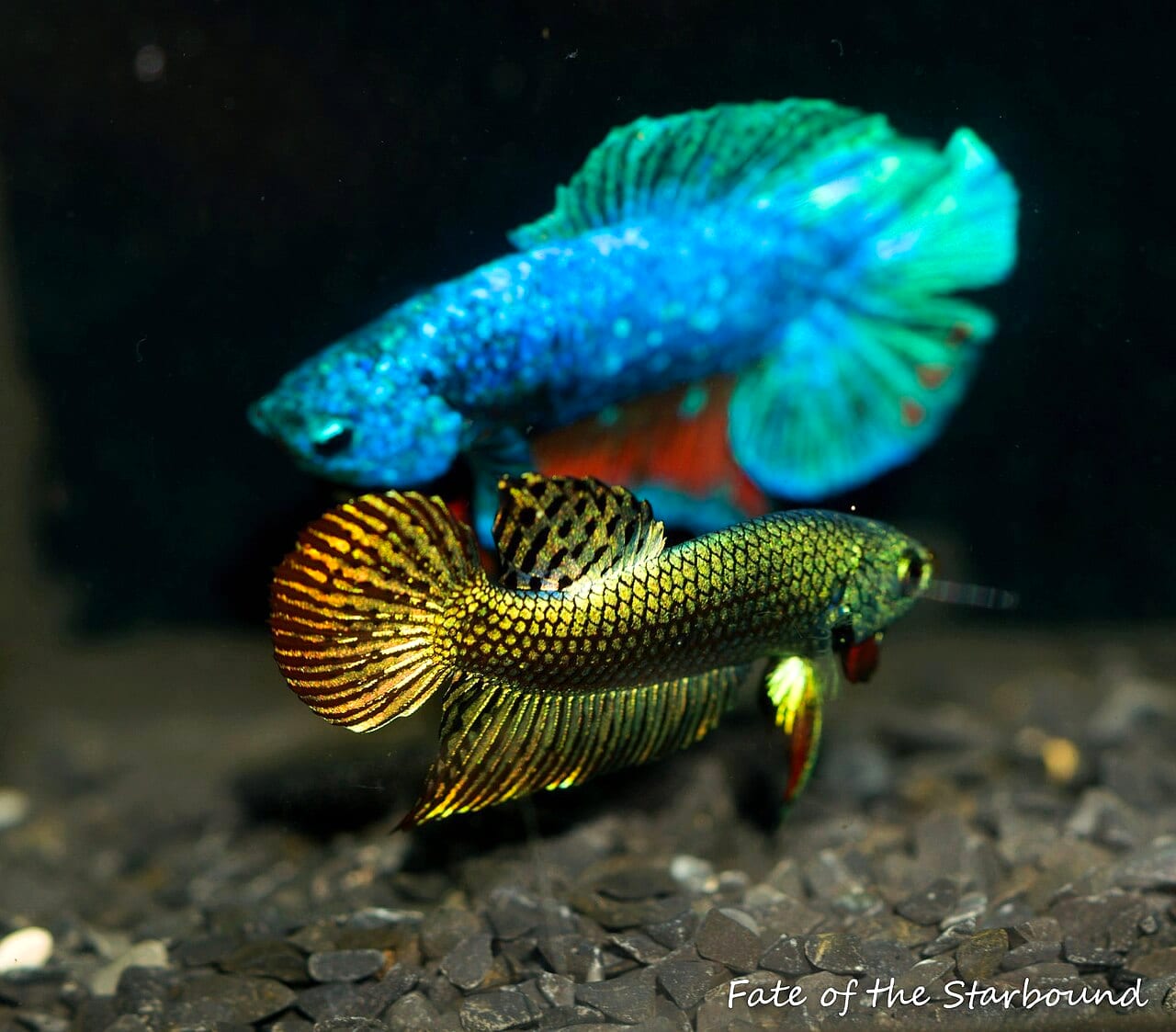
Basic color identification:
- Solid red: body and fins red, full coverage. NR present, extended red alleles.
- Royal blue: deep blue body, iridescent. The in-between form of the blue series, so it never breeds true.
- Steel blue: slate gray-blue. One end of the blue series; two steels give steel.
- Green (turquoise): green iridescent body. The other end of the blue series.
- Cambodian: pale body, red or blue fins. nr/nr (no body red), or reduced melanin.
- Black melano: solid black, female infertile. bl/bl, not to be confused with black lace, a similarly dark pattern from different alleles that doesn’t carry the fertility cost. See black melano for the full breeding picture.
- Dragon: metallic opaque iridescence over color. Op present, multi-generation selection.
- Marble: unstable pattern of color and white. Mb present (transposable element active).
- Cellophane: transparent fins, flesh-colored body. Absence of most pigments.
For deeper identification, see color morphs.
Genetics is a rabbit hole. The four-layer frame is enough for most hobbyists; the per-article detail is for breeders planning specific lines. Start with black melano if you want the most-discussed genetic case first, or marble gene for the most recent peer-reviewed finding in the field.
For breeders selecting for color traits: pigment expression is strongly diet-dependent. New Life Spectrum Betta Formula (affiliate) includes krill and spirulina as carotenoid precursors, the inputs that drive red and orange saturation in erythrophores. For sourcing genetically documented lines, see where to buy show bettas.
Related on this site
- Fin Types: Halfmoon, Crowntail, Plakat, Double-Tail, and Every IBC Form
- Giant Betta Fish: Genetics, Care Requirements, and What Makes Them Different
- Betta Black Melano Genetics: Why Females Are Infertile
- Betta Color Morphs: The Modern Catalog
- Betta Dragon Scale Genetics: Intensified Iridophore Selection
- Betta Iridescence: Blue, Steel, Green, and the Structural Color System
- The Marble Gene: Why Marble Bettas Change Pattern for Life