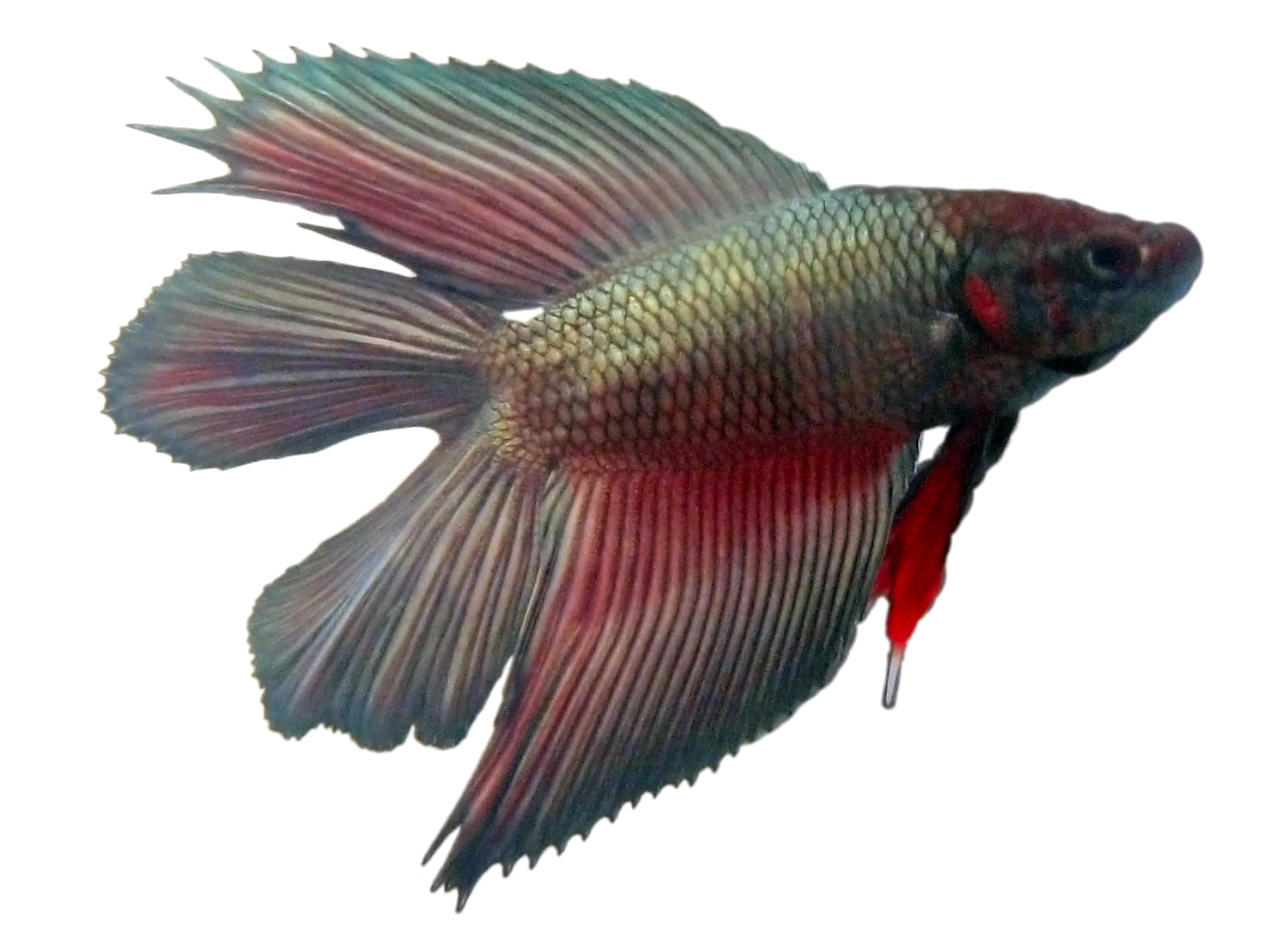
Fin type and color are separate genetic axes in Betta splendens. Color is controlled by the pigment and iridophore system; fin form is controlled by a distinct set of loci affecting fin ray branching, webbing, and growth. A halfmoon can be any color. A plakat can carry any color genetics. The two systems are effectively independent. The 2022 genetic-architecture paper (PubMed 36129976) confirmed that tail-shape variation is highly heritable but polygenic, with no single “halfmoon gene.” Show classification is governed by IBC Exhibition Standards.
What follows is the complete catalog of recognized fin forms, with the genetics where documented and the welfare implications where relevant.
Halfmoon (HM)
The halfmoon standard requires a caudal spread of exactly 180 degrees: the tail fans into a half-circle when the fish flares or swims freely. The dorsal and anal fins should also be large and symmetrical. HM is the prestige form in the International Betta Congress show circuit.
The halfmoon form was developed in the early 1990s by a group of California breeders including Peter Goettner. The first halfmoons were shown publicly at an IBC event in the San Francisco Bay Area in 1992. Prior to that event, 180-degree spread was considered unattainable in B. splendens show breeding.
The genetics producing halfmoon are polygenic and incompletely dominant. Crossing two halfmoons produces halfmoon offspring at higher rates than crossing HM with other forms, but the 180-degree standard is not guaranteed. Selective pressure across many generations produces more consistent spread.
Welfare note: Long-finned halfmoons carry more fin mass than they would carry in the wild. Heavy fins slow the fish and increase tearing risk in tanks with rough decorations. This is manageable with appropriate tank design. Flow matters as much as decor: a long-finned fish fights any real current, so a double sponge filter (affiliate) on a small air pump is the usual choice for halfmoons. The trade-off is the hum of the pump and the bubbling, which some people don’t want in a bedroom.
Halfmoon Plakat (HMPK)
The halfmoon plakat is a short-finned (plakat) fish that achieves 180-degree caudal spread. HMPK are among the most structurally sound competition fish: the plakat body plan is less prone to tearing than long-finned forms, and the fish swim more naturally.
HMPK has become one of the dominant show classes in modern IBC competition. Thai breeders have driven much of the HMPK development since the 1990s, building on traditional plakat fighting genetics for body robustness while selecting for the Western halfmoon spread standard.
Super Delta (SD)
Super delta exceeds 120 degrees of caudal spread but does not meet the 180-degree halfmoon requirement. SD is a separate IBC show class. Many fish that would be disqualified as imperfect halfmoons compete successfully as super deltas.
Delta
Delta bettas have a roughly triangular caudal spread of 90 to 120 degrees. The edges of the caudal should be straight. Delta is the base form from which super delta and halfmoon were selected upward.
Double-Tail (DT)
The double-tail has a two-lobed caudal fin separated at the base, caused by a single dominant gene that also duplicates the dorsal fin. Every double-tail betta has a wider, split-looking dorsal: the same gene that splits the tail widens the dorsal. This is the diagnostic feature.
Double-tail crossed with single-tail produces roughly 50% double-tail offspring (dominant inheritance). The form was documented in the hobby before the IBC era. Double-tail body morphology is typically shorter and deeper than single-tail forms, a secondary effect of the same gene.
HMPK double-tail crosses produce offspring called HMPKDT, a HMPK body plan with a double-tail. These are shown as a sub-class in IBC events.
Veiltail (VT)
The veiltail is the oldest and most common fancy fin form. The caudal droops downward asymmetrically rather than spreading symmetrically. Most pet-store bettas are veiltails. VT is recessive to most other tail forms in crosses, meaning VT crossed with HM produces predominantly non-VT offspring.
Veiltail is not shown in IBC competition. The droop and asymmetry disqualify it. Despite this, the form is the most widely recognized by the general public and the economic backbone of the mass betta market.
Crowntail (CT)
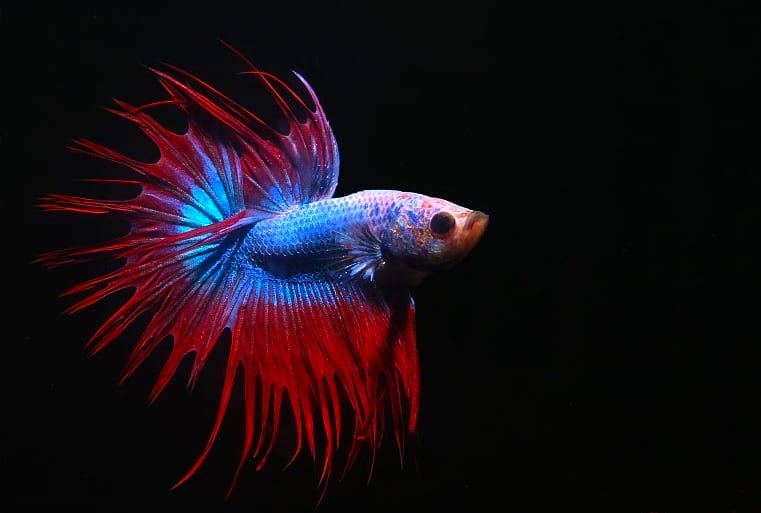
Crowntails require still or near-still water. The extended fin rays and webbing reduction mean any significant current folds the fins against the rays and causes splitting. A double sponge filter (affiliate) running off a small air pump is the correct filtration for this fin type.
Crowntail bettas have reduced webbing between fin rays, producing a spiky, crown-like appearance when the fins are spread. The reduction can be partial (two-ray reduce) or more complete (four-ray reduce, giving a more skeletal look).
The crowntail form was developed in Indonesia, credited to Ahmad Yusuf, in the late 1990s. It was introduced to the Western show circuit at IBC events in the early 2000s and became a separate show class.
Genetics: the crowntail characteristic is dominant in crosses with standard-webbed forms, though complete expression is polygenic.
Plakat (PK)
The plakat is the short-finned form, closest to the ancestral wild-type body plan. Plakat caudal fins are rounded and compact. The term comes from the Thai ปลากัด (plakat), meaning “biting fish,” which is the traditional fighting form.
Two distinct plakat populations exist:
- Plakat morh (fighting plakat): bred for stamina, jaw strength, and aggression over centuries of Thai fighting culture
- Plakat cheen (show plakat): bred for color and symmetry on the fighting body plan, competes in IBC events
Show plakat combined with halfmoon spread gives HMPK (above). Combined with double-tail gives PKDT.
The plakat is increasingly favored in the Western show circuit for its welfare-friendly profile: shorter fins reduce swimming drag, tearing risk, and the fin-biting behavior that sometimes occurs in long-finned forms.
Rose Tail
The rose tail is an extreme form of halfmoon with excessive branching in the fin rays, causing the caudal to fold over itself. The ruffled, rose-petal appearance is striking. It is not shown competitively in IBC events.
Welfare concern: the excess fin tissue creates significant drag, making normal swimming labor-intensive. Rose tails are prone to fin tearing and the excessive fin mass strains the fish over time. The form sits at the welfare margin of selective betta breeding.
Rosetail vs Feathertail
Feathertail is a more extreme expression of the same excessive branching. Both forms represent selection beyond what the fish can comfortably carry.
Dumbo / Elephant Ear (EE)
Dumbo bettas have abnormally enlarged pectoral fins. The name comes from the resemblance to elephant ears. The enlarged pectorals are genetic and have become a popular show and pet-trade modifier: any fin type can be combined with the dumbo pectoral (HM dumbo, HMPK dumbo, CT dumbo, etc.).
The pectoral enlargement is a recessive trait. Two copies are needed for full expression. One copy may produce slightly larger pectorals than normal.
Welfare note: very large dumbo pectorals can restrict swimming ability in tight spaces. Tanks for dumbo bettas should allow free lateral movement.
Giant / King Betta
The giant betta is a size modifier, not a fin form. Giant bettas reach 12 cm or more vs the standard 6-7 cm. The trait is recessive and was developed through selective breeding of naturally large individuals. Giant bettas are not a separate species. They are B. splendens selected for size.
Giant bettas require larger tanks than standard bettas because of their size and higher metabolic demand.
IBC show notation
IBC competition uses abbreviations:
- HM = halfmoon
- SD = super delta
- DT = double-tail
- CT = crowntail
- VT = veiltail
- PK = plakat
- EE = elephant ear (dumbo)
- G = giant
Combined forms: HMPK (halfmoon plakat), PKDT (plakat double-tail), HMPKDT (halfmoon plakat double-tail).
Genetics summary
| Form | Inheritance | Documented gene(s) |
|---|---|---|
| Double-tail | Dominant (single locus) | DT locus, also affects dorsal |
| Crowntail | Dominant (incomplete) | CT locus, polygenic modifiers |
| Halfmoon | Polygenic | Multiple fin-spread loci |
| Veiltail | Recessive (to HM) | VT locus |
| Dumbo/EE | Recessive | EE pectoral locus |
| Giant | Recessive | Multiple size loci |
Color genetics are separate from all of the above. See color morphs and iridescence.
Knowing which fin type you want is the first practical filter when sourcing from a named breeder. IBC-affiliated breeders document fin form alongside color line. See where to buy show bettas for the sourcing guide. If you’re breeding, fin form crosses and their expected ratios are covered in pair selection.