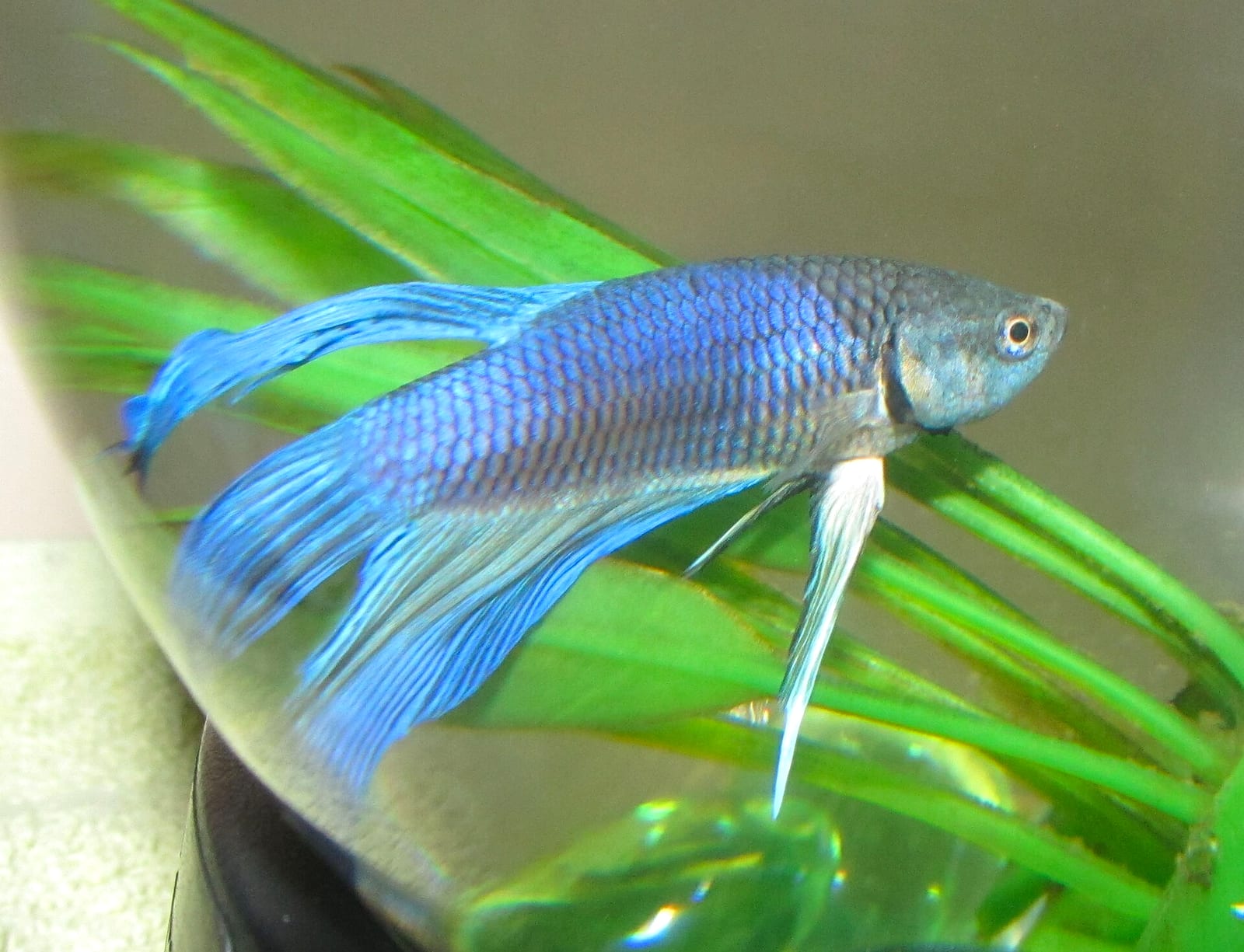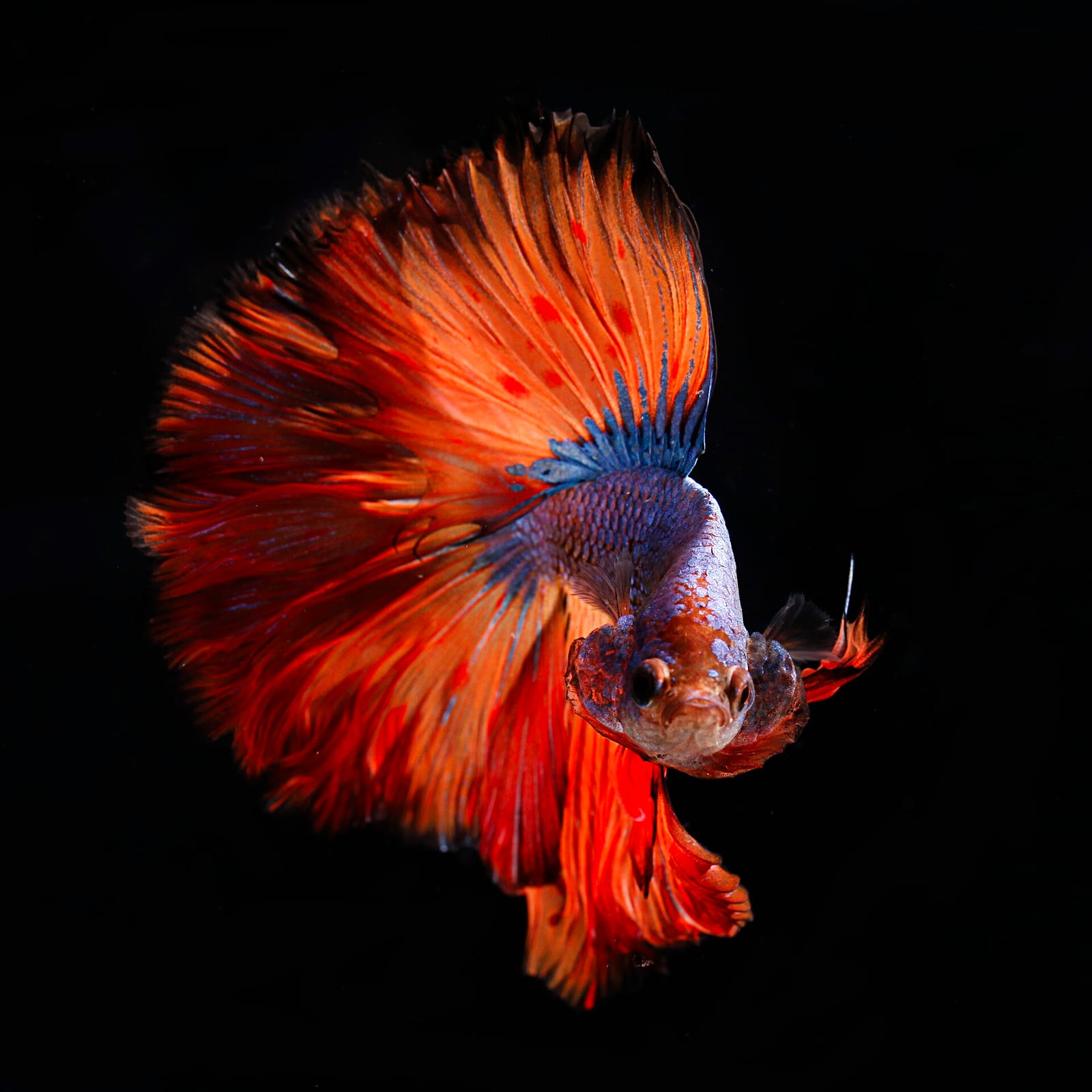
Iridescent color in bettas is not pigment. It’s structural color: light interference through layered guanine crystal platelets in iridophore cells. Royal blue, steel blue and turquoise-green come from a single locus with an in-between form. Blue-green iridescence in a betta is the same optical physics as in a peacock feather or a morpho butterfly wing. The genetics at the single-locus level is straightforward; the patterning is more complex (PubMed 32385046).
One locus, three blues
Royal blue, steel blue and turquoise-green are three forms of the same trait, controlled at a single locus. A 2021 genome study placed it in one region of chromosome 20, and its candidate gene list includes one involved in making purines, the raw material of iridophore crystals. Royal blue is the in-between form, and turquoise-green and steel blue are the two ends:
- Turquoise-green: two copies of the turquoise form.
- Royal blue: one copy of each. Deep, saturated blue.
- Steel blue: two copies of the steel form. Paler and grayer, and the one blue that lacks red pigment cells in the upper layer of the scales.
Some hobby guides put steel in the middle instead. The published crossing data puts royal there: two royal blues produce turquoise-green, royal blue and steel blue offspring in a 1:2:1 ratio.
Why the colors are structural
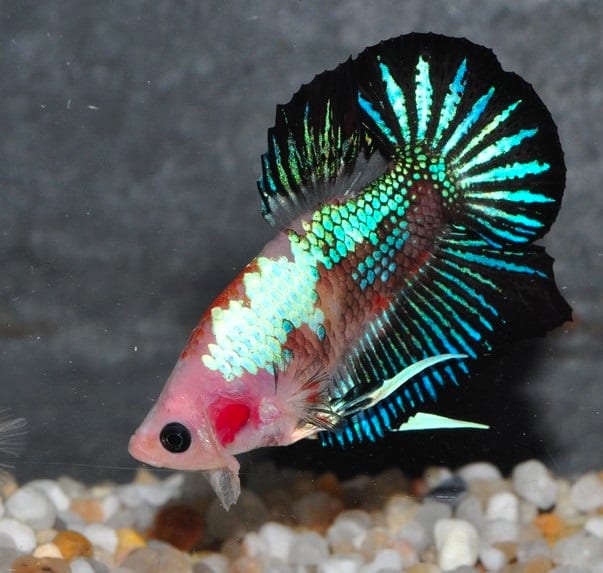
Iridophore cells contain stacked platelets of guanine crystals, and the spacing between the layers decides which wavelengths bounce back. That is why the blues shift with viewing angle and lighting the way a pigment never does. None of it is pigment: remove the iridophores and the blue or green goes with them, whatever else the fish carries.
Cross predictions
| Cross | Offspring |
|---|---|
| Royal × royal | 1 turquoise : 2 royal : 1 steel |
| Royal × steel | 1 royal : 1 steel |
| Royal × turquoise | 1 royal : 1 turquoise |
| Steel × turquoise | All royal |
| Steel × steel | All steel |
| Turquoise × turquoise | All turquoise |
These are the expected ratios for a single locus with an in-between form. Real spawns wobble around them, and other genes (red, melano, opaque) change how each blue looks.
Iridescence overlay on other colors
The iridophore layer sits on top of other pigment layers. A blue betta has iridescent blue over whatever else is going on. Combinations:
- Royal blue only: royal blue with minimal melanin and no red.
- Blue-red: iridescent blue body, red fins: a blue plus red in the fin erythrophores.
- Blue butterfly: blue body, color bands in fins: a blue plus fin-pattern genes.
- Green copper: turquoise with copper iridophores (opaque gene). A metallic greenish-copper look.
Iridescence is stacked on other genes, not exclusive to them.
The opaque gene (dragon lineage)
A separate opaque allele (Op) intensifies iridophore expression, producing the dense metallic look of dragon scale. Under the opaque gene, platelets are denser and more uniform, producing a near-mirror finish. Selected for over multiple generations to stabilize.
Dragon scale is covered in detail at dragon scale.
Pattern variants
Iridescence can be patterned:
- Full coverage: iridescent from head to tail.
- Butterfly: iridescent body with fin color bands.
- Mask: iridescent head, non-iridescent body.
- Cambodian blue: iridescent body with pale fins.
Pattern inheritance is polygenic and less predictable than the three blues. Selection across generations stabilizes specific pattern lines. The IBC Exhibition Standards define how iridescent coverage is evaluated in competition: uniform, dense coverage across the body scores higher than patchy or faded expression.
Color change in aging fish
Iridescence can darken or intensify with age. A 6-month blue betta may reach peak iridescence at 9-12 months, then slowly dull into year 3 as iridophore cells accumulate damage. This is normal aging, not disease.
Diet matters slightly. High-protein diet maintains iridophore health; poor diet accelerates dulling.
The modern color palette
Most modern color morphs involve multiple loci. The hobbyist color name for a fish often obscures the genetics. A “royal blue dragon halfmoon” is:
- Halfmoon (polygenic fin shape, selected).
- Dragon (opaque gene + multi-generation selection).
- Royal blue (the in-between form).
Breeding two royal blue dragons together therefore produces turquoise, royal and steel offspring in roughly 1:2:1, with variation in dragon intensity and fin shape on top.
Identifying iridescent genotypes
The three blues mostly sort by eye, with a caveat for fish whose other colors muddy the picture:
- Deep, saturated blue: royal, which always carries one copy of each form.
- Paler, grayer blue: steel.
- Green to turquoise: turquoise.
Breeding settles it. A steel crossed with a turquoise should give all royals; any steel or turquoise fry mean one parent was really a royal.
Losing iridescence
A melanistic background (see black melano) can mask iridescence, producing a black fish with faint blue edges rather than full iridescence. The iridophores are still present; they’re suppressed by the melanic overlay.
Similarly, cellophane (absence of pigment) can reveal iridescent-free fish whose iridophores are genetically present but unexpressed for other reasons.
Practical breeding application
If you want a spawn of all royal blues, cross a steel with a turquoise. Royal can’t be bred true, because every royal carries both forms.
If you want all three blues in one spawn, cross two royals and expect the 1:2:1 split.
If two royal blues gave you green and gray fry, nothing went wrong: that is the expected result.
If your line has drifted to all turquoise or all steel, it will stay that way when bred to itself. Cross a steel to a turquoise, or bring in a royal, to get royals back.
The three blues are the betta color system that behaves most like a textbook single-gene example. Use it as a clean entry point before tackling the more complex pattern and layer interactions. Iridophore expression is most vivid in well-conditioned fish. Diet quality affects purine availability; New Life Spectrum Betta Formula (affiliate) and similar high-protein staples support the metabolic load of producing reflective iridophore platelets.