Betta splendens has a 600-year history of human selective breeding, beginning with Thai (Siamese) villagers breeding for fighting ability in the 14th century and continuing through 19th-century Western scientific description, 20th-century pet trade expansion, and 21st-century genomic characterization. This page is the documented history with primary sources.
Pre-1800: Thai selective breeding
Traditional Siamese fighting fish keeping predates European contact. Village breeders selected males from wild splendens complex populations in rice paddies and canals, housing winners in individual clay jars and staging bouts. Documented accounts go back at least to the 17th century; oral tradition and archaeological inference suggest breeding practices existed centuries earlier.
Rama III (reigned 1824-1851) is reported to have imposed taxes on betta fighting bouts, reflecting the activity’s economic significance. The tax record (preserved in Thai royal archives) is one of the clearest documents confirming pre-modern organized betta-related commerce. The practice didn’t end with the monarchy that taxed it; informal fighting traditions carried on in villages well past the colonial era and continue in some communities today, alongside the show-breeding hobby this page otherwise traces.

1840s: First Western scientific encounter
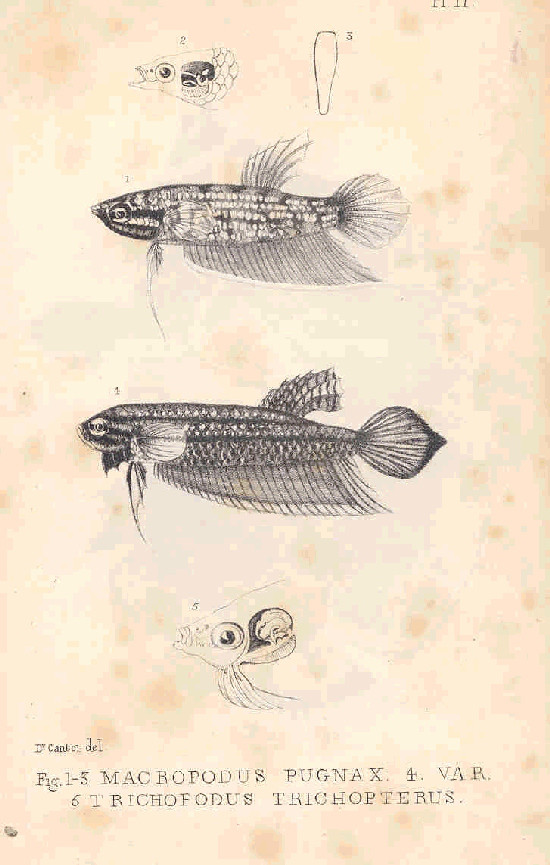
Theodore Cantor (1809-1860) was a Danish-born naturalist employed by the British East India Company. Trained in medicine and natural history in Copenhagen and Germany, he served as an assistant surgeon on East India Company expeditions through Malaya and the Straits Settlements.
In 1849, Cantor’s Catalogue of Malayan Fishes included the first scientific description of what we now call Betta splendens, under the name Macropodus pugnax. The name reflected Cantor’s placement in the then-broader genus Macropodus (which includes paradise fish) and the specific name (pugnax = “pugnacious”) referencing the fighting behavior.
Cantor’s description is archived in the Biodiversity Heritage Library and accessible for verification.
A common error
Popular hobbyist literature often calls Cantor “British.” He was Danish, trained in Copenhagen, and served under British imperial employment. Describing him as “British” elides his actual nationality. The accurate description: Danish-British naturalist, East India Company employee.
1910: Regan renaming
Charles Tate Regan (1878-1943), British ichthyologist at the British Museum (Natural History), undertook a revision of the family Anabantidae (labyrinth fishes). In a 1910 paper in the Proceedings of the Zoological Society of London, Regan restricted the genus Macropodus to paradise fishes and relatives, and placed the fighting fish in the genus Betta as Betta splendens.
The species name “splendens” references the iridescent coloration of males.
This is the name in current use, though taxonomic revisions continue; the 2020 chromosome-level genome assembly (PubMed 32385046) confirmed Betta splendens as a well-defined species within a complex that includes multiple related wild forms.
Early 20th century: Export to the West
Specimens reached European aquarium hobbyists in the late 19th century. By the 1920s and 1930s, betta keeping was established in European and American hobby communities. Early Western bettas were still relatively close to wild-type: short-finned, modestly colored, straightforward breeding.
Mid-20th century: Fin elaboration
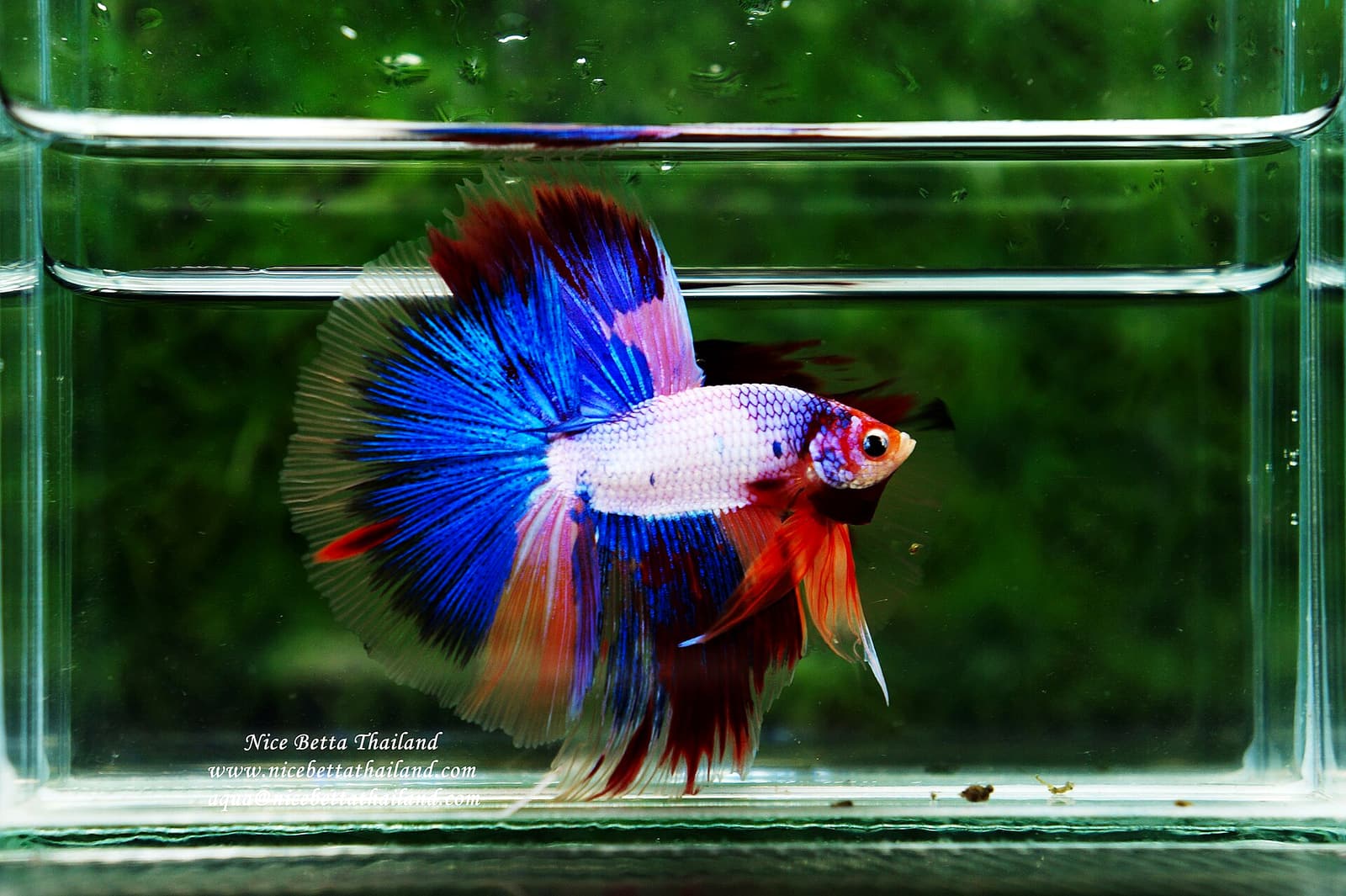
The elaborate long-finned forms that dominate the modern pet trade emerged through 20th-century selection. Key milestones:
- Veiltail. The long asymmetric caudal, dominant in pet-store bettas from the 1950s through 1990s.
- Halfmoon. Developed in the 1980s and 1990s; the 180-degree caudal spread. Rajiv Massillamoni is credited with stabilizing the modern halfmoon standard in the 1990s.
- Crowntail. A late 1990s Indonesian innovation: receding webbing between rays producing spike extensions.
- Double tail. Dates earlier than halfmoon but became more prominent in show circuits through the 1980s.
- Plakat. The short-finned modern show form, closest to the fighting lineage. Gained show prominence in the 2000s.
Late 20th century: IBC standards
The International Betta Congress (IBC) was founded in 1967 to standardize show classes and formalize breeding goals. The IBC’s exhibition standards are the authoritative reference for modern show bettas. See ibcbettas.org.
2019: Thai national aquatic animal
On February 5, 2019, the Thai government officially declared Betta splendens the national aquatic animal of Thailand. The declaration followed a proposal from the Thai Department of Fisheries recognizing both:
- Cultural heritage value (600+ years of Thai selective breeding).
- Economic significance of the modern betta industry (Thailand is the largest exporter of ornamental bettas globally).
The decree is documented in Thai government records and the Department of Fisheries official publications.
2020: Genome assembly
The 2020 chromosome-level genome assembly provided the first high-quality genetic reference for the species. Resolved 21 linkage groups, cataloged protein-coding genes, and established a platform for subsequent genetic work on color, fin, and behavior.
2022: Phenotypic architecture paper
The 2022 genetic-architecture paper (PubMed 36129976) mapped specific loci to specific traits. Notable findings included:
- Color genes cluster in a few linkage groups.
- Tail shape is polygenic.
- Marble pattern is polygenic, and its molecular basis is still unpublished.
- Fighting-line bettas show strong selection signatures across centuries.
2023: Disease research
The 2023 ScienceDirect papers on Betta splendens mycobacteriosis (Sirimanapong et al.) documented the Mycobacterium chelonae burden in commercial Thai production. Significant welfare and zoonotic implications.
2025-2026: Conservation milestones
The 2025 IUCN Krabi feature highlighted endemic betta species at risk. The 2026 Wiley paper documented the first captive breeding of Betta hendra, a critically endangered close relative. Both signal growing scientific and conservation attention to the genus.
The long arc
From anonymous 14th-century Thai villagers breeding fighters in clay jars, through Cantor’s 1849 specimen cabinet, through Regan’s 1910 museum revision, through IBC show circuits and Thai export farms, to modern genomic characterization and conservation attention: Betta splendens has accumulated 600 years of human engagement, documentation, and transformation.
The fish you buy at PetSmart is the inheritor of all of it. That’s worth knowing.
Sources
Where to follow up:
- Cantor 1849 description at Biodiversity Heritage Library.
- Regan 1910 paper at Proceedings of the Zoological Society archive.
- Thai Department of Fisheries for the 2019 decree.
- PubMed for the 2020 genome and 2022 phenotypic architecture papers.
- Wiley and ScienceDirect for the 2023-2026 research.
When writing about betta history online, cite these directly rather than quoting secondary sources. The primary record is accessible and worth engaging with.
Modern keepers maintain the same species that Thai villagers bred in clay jars, the biology hasn’t changed. What has changed is the equipment. Seachem Prime (affiliate) eliminates the chloramine problem that killed fish in 19th-century European tanks. A test kit closes the feedback loop that early importers operated without. See tank setup for the current baseline.