Betta imbellis (the peaceful betta) occupies the southern end of the range shared by the Betta splendens complex. It is one of the most commonly kept wild betta species, valued by hobbyists for its relative tolerance of conspecifics compared to B. splendens, its compact body plan, and the blue-green iridescent scale margins that distinguish it from its more famous relative.
Taxonomy and nomenclature
Betta imbellis was described by Charles Tate Regan in 1910, in the same paper in which he formally described and renamed Betta splendens from Cantor’s Macropodus pugnax. The species name imbellis means “peaceful” or “non-warlike” in Latin, acknowledging the behavioral difference from the fighting species.
The species belongs to the Betta splendens complex (sometimes called the splendens group), a clade of closely related anabantoids that includes B. splendens, B. smaragdina, B. mahachaiensis, and B. siamorientalis, among others. All are bubble-nest builders. All are closely enough related that captive hybridization is possible between most of them.
Distribution and habitat
Betta imbellis occurs across southern Thailand (primarily the provinces of Narathiwat, Satun, Trang, and Pattani) and throughout peninsular Malaysia. Populations extend into Singapore, where the species was once considered locally extinct and has since been rediscovered.
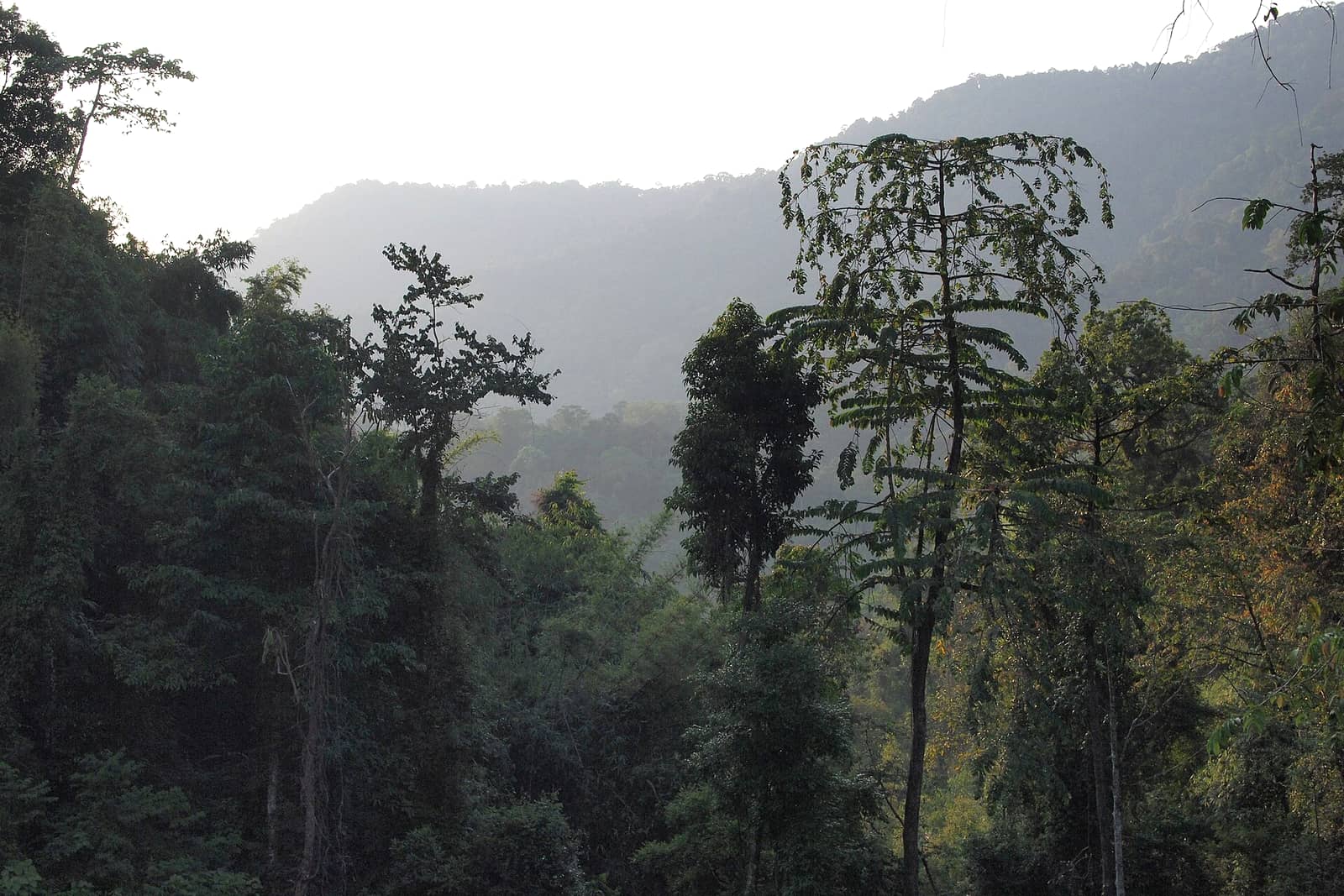
The natural habitat is lowland peat swamps, forest streams, rice paddies, and drainage ditches in the coastal lowlands. The water is typically tannin-stained, warm (24–28°C), soft, and slightly acidic (pH 5.5–7.0). Submerged and emergent vegetation is dense. These are the same general habitat conditions as B. splendens, and indeed the two species are syntopic (occurring together) in parts of southern Thailand, where a natural hybrid zone has been documented. Captive hybridization between the two species is also possible and well documented, and the resulting hybrids are fertile, a sign of just how close the genetic proximity between imbellis and splendens is. That proximity is part of why imbellis care requirements track splendens so closely: two recently diverged species sharing a habitat type share the same tank parameters.

Identification
Male B. imbellis reach 4–5 cm standard length, noticeably smaller than domesticated B. splendens (6–7 cm). Key identification features:
- Fins: Shorter and rounder than ornamental splendens. No halfmoon or crowntail forms exist in the wild type.
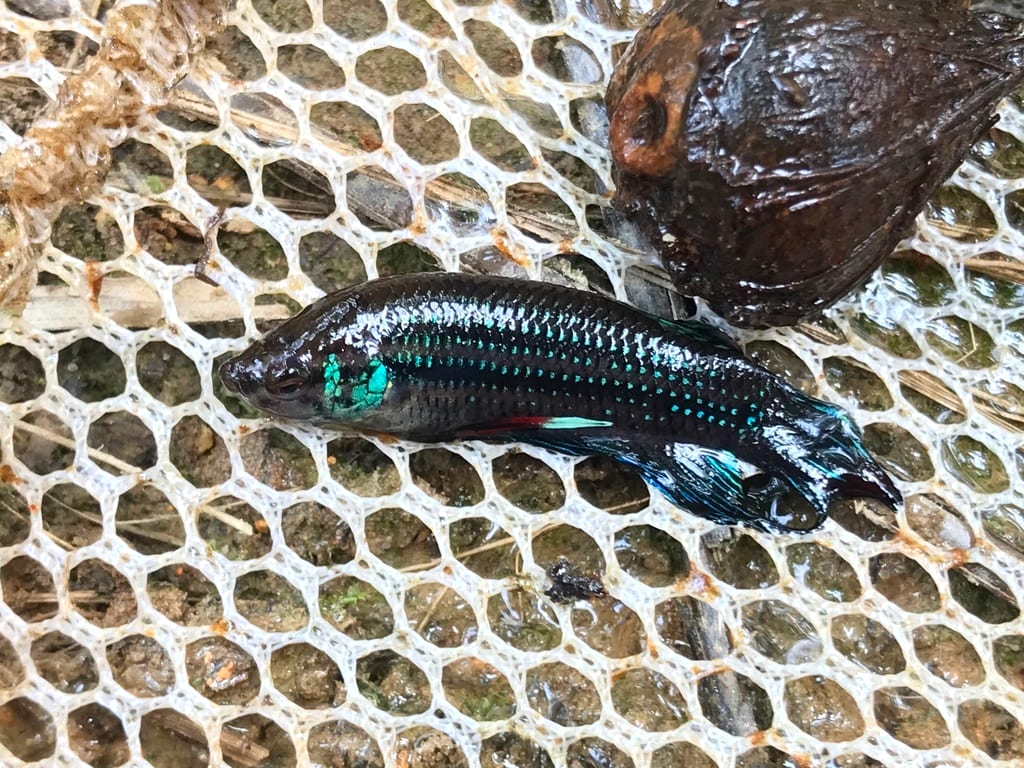
- Iridescence: Blue-green iridescent scale margins on a dark body. The pattern covers the flanks in a scaled, reticulated arrangement rather than the solid-color presentation of many domestic splendens.
- Red fin margins: Males typically have red edges on the caudal and anal fins.
- Body shape: More compact and somewhat deeper-bodied than wild-type splendens.
Females are smaller than males and less iridescent, as in other Betta species. The white ovipositor spot visible between the ventral fins is the clearest female indicator.
Behavior and aggression
The “peaceful” label holds relative to B. splendens: imbellis males are less likely to immediately fight to exhaustion when they encounter a conspecific male. Some keepers maintain small groups of imbellis in large, heavily planted tanks without serious injury. Careful observation is required. Males do display, do establish hierarchies, and will injure each other in cramped or poorly decorated conditions.
The lower aggression appears to be linked to habitat: imbellis occupies dense, heavily vegetated water where line-of-sight between males is frequently broken. The visual trigger for escalated aggression is reduced by the environment in a way that open-water species do not experience.
Male-female housing has the same caveats as B. splendens: males can harass females outside of spawning condition to serious injury. Pairs should only be maintained together with ample cover and careful observation.
Captive care
Requirements closely parallel those for B. splendens:
- Tank size: 10 gallons minimum for a single male. Larger for a group.
- Temperature: 24–28°C (76–82°F)
- Water: Soft, slightly acidic to neutral, pH 6.0–7.0 in the tank (the wild range runs a touch lower, down to pH 5.5, in undiluted peat-swamp water). Low hardness. Tannin-stained (via Indian almond leaves (affiliate) or peat filtration) reduces stress and mimics natural conditions.
- Cover: Dense live plants or artificial cover is important. More so than for splendens, given the species’ natural habitat and behavioral needs.
- Diet: Same as splendens: high-protein pellet or flake with live/frozen supplementation (bloodworm, daphnia, brine shrimp).
- Tankmates: More community-tolerant than B. splendens in a spacious, heavily planted tank; peaceful nano fish and non-nippy bottom dwellers generally coexist without incident. Avoid fin-nipping species (tiger barbs, serpae tetras) regardless of tank size, since imbellis fins, while shorter than ornamental splendens, are still a target.
B. imbellis is somewhat hardier than many wild betta species and adapts reasonably well to standard aquarium water. It is a better choice than some other wild bettas for keepers who want a wild species but cannot maintain specialized peat-blackwater conditions.
Conservation status
IUCN Red List 2021: Least Concern. The species has a wide range and appears tolerant of habitat disturbance at moderate levels. The primary ongoing threat across its entire range is lowland habitat loss from oil palm agriculture, urban development, and drainage of peat swamps. No targeted conservation programs exist specifically for B. imbellis, though broader Southeast Asian freshwater fish conservation efforts cover its habitat.
Populations in Singapore, previously thought locally extinct, were rediscovered in the 2010s, a reminder that range assessments for small, cryptic fish are often incomplete. The 2021 IUCN Red List assessment rates the species as Least Concern, while the broader species complex is documented taxonomically in Tan & Ng’s definitive 2005 treatment of Southeast Asian fighting fishes (Tan & Ng, Raffles Museum Bulletin, 2005). Kottelat’s 2013 reference work (Raffles Bulletin of Zoology) provides the authoritative distribution data for inland Southeast Asian species.