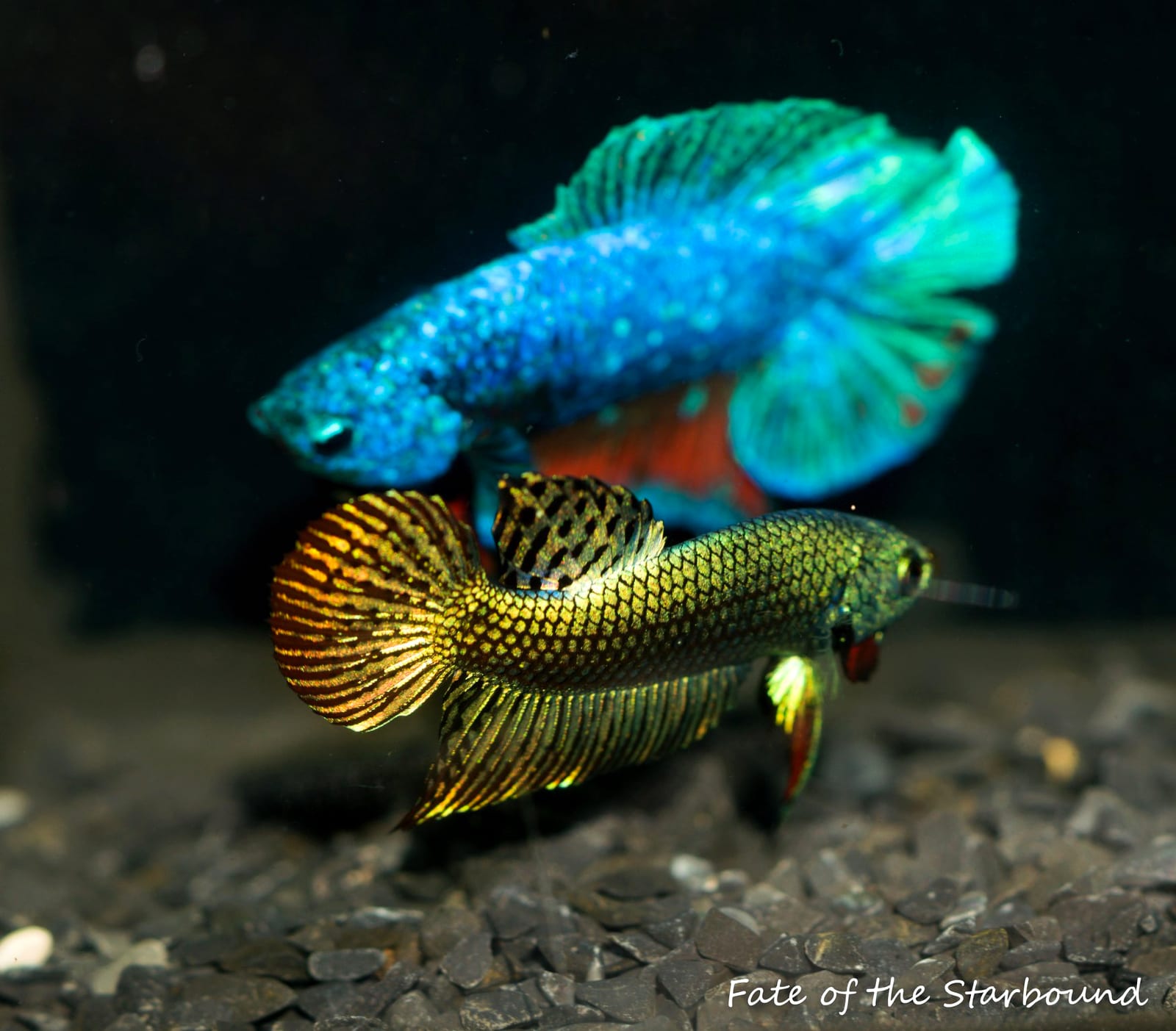
A galaxy koi betta is a koi-patterned fish carrying a second colour system on top: dense iridophore speckling that scatters metallic blue and green flecks across the red, black and white blocks like stars over a nebula. That is where the name comes from. It describes colour only. A galaxy koi can be a plakat, a halfmoon, a crowntail or a dumbo, because none of that is what the word is telling you.
The useful way to read the term is as two independent statements stacked into one label. “Koi” is the pattern layer, covered in full on the koi betta page. “Galaxy” is the iridescent layer. They are produced by different cell types, they map to different chromosomes, and they can be bred apart.
What separates a galaxy koi from a plain koi?
Speckle density, and specifically iridescent speckle density. A standard koi is built from pigment blocks with defined boundaries. A galaxy koi has those same blocks with a scatter of reflective flecks laid over them, often heaviest along the flanks and into the base of the caudal.
The flecks are not pigment in the ordinary sense. They are iridophores, cells packed with stacked crystalline platelets that produce colour by interference rather than by absorbing light. That difference has a visible signature: pigment looks the same from every angle, structural colour does not. Rotate a galaxy koi under a light and the flecks ignite and go dark. Rotate a plain red koi and the red stays red.
If you are trying to tell the two apart in a photograph, that is the tell to look for. A single still image cannot show it, which is a recurring problem for anyone buying online.
What creates the metallic speckles?
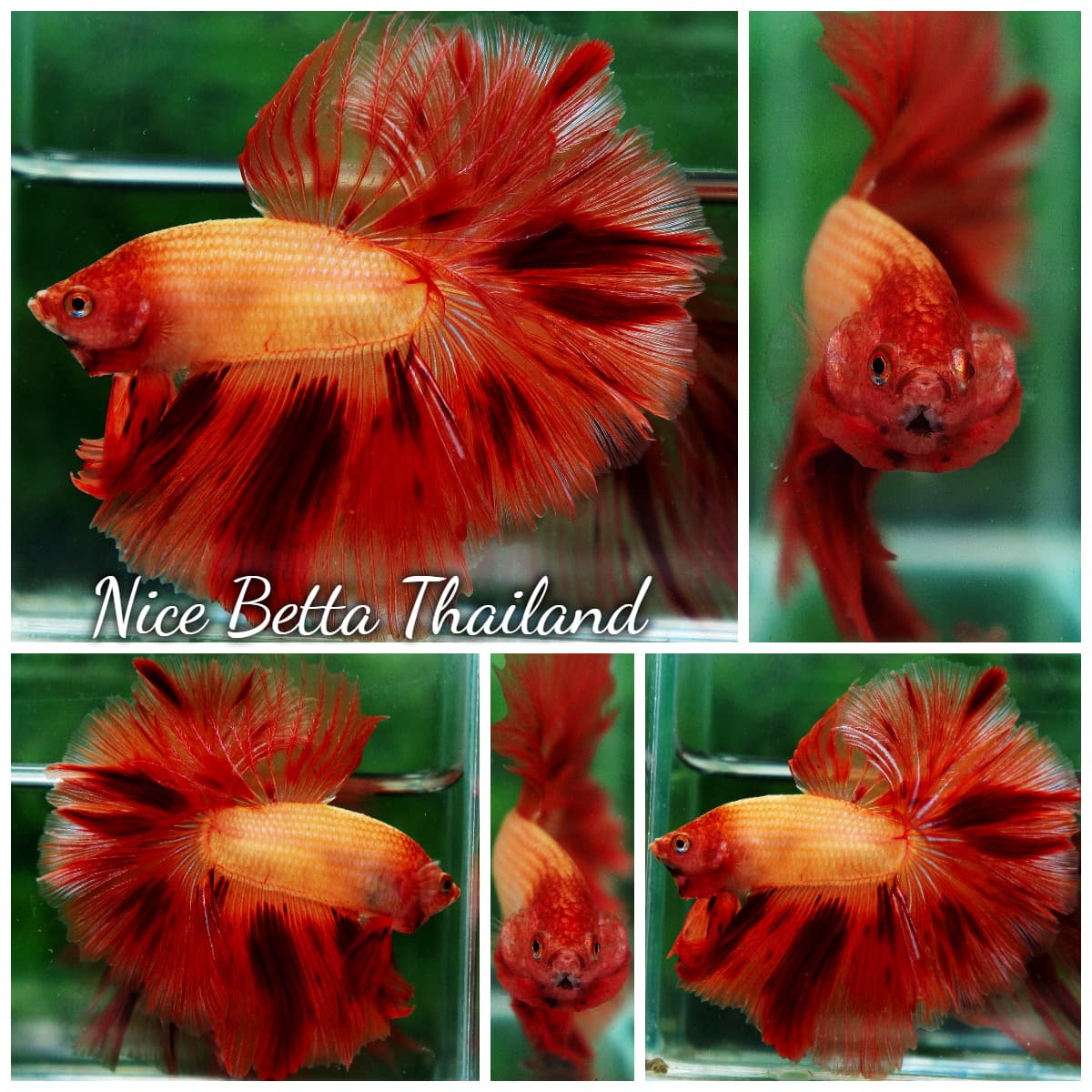
Iridophores generate colour from purine crystals, and the 2022 Science Advances survey (PMC9491723) got closer to the biochemistry than any earlier work on the species.
Comparing the iridescent colour classes, royal blue, turquoise green and steel blue, the authors identified a single locus at 8.96 to 9.19 Mb on chromosome 24. The candidate gene is mthfd1l, methylenetetrahydrofolate dehydrogenase 1 like, which participates in tetrahydrofolate synthesis. Tetrahydrofolate feeds the de novo assembly of purines, and purines are the raw material of the crystal platelets inside an iridophore.
Read that chain in order and it explains something the hobby has described for decades without a mechanism: iridescence is a supply problem. The fish is manufacturing crystals, and a gene affecting the metabolic pathway that supplies their building blocks changes how much crystal ends up in the skin. Betta iridescence covers the optics of the resulting colour.
Two systems, two sets of loci
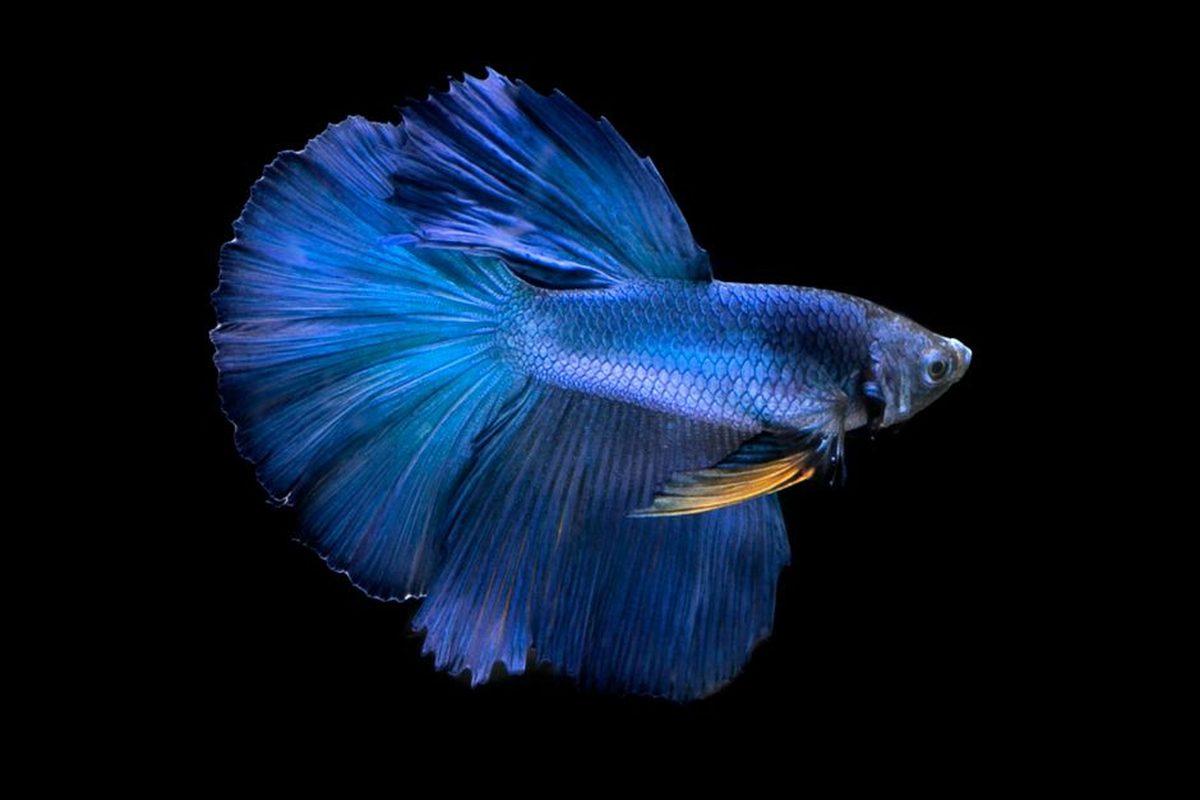
The pattern half and the iridescent half were mapped separately in the same study, and the numbers are worth putting side by side.
| Layer | What it does | Mapping in the 2022 survey |
|---|---|---|
| Mosaic pattern (the koi blocks) | Where red, black and white land | Nine loci across eight chromosomes, polygenic |
| Iridescence (the galaxy flecks) | Metallic blue-green reflectance | Single locus, chromosome 24, near mthfd1l |
One layer is polygenic and scattered, the other is concentrated. That asymmetry is the reason a breeder can hold iridescence in a line far more reliably than pattern. Speckling responds to selection; block placement does not.
The same paper lists galaxy alongside koi, candy, lemon and marble as commercial names sitting on the mosaic phenotype, which is a reminder that the trade vocabulary and the genetics do not line up one to one. Show entry follows the IBC exhibition standards, which classify by defined colour and pattern classes rather than by seller labels.
Why does the same fish look different in every photo?
Because half its colour is angle-dependent and half is not.
Under a warm aquarium light with the fish side-on to the viewer, the flecks catch and the fish looks studded. Under flat overhead light or with the fish angled away, the same flecks read as dull grey-green and the pattern blocks dominate. Neither image is dishonest and neither is complete.
Three practical consequences:
- Judge a galaxy koi in person or on video. A still photo is the one format that cannot show the property you are paying for.
- Tank lighting changes the fish. Colour temperature and beam direction both matter. Lighting covers choosing a fixture, and for a 5-gallon its default is the NICREW ClassicLED Plus, with a built-in timer and adjustable brightness.
- Seller photos are usually shot under the most flattering angle available. That is normal in every ornamental fish trade and is a reason to buy from someone who posts video.
Check NICREW ClassicLED Plus on Amazon Affiliate link. As an Amazon Associate we earn from qualifying purchases. See our disclosure.
Does the speckling spread as the fish ages?
Often, yes, and in two directions at once.
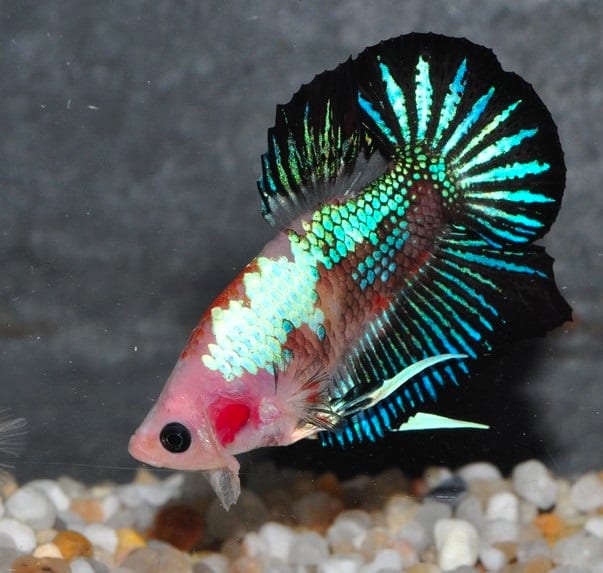
Iridophore coverage tends to increase through the first several months as the fish finishes developing, so a young galaxy koi frequently ends up more heavily speckled than it looked at purchase. Meanwhile the mosaic pattern underneath keeps drifting the way any marble-family pattern does, so the blocks the flecks sit on are moving too.
The combination is why galaxy koi are among the least predictable fish in the trade over a two-year horizon. Buy one because you like what it is doing now, not because you expect it to hold. The marble gene covers pattern drift in the family generally.
Older fish eventually go the other way. Iridescence dulls with age along with the rest of the colour, usually from around three years, which is normal senescence rather than illness.
Galaxy koi or dragon scale?
They are frequently confused because both are iridophore traits, and the difference is coverage geometry.
Dragon scale is continuous. Thick, opaque metallic scaling covers the body like plate armour, and at its most extreme it can grow over the eyes, which is a documented welfare concern in heavily selected lines. See dragon scale genetics.
Galaxy speckling is discontinuous. Individual reflective scales scattered against visible pattern underneath, with the pigment blocks still readable between them.
A fish whose metallic coverage has closed up into a continuous sheet has stopped being a galaxy koi in the descriptive sense, whatever the label on the cup says. If you are buying for the speckled look specifically, check that the pattern underneath is still visible.
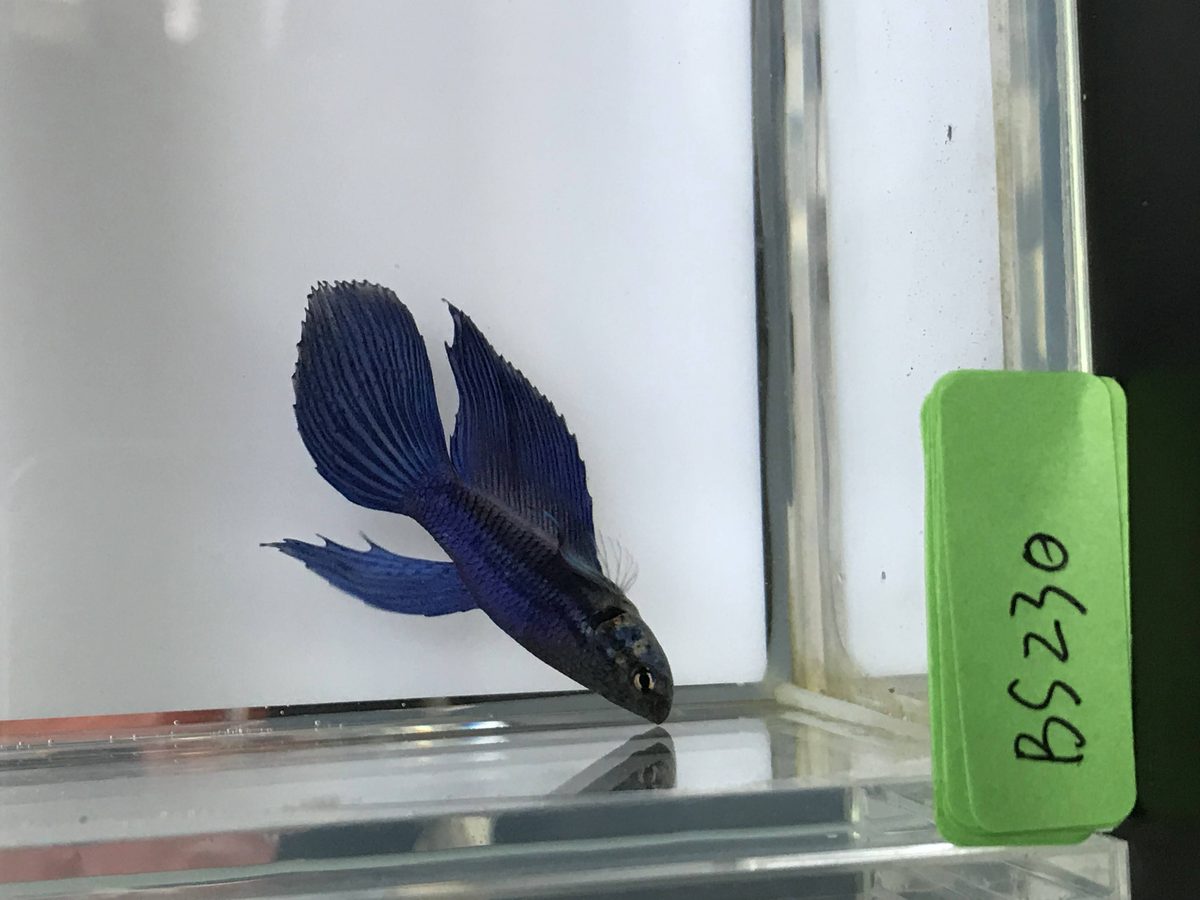
Breeding galaxy koi
The two layers behave differently under selection, so plan for them differently.
- Iridescence responds. Pairing two heavily speckled fish reliably raises average coverage in the fry, consistent with a concentrated genetic basis.
- Pattern does not. Block placement recombines freshly in every fish. Select for colour set and contrast, accept the arrangement.
- Grade late. Speckling is still filling in at three months, and the pattern beneath is still moving at six.
- Watch for coverage closing up. Selecting hard for iridescence over several generations drifts a line toward continuous metallic scaling, which loses the galaxy look and can bring the dragon-scale eye issues with it.
Expect a low keeper rate. Sourcing from a breeder who documents both layers, rather than a farm selling on a single photograph, is covered in where to buy show bettas.
Related on this site
- Koi Betta: A Colour Pattern, Not a Fin Type
- Betta Iridescence: Blue, Steel, Green, and Structural Colour
- Betta Dragon Scale Genetics: Intensified Iridophore Selection
- Betta Color Morphs: Modern Catalog and Genetics
- The Marble Gene: Unstable Pattern in Betta splendens
- Betta Fin Types: Halfmoon, Crowntail, Plakat, IBC Forms