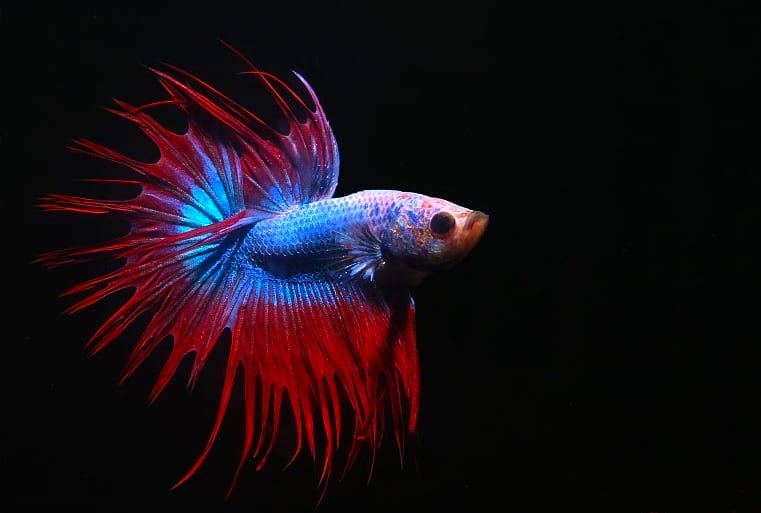
A crowntail betta is a fin form defined by what is missing. The webbing, the thin membrane stretched between the bony rays of the fin, is reduced, so the rays stand out past it as separate spikes and the edge of the tail reads like a crown. The rays themselves are not unusually long. The difference is the membrane. Crowntail says nothing about colour and nothing about how far the tail spreads, which is why crowntail and halfmoon are sometimes described as competing forms when they are answers to two different questions. The fin type catalog has the short entry; this is the long one.
What actually makes a crowntail?
Take any betta fin apart and you get two components. Rays are the stiff, segmented, branching supports that fan out from the base. Webbing is the soft tissue spanning the gaps between them. In a standard fin the webbing runs all the way to the ray tips, so the outer edge is a continuous curve and you barely see the rays at all.
In a crowntail the webbing stops short. How far short is the whole variable. A light reduction leaves shallow notches; a heavy reduction leaves the rays exposed over most of their length and the fin looks skeletal. The trait shows in the caudal, dorsal and anal fins together, not in the tail alone, which is one quick way to tell a genuine crowntail from a fish whose tail has simply split.
The reduction is a developmental trait, present from the start. Fry begin showing it in the finnage from around six to eight weeks and it becomes unambiguous by three months.
How does a crowntail differ from a halfmoon?
They are not alternatives on the same scale. Halfmoon describes spread, meaning how far the caudal opens. Crowntail describes webbing, meaning how much membrane fills the fin. A fish can have both traits, and show classes exist for exactly that combination.
The 2022 Science Advances survey put the distinction in one sentence: the crowntail breed differs from the halfmoon breed by having reduced webbing tissue between the fin rays (PMC9491723). If you are choosing between a halfmoon and a crowntail, you are not choosing between two grades of the same thing. See halfmoon for the spread axis.
What is known about the genetics?
The 2022 survey compared halfmoon against crowntail directly and found a significant signal at 12.21 to 12.27 Mb on chromosome 2, described by the authors as possibly associated with the webbing phenotype. That is a narrow window and a specific chromosome, which is more than the hobby had before, but the authors’ own hedge is doing real work in that sentence and should not be dropped when the finding gets repeated.
Note what the same study found alongside it. The long-fin foundation maps elsewhere entirely, to kcnj15 around 9.60 Mb on chromosome 14, and fin spread to a region on chromosome 16. Three fin questions, three different chromosomes. That is the genetic reason the hobby can recombine these traits so freely: they are not variants of one gene competing for the same slot.
Older hobby genetics described crowntail as a simple dominant with polygenic modifiers, and crosses do behave roughly that way in practice, with partial expression common in the first generation and reduction deepening under selection. The mapped result does not contradict that, but it also does not confirm a single-locus model. Treat inheritance as directionally predictable and quantitatively not.
What do “single ray”, “double ray” and “cross ray” mean?
Hobby naming counts branches, not spikes. A fin ray divides as it grows outward, and where the webbing recedes determines how the exposed structure looks:
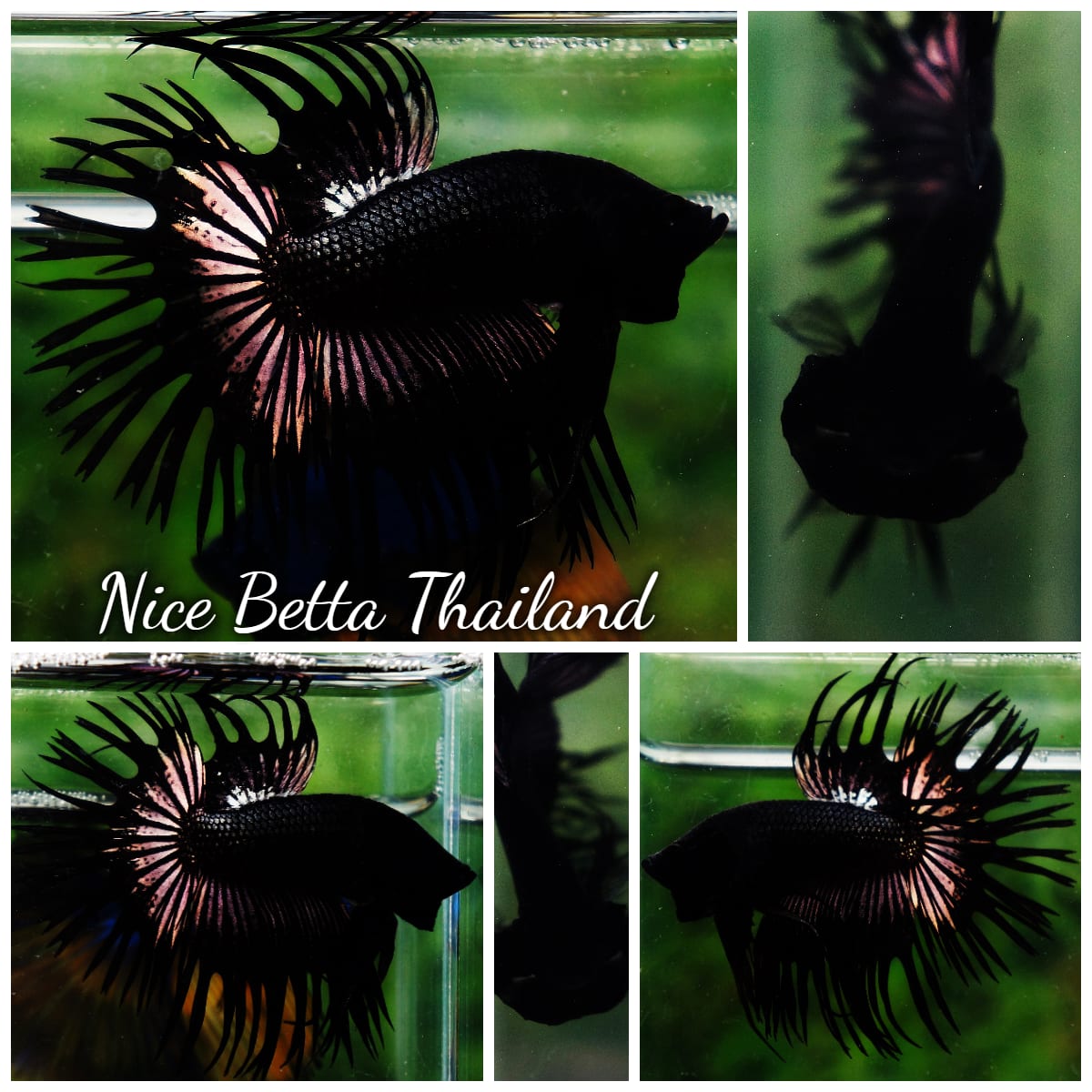
- Single ray. Webbing recedes between unbranched rays. Simple, evenly spaced spikes.
- Double ray. Each ray has split once before the webbing gives out, so the spikes emerge in pairs with a shallow web between the two halves.
- Cross ray or king crown. Multiple branch orders exposed, the extensions of neighbouring rays crossing over each other into a lattice.
You will also see the reduction described by depth instead of branching, as two-ray or four-ray reduction. Both conventions circulate and neither is wrong; they are measuring different features of the same fin. Formal show classification is set by the IBC exhibition standards rather than by trade usage, and the current standards book is the document to check before entering a fish.
The practical point for a buyer: the deeper the reduction, the more striking the fish and the more fragile the fin.
Why does water flow matter more for a crowntail?
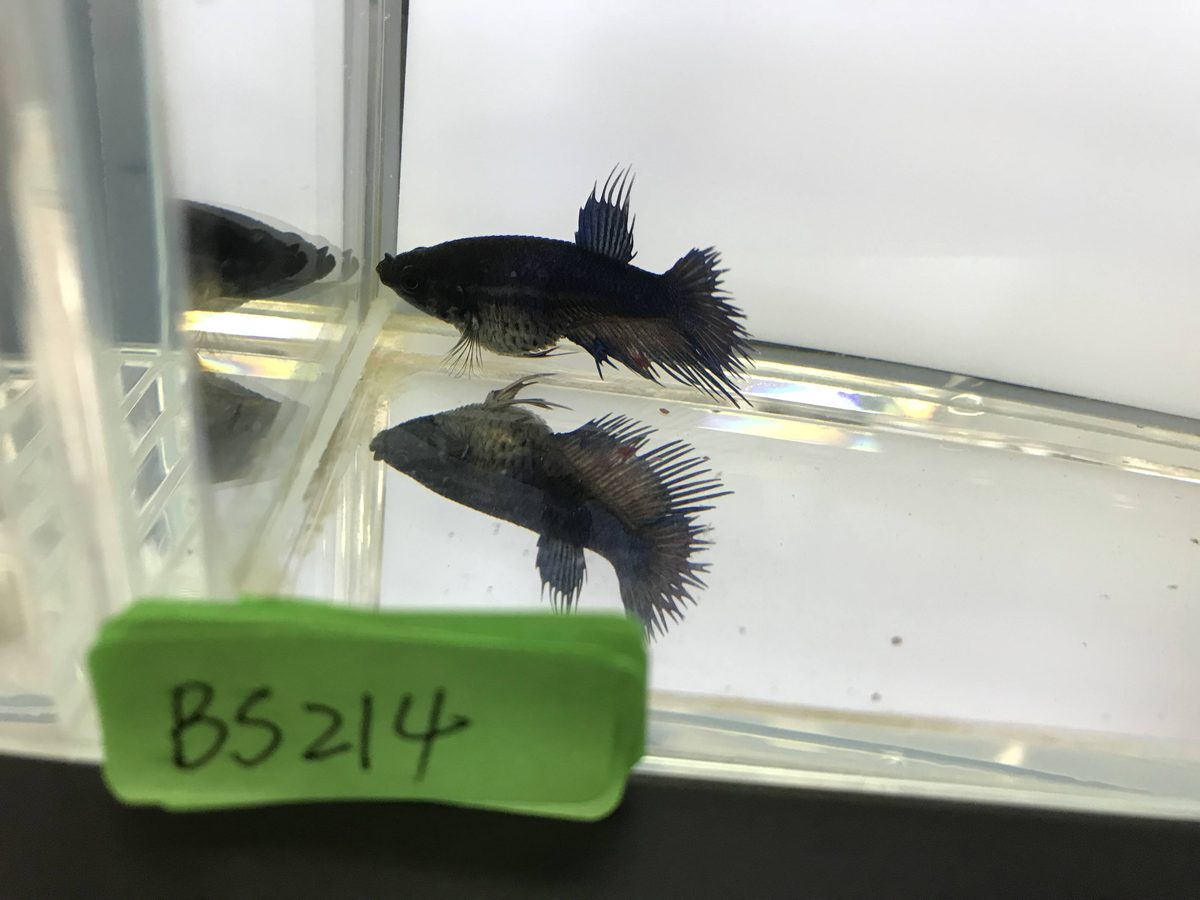
Because the exposed rays have almost no lateral support. Membrane is what holds a normal fin flat and lets it move as a sheet. Strip most of it out and each ray flexes on its own, so current bends the rays individually, folds them back against each other, and works splits into whatever webbing remains.
The fix is not complicated. Run air-driven filtration or baffle whatever outflow you have. A double sponge filter (affiliate) on a small air pump moves enough water for biological filtration without producing a current the fish has to fight. Best filters compares the alternatives.
The same logic applies to decor. Anything a fin can hook on is worse for a crowntail than for a standard fin, because a single ray catching alone concentrates all the force on one point.
Are curled rays a disease?
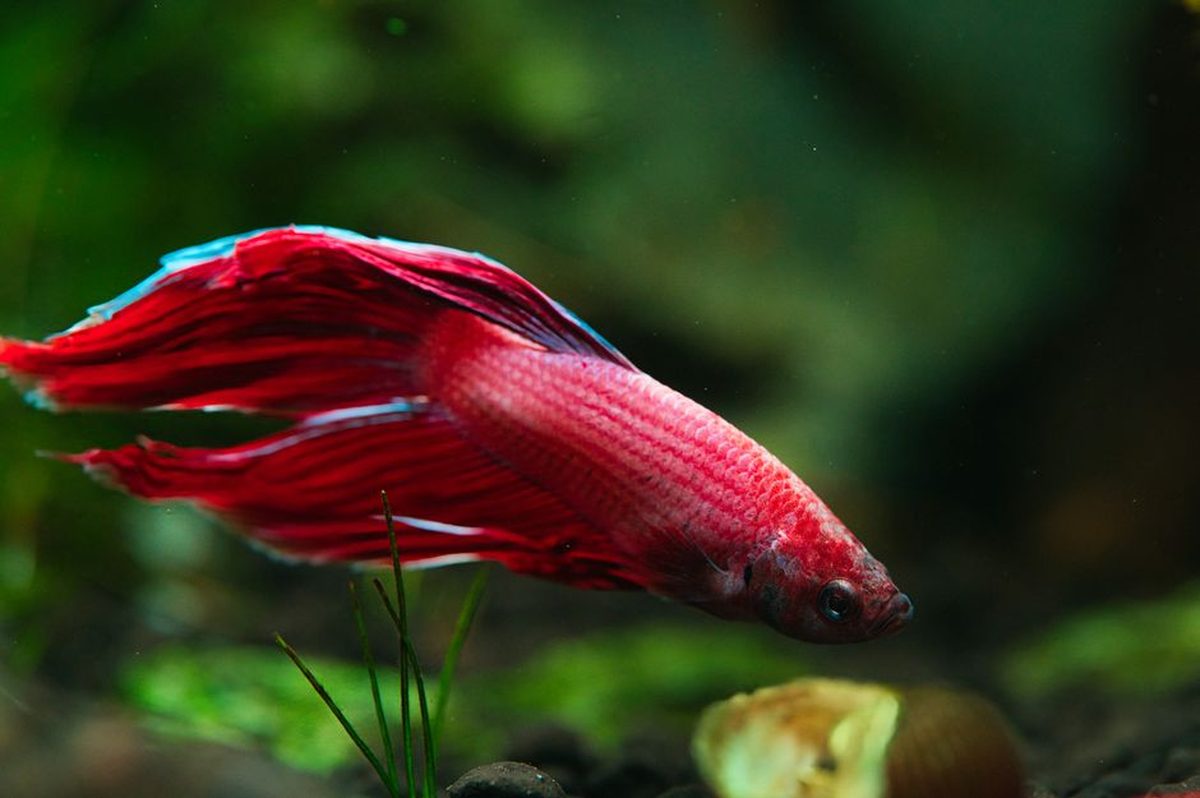
Curling and shortening ray tips are the complaint that brings most crowntail keepers looking for answers, and the honest position is that the mechanism is not settled in published literature. What is documented is the general one: water chemistry and stability drive fin condition in captive betta, and the 2022 laboratory care review (PMC9334006) treats water quality as the controlling husbandry variable rather than any single additive.
Keepers consistently report ray curl in hard, high-TDS water and improvement after moving to softer water with regular changes. That is an association reported from practice, not a demonstrated cause, and it is worth saying so plainly. What you can do without guessing:
- Test and record what the fish is actually living in. The full target table is in water parameters.
- Hold the numbers steady rather than chasing an ideal value.
- Increase water change frequency before adding anything to the tank.
- Rule out flow. Curl at the tips of the longest rays on one side is usually mechanical.
Is ray damage the same as fin rot?
No, and confusing them wastes medication on a plumbing problem. A crowntail’s normal edge is already ragged by design, which makes visual diagnosis harder than on a halfmoon.
Mechanical damage is clean. A ray snaps or a piece of webbing splits along an existing line, the break is sharp, and nothing changes over the following days. Infection advances. Margins go dark, milky or fuzzy, the erosion moves inward toward the body between one day and the next, and it does not respect ray lines.
Work through fin damage versus fin rot before treating, and fin rot if the answer is infection. Broken rays regrow, usually with a visible kink at the old break.
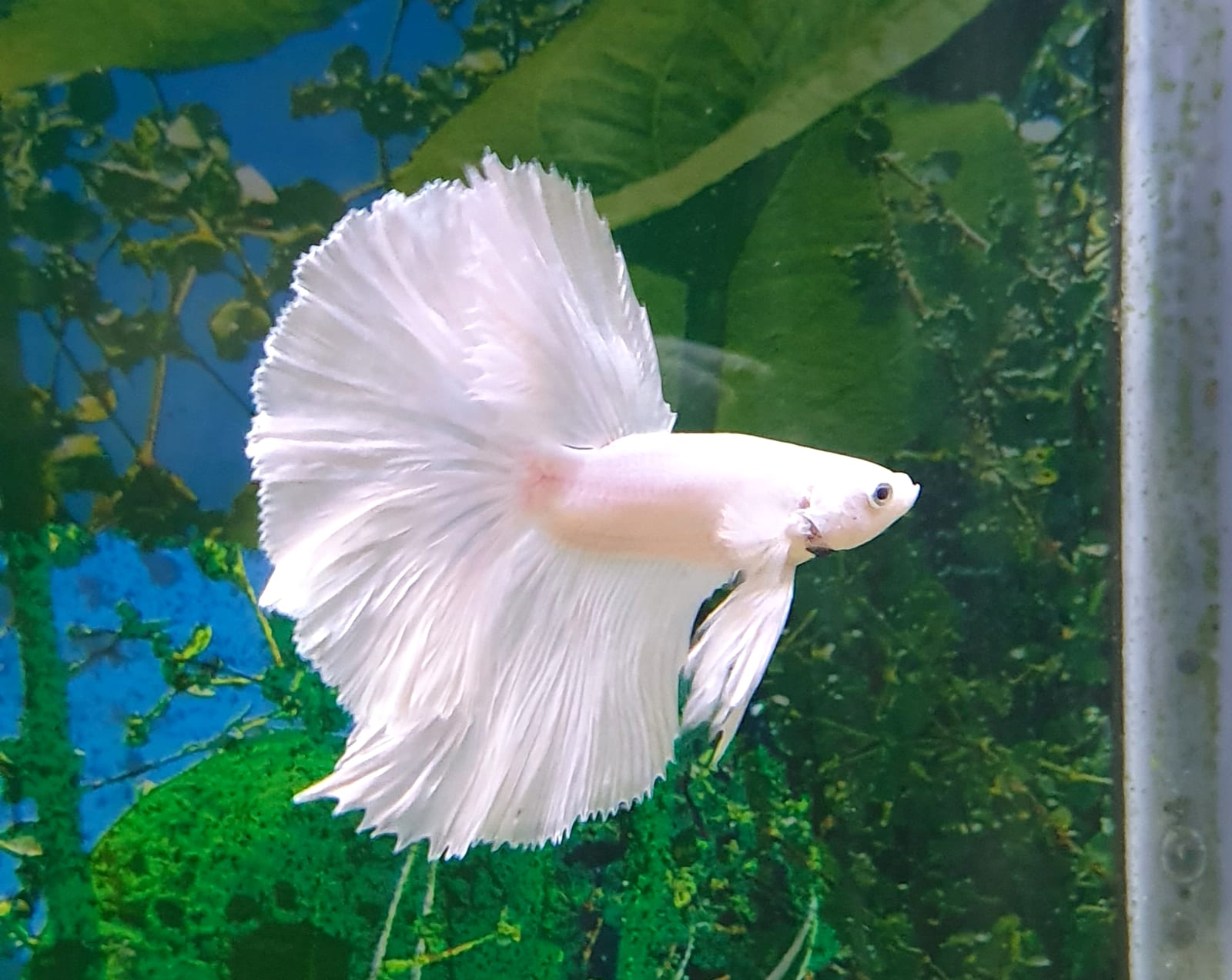
Breeding crowntail
Crowntail expression deepens under selection and fades without it, so a line left uncrossed for a few generations drifts back toward fuller webbing. Points that matter in practice:
- Grade at three months, not at eight weeks. Reduction is still developing before then.
- Crossing crowntail to a full-webbed partner gives partial reduction in a share of the fry, which is useful for reintroducing vigour but sets the project back on expression.
- Symmetry is harder to fix than depth. Uneven reduction between the top and bottom halves of the caudal persists through crosses.
- Ray count and branching order both track with the parents, so select on the structure you want rather than on overall spikiness.
Pair selection covers grading, and where to buy show bettas covers finding breeders who document fin form rather than selling on photographs.