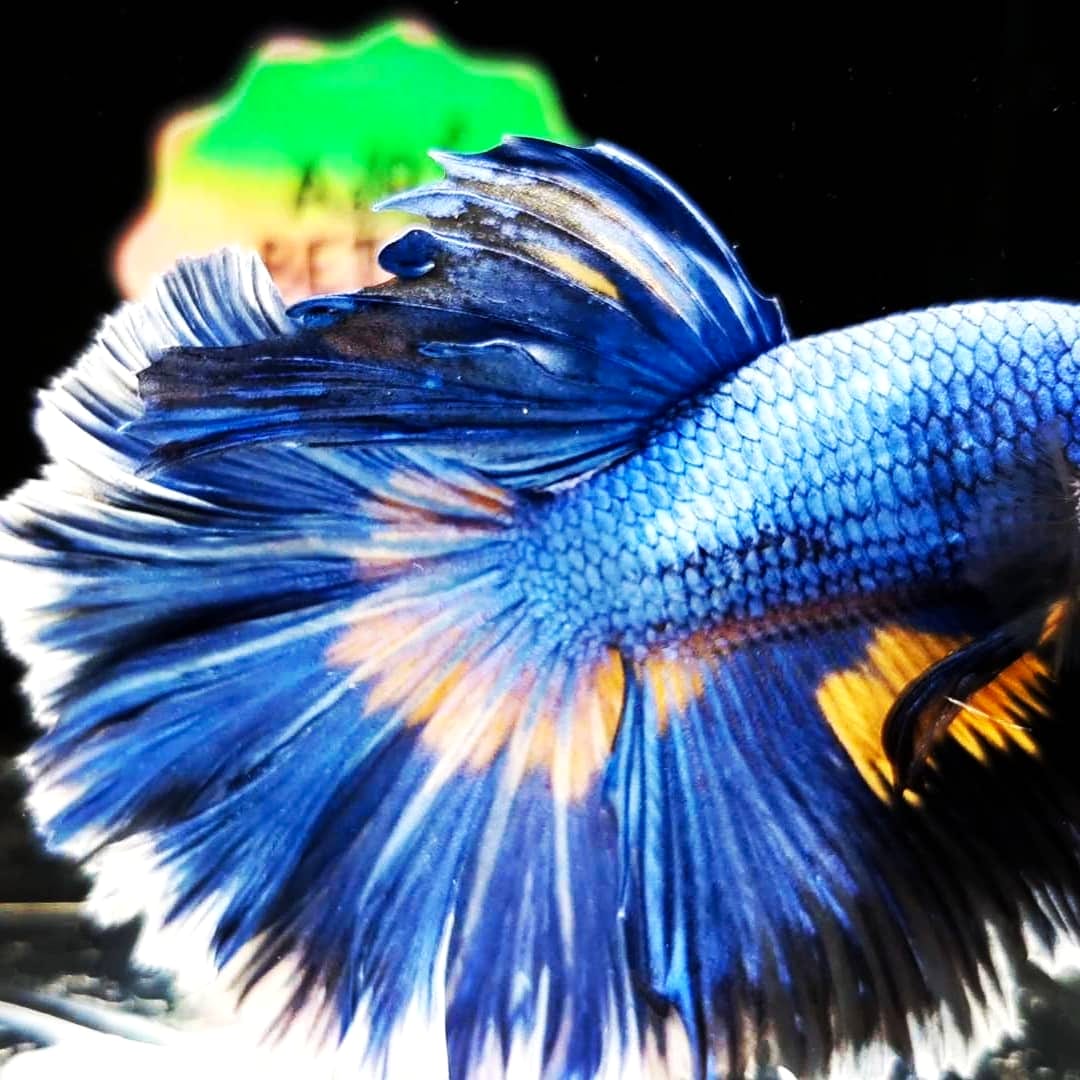
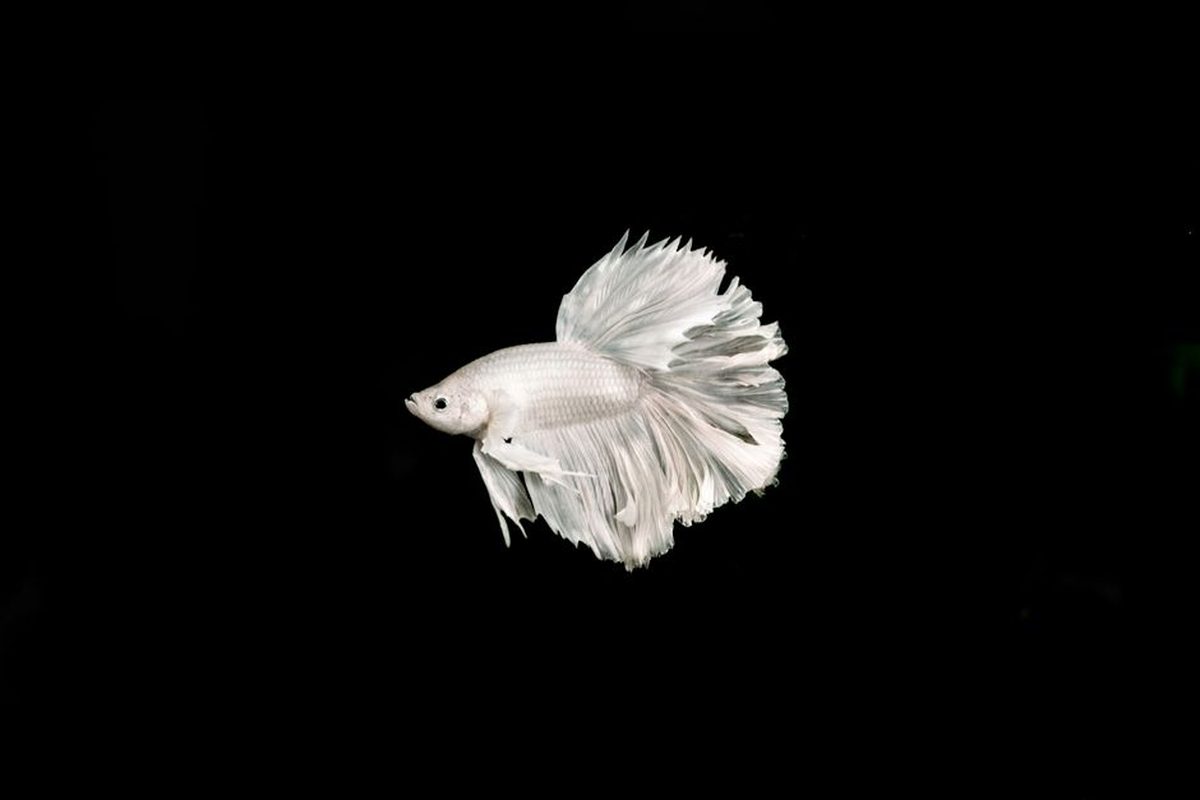
A halfmoon betta is a fin form, and only a fin form. The caudal fin opens to a full 180 degrees when the fish flares, so the top and bottom edges line up and the tail reads as a half-circle with a straight leading edge. The dorsal and anal fins are bred large enough to fill the gaps on either side. Nothing about the word describes colour: a halfmoon can be red, koi, galaxy, black melano, or anything else. If you came here from the fin type catalog, this page is the long version of the halfmoon entry.
What makes a betta a halfmoon?
Three things have to be true at once, and the first is the only one that is measurable.
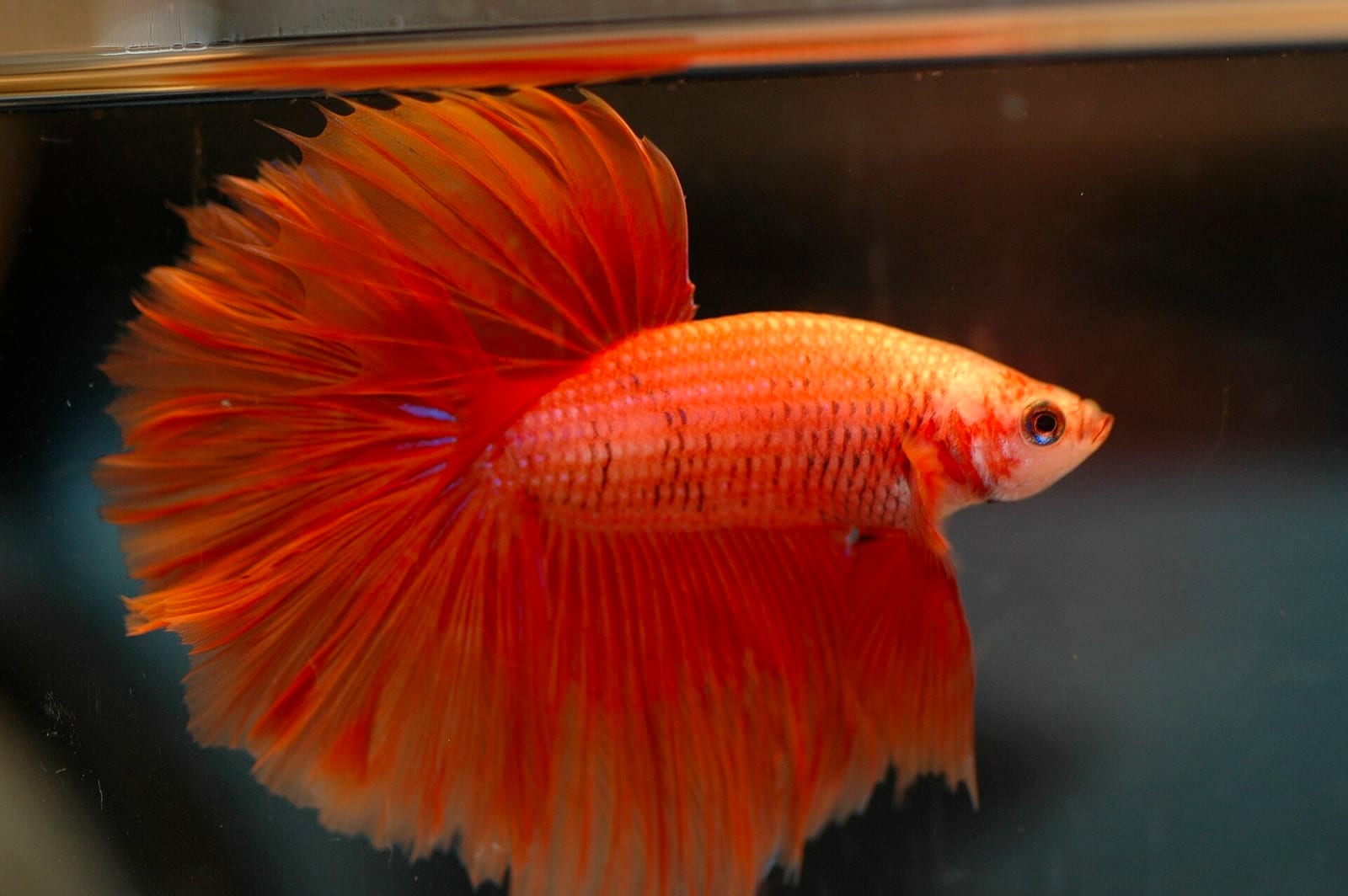
The caudal reaches 180 degrees. Flare the fish and look at it side-on. The outer edge of the tail should form a flat line, top point to bottom point, with the body at the centre of the semicircle. At 170 degrees the tail is still slightly cupped and the fish is a super delta. Past 180 it becomes an over-halfmoon, which is a separate thing (below).
The caudal edge is clean and straight, not scalloped. Ray branching is what fills a fin out. Too little branching leaves gaps between the rays at the edge; too much starts folding the fin over on itself.
The dorsal and anal fins match. A wide tail on a narrow dorsal reads as unbalanced and loses points under IBC exhibition standards, which judge form and finnage as a whole rather than scoring the caudal in isolation.
Most fish sold as halfmoon in chain stores land somewhere between 150 and 180 degrees. That is not a scam so much as a naming convention: the trade uses “halfmoon” for the general shape, while the show circuit uses it for the measurement.
Is halfmoon a colour or a fin type?
A fin type. This distinction matters more than it sounds, because the pet trade sells combined names (halfmoon koi, halfmoon dumbo, crowntail halfmoon) that blur two independent systems. Fin geometry and pigment sit on different loci and are inherited separately. The practical consequence: a breeder can hold a halfmoon line and swap colours into it, or hold a colour line and swap fin forms into it, and neither project interferes with the other. The colour morph catalog covers the pigment half.
Which genes build a halfmoon?
Two separate genetic questions sit behind one fish: what makes the fins long at all, and what makes a long fin spread flat.
The long-fin foundation is the better resolved of the two. The 2022 Science Advances survey of 727 domesticated betta plus 59 wild fish across six other species (PMC9491723) found an extremely strong association at roughly 9.60 Mb on chromosome 14 (P = 4.15 × 10⁻¹⁹⁸) separating long-finned from short-finned breeds. The candidate is kcnj15, a potassium channel gene, and the expression data is the persuasive part: transcripts are abundant in long-fin breeds and close to undetectable in short-fin breeds. That single locus is the gate between a plakat body plan and everything with trailing fins.
Spread is a second question and the answer is softer. Comparing halfmoon against veiltail, the same study flagged a 300-kb window at 13.48 to 13.79 Mb on chromosome 16 as possibly associated with fin spread. “Possibly” is the authors’ own hedge, and it is worth keeping. There is no clean single halfmoon allele on the table, which fits what breeders have reported for thirty years.
The paper frames the sequence plainly: veiltail was the first long-finned form on record, and selection afterwards for a full 180-degree spread produced the halfmoon. That is a selection history, not a mutation event. The 2020 chromosome-level assembly is what made this mapping possible at all.
Why two halfmoons do not produce a spawn of halfmoons
Because spread behaves like a quantitative trait rather than a switch. Cross two clean 180-degree parents and the fry distribute across a range: some at 180, more in the 150 to 175 band, a few over-spread and folded. Breeders select the closest to standard each generation and repeat. A line gets more consistent with time; it does not become guaranteed.
Two practical consequences. First, buying a halfmoon pair does not hand you a halfmoon project, it hands you generation one of a halfmoon project. Second, fry graded at eight weeks will not hold their grade: fins are still extending at that age and the spread you measure at week 8 is not the spread you get at month 6. Pair selection covers how to grade for it.
Halfmoon, super delta, over-halfmoon, rosetail
These are points on one axis, measured at the caudal edge.
| Form | Caudal spread | What you see |
|---|---|---|
| Delta | roughly 90 to 120 degrees | triangular, straight edges |
| Super delta | above 120, short of 180 | nearly flat but still slightly cupped |
| Halfmoon | 180 degrees | flat leading edge, clean half-circle |
| Over-halfmoon (OHM) | past 180 degrees | edge curves back toward the body |
| Rosetail | past 180 with heavy branching | fin folds over itself, ruffled |
Over-halfmoon and rosetail are what happens when selection for spread and branching runs past the point of return. Extra fin tissue is extra drag and extra weight, and rosetail fish in particular carry more fin than the body was selected to move. That is a welfare cost with no compensating benefit to the fish, which is why serious breeders treat rosetail as a line problem rather than a goal.
Halfmoon plakat (HMPK)
An HMPK is a short-finned fish that still opens to 180 degrees. Structurally it is the sounder animal: the same spread standard, far less fin mass to drag, tear, or catch. Seriously Fish lists half moon plakat alongside half moon and half moon elephant ear among the documented ornamental strains, and notes that the wild form is now rarely seen in the hobby at all.
If you like the halfmoon silhouette but not the maintenance load of trailing fins, HMPK is the version to buy.
What does a halfmoon need that a plakat does not?
The differences are all consequences of fin mass.
Low flow. A large caudal is a sail. Filter output that a plakat ignores will pin a halfmoon against the glass and keep it there, which is exhausting and eventually shreds the fin edge. Baffle the outflow or run an air-driven sponge. Best filters covers the options.
Nothing sharp. Plastic plants with moulded seams, sharp driftwood edges, and decorations with narrow gaps are the usual causes of a torn caudal. Silk or live plants instead.
Space to turn. A halfmoon needs room to swing that tail without catching it. Five gallons is the working minimum, for the same reasons that apply to any adult male.
Clean water, held steady. Fin edges are the first tissue to show a water-quality problem and the last to recover from one. The targets are in water parameters. Tannins help during regrowth, and Indian almond leaves (affiliate) are the standard way to add them.
Long fins are also the main risk factor for self-directed damage. If a halfmoon starts arriving each morning with fresh notches and no pathogen signs, read tail biting before reaching for medication.
How long does a halfmoon hold its spread?
Usually a year to eighteen months at peak, then a slow decline. Fin rays lose stiffness with age, the caudal starts to droop under its own weight, and the flat edge softens. Older halfmoons often stop flaring fully, which reads as lost spread but is partly reduced effort. None of that is disease. It tracks the same slow decline the rest of the fish goes through.
What is worth watching is the difference between wear and infection. Mechanical damage leaves clean splits along the ray lines. Fin rot leaves ragged, darkened or milky margins that keep advancing. Fin damage versus fin rot is the distinction that decides whether you medicate or just improve the tank.
What to check before buying
In the cup or the bag, before money changes hands:
- Get it to flare. Spread is meaningless at rest. A card or a neighbouring cup for a few seconds is enough.
- Look at the caudal edge, not the middle. Scalloping, gaps, and folds all show at the margin.
- Check the dorsal. A narrow dorsal on a wide tail is the most common shortfall in trade halfmoons.
- Count fresh tears. Shipping damage heals. Old, blunted, healed-over edges suggest a fish that has been in a cup a long time.
- Ask the age. A four-month fish still has fin growth ahead of it; a ten-month fish is showing you its finished form.
For a documented line rather than a farm fish, where to buy show bettas covers sourcing from breeders who record fin form alongside colour.