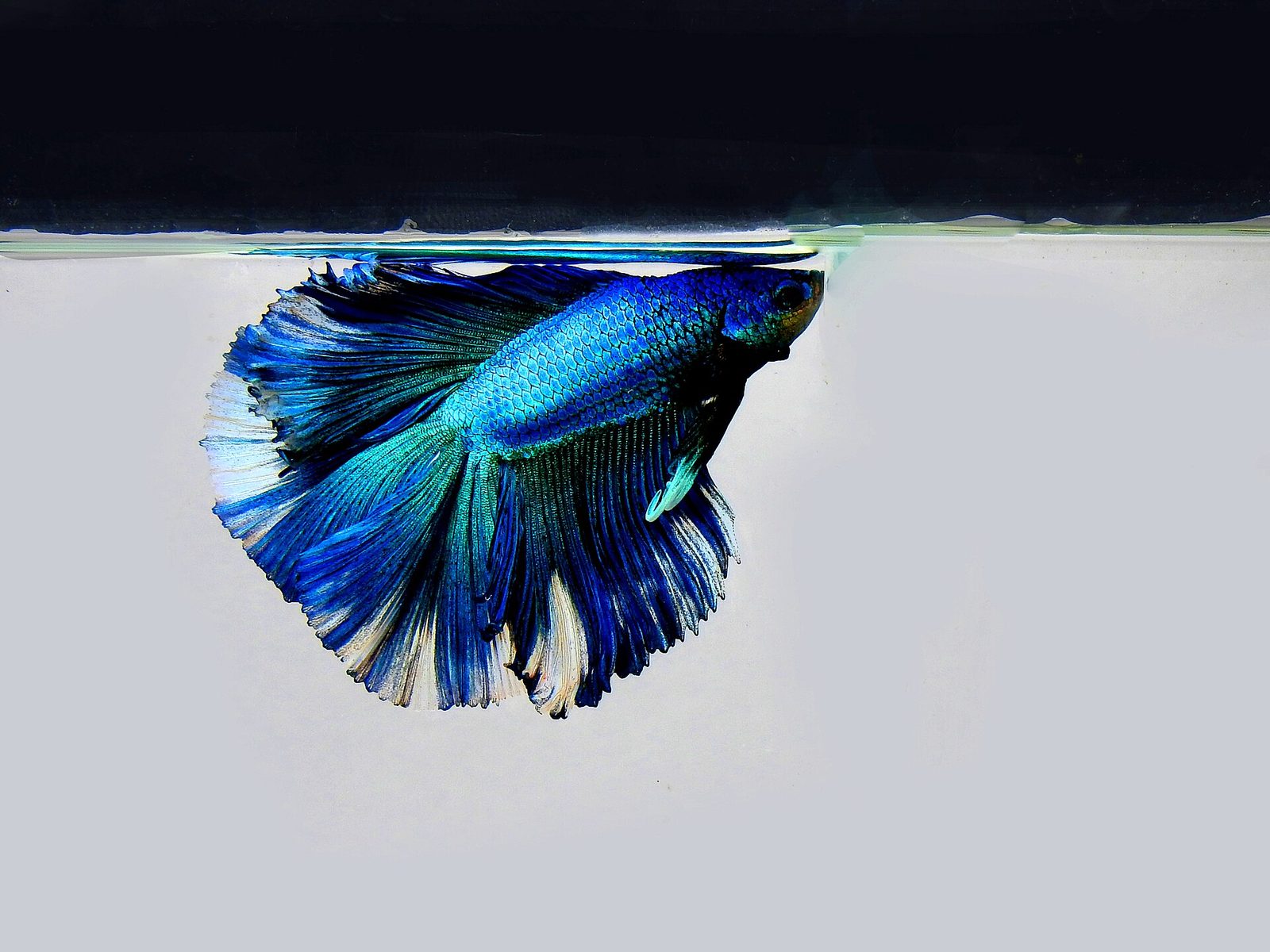
Bettas jump because they go to the surface to breathe and because the shallow, warm, oxygen-poor water they evolved in rewarded moving between pools. You stop it by covering the tank completely, closing feeding holes and filter cutouts with fine mesh, dropping the water line an inch or two below the rim, and fixing any ammonia reading above 0.25 ppm before you blame the lid.
This page has affiliate links. As an Amazon Associate we earn from qualifying purchases. See our affiliate disclosure.
Why do betta fish jump?
Because the surface is already where they spend a large part of their lives, and because jumping used to work.
A betta is an anabantoid. It carries a labyrinth organ, described in the University of Florida’s extension guide to the species as paired chambers above the gills, extensions of the first gill arch, containing complex folded bony structures covered with respiratory epithelium, which let the fish take oxygen from the air. There is more on the anatomy in betta anatomy.
That organ exists because of where the fish lives. The same UF/IFAS guide records a Thai betta population in water averaging 29.9 degrees C with dissolved oxygen averaging 3.8 mg/L and ranging from 0.0 to 7.4. Zero is a real reading in that dataset. Warm water holds less oxygen than cool water to begin with, and a rice paddy in the dry season is a shallow, sun-heated, plant-choked body of water that goes anoxic in patches. A fish that can breathe air lives in places other fish cannot, and a fish that can also cross a few inches of wet mud to reach the next pool lives longer still.
None of that is switched off by a hundred generations in a breeding facility. What you have in a glass box on your desk is an animal whose escape behaviour is going to the surface and going up.
Which is why Seriously Fish puts it in six words in the care notes: bettas are excellent jumpers, so keep the aquarium well covered and do not fill it to the top.
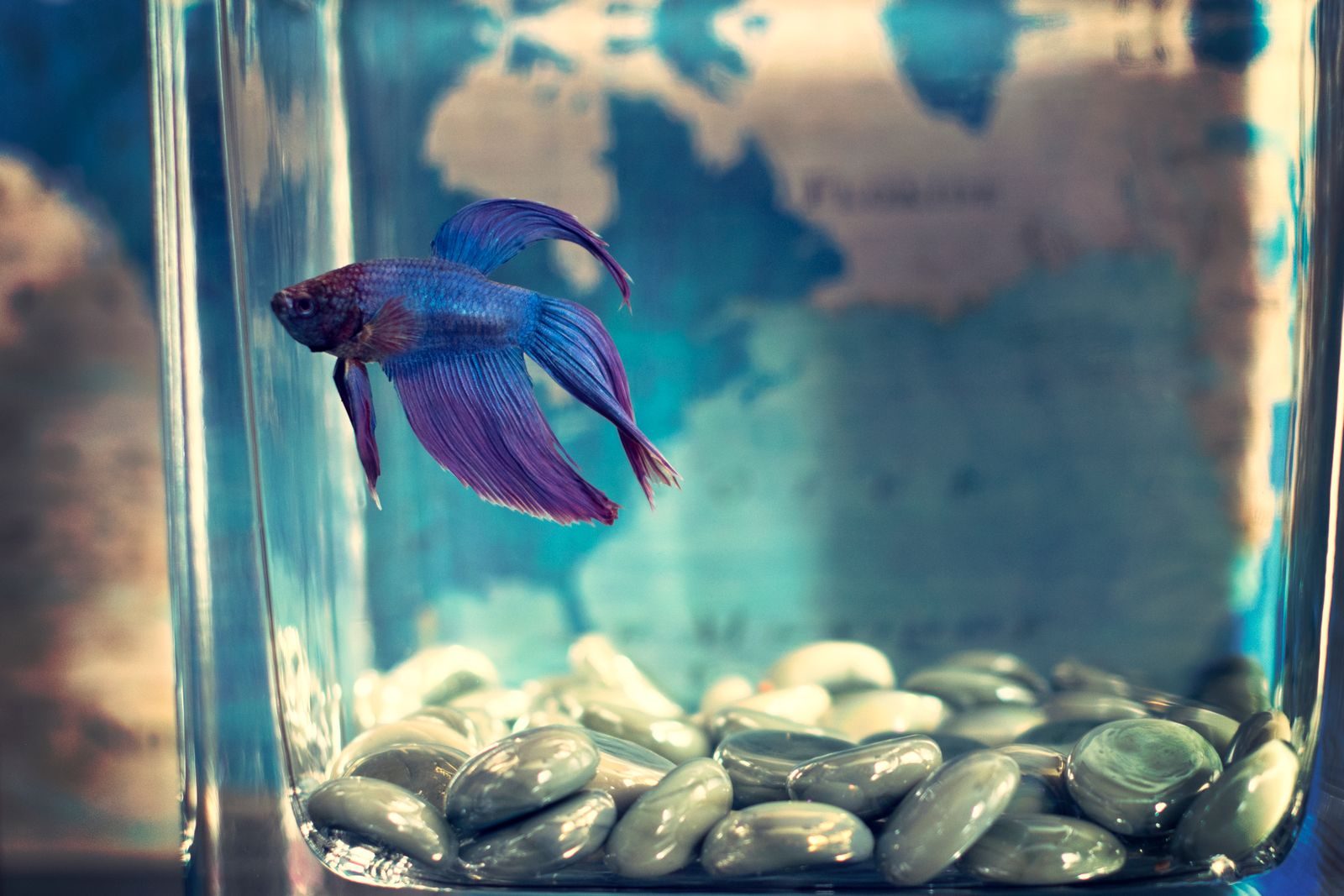
Does a betta have to reach the surface, or will it drown without air?
Here the hobby and the literature disagree, and the disagreement is worth stating plainly because you will be told the confident version.
The confident version is that a betta denied surface access drowns. It gets repeated everywhere. The evidence is less tidy than that.
UF/IFAS says that many labyrinth fishes are obligate air breathers, meaning they must breathe at the surface to survive, which is true of the family. But when researchers compare species directly, B. splendens is not one of the obligate ones. The 2019 study by Mendez-Sanchez and Burggren in the Journal of Morphology is titled around exactly this contrast: it studies the facultative air-breather Siamese fighting fish (Betta splendens) and the obligate air-breather the blue gourami (Trichopodus trichopterus). Facultative means the fish can meet its needs through the gills when the water holds enough oxygen, and uses the labyrinth when it does not. The same study found that mild hypoxia grew the labyrinth surface area of B. splendens by about 30 percent, which is an animal tuning the organ to the water it finds itself in.
So the accurate statement is narrower and more useful than the popular one: a betta in cool, well-oxygenated, clean water can probably manage on gills alone. A betta in the warm water we actually keep them in, at 26 or 27 degrees, cannot be assumed to. Warm water carries less dissolved oxygen, and the temperature page argues for warmth on every other ground.
The practical instruction is identical under both readings, which is why the disagreement stays academic: never seal a tank airtight and never fill it to the brim. Seriously Fish makes the same point from the other direction, noting the fish requires occasional access to the layer of humid air that forms above the water surface. Cling film across the top of a container is the wrong answer to a jumping problem.
Is bad water making him jump?
Test before you buy a lid. It may be both, and only one of those is an emergency.
A fish that starts jumping in a tank it has lived in quietly for six months is telling you something changed. Water quality is the first thing to rule out, because it is the one item on the list that is also killing him slowly. The laboratory husbandry review for the species is specific about the threshold: ammonia has detrimental effects on health at levels above 0.25 ppm.
Be honest about what this claim rests on. Nobody has run an experiment that measures betta jump frequency against ammonia concentration. What is documented is that ammonia above 0.25 ppm harms them, that fish avoid water they find aversive when they can, and that keepers report the behaviour resolving when the water does. That is an inference, not a measurement, and this page is not going to dress it up as one. Test anyway, because the reading matters regardless of what it explains.
The checklist to run before you accept “he just likes jumping”:
- Ammonia and nitrite, both zero. Anything else means the cycle has stalled or the tank was never cycled.
- Nitrate under about 20 ppm, against the numbers on the water parameters page.
- Temperature, stable, and not sitting above 27 C for weeks. A tank near a sunny window swings.
- Surface film. A thick protein film across the top genuinely does interfere with gas exchange at the surface, and it is easy to miss because you look through the front of the tank rather than down into it.
- Flow. UF/IFAS notes that bettas prefer calm water, citing research using flow as a stressor, so a filter aimed across a 5-gallon is a real irritant rather than a preference.
A continuous test strip that sits in the tank is a useful complement to a proper liquid kit, because ammonia problems usually appear between the weeks you remember to test.
Check the API Freshwater Master Test Kit on Amazon Affiliate link. See our disclosure.
Check the Seachem Ammonia Alert on Amazon Affiliate link. See our disclosure.
If ammonia is reading, dose a conditioner that binds it while you sort out the cause, and do the water change. There is a full protocol on the how to cycle a tank page.
Check Seachem Prime on Amazon Affiliate link. See our disclosure.
Where do fish actually get out?
Almost never over the front rim of a properly covered tank. Almost always through a hole somebody built on purpose and then forgot about.
The 2022 Comparative Medicine husbandry review for B. splendens is unusually direct about this, because a research colony that loses fish off the floor has a data problem as well as a welfare problem. Its finding, verbatim: wild betta and other strains tend to jump through the holes on the lid used to introduce food, or through small gaps between the lid and the tank. Its fix is equally specific. Lids must always be properly secured, and feeding holes get covered with mesh tape whose holes are about 3 mm wide, which is convenient for feeding and too small for a fish to pass through.
Three millimetres. That is the number to hold in your head when you look at your own tank, because almost every gap you are about to find is larger than that.
Run the audit with your eye at the level of the rim, looking along the top of the tank rather than into it:
| Opening | Typical size | Verdict |
|---|---|---|
| Feeding flap or hole in a hood | 30 to 60 mm | Wide open. Mesh it. |
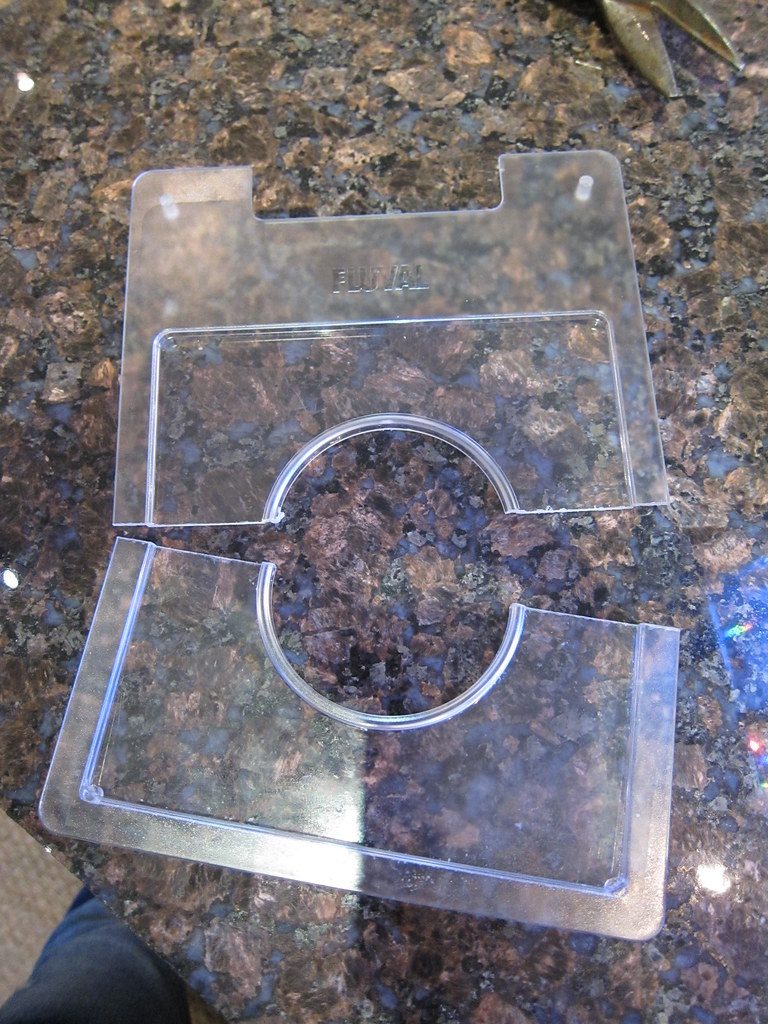
| Filter cutout at the back of a hood | 40 to 100 mm | The most common escape route on a used tank. |
| The strip a hang-on-back leaves open | 15 to 40 mm | Open, and directly under the outflow. |
| Heater and airline cord notches | 8 to 20 mm | Fits a young fish, and a bigger one after a running start. |
| Gap where a glass canopy meets the plastic back strip | 5 to 15 mm | Easy to miss, present on most kit tanks. |
| Corner where a lid meets a divider panel | 10 to 30 mm | Exists only in a divided tank and nobody checks it. |
| A hood cutout for equipment you removed | Whatever it was | Still there. Still open. |
That last row is worth its own sentence. The single most common configuration behind a fish on the carpet is a hood with a rectangular cutout for a hang-on-back filter that got swapped for a sponge filter two years ago, leaving a mouth-shaped hole in the lid above the water. Nobody notices, because a lid reads as “closed” from across the room.
What does a jump-proof setup actually look like?
Four things, and the first two are non-negotiable.
A cover that reaches every edge. A glass canopy cut for the tank is the easiest version and it also cuts evaporation, which matters more than people expect on a heated 5-gallon. A rimless tank needs a piece of glass or acrylic cut to size with a shallow lip, or a screen top built from window screen and frame stock. Either works. What does not work is a piece of card, which sags in humidity, or a partial cover leaving a third of the surface open on the theory that the fish will jump where the lid is.
Fine mesh over every remaining opening. Where a cord or a hose has to pass through, close the rest of the gap. Aquarium-safe mesh, mesh tape, or a piece of window screen cable-tied over a cutout all do the job.
A water line below the rim. Covered next.
Nothing above the tank that a fish would want to reach. A light fixture with a warm bulb sitting directly on an open rim is a heat source over the water, and heat over the water is a reason to go up.
Check the All Glass Versa Top canopy on Amazon Affiliate link. See our disclosure.
Check a DIY magnetic anti-jump mesh cover on Amazon Affiliate link. See our disclosure.
How far below the rim should the water be?
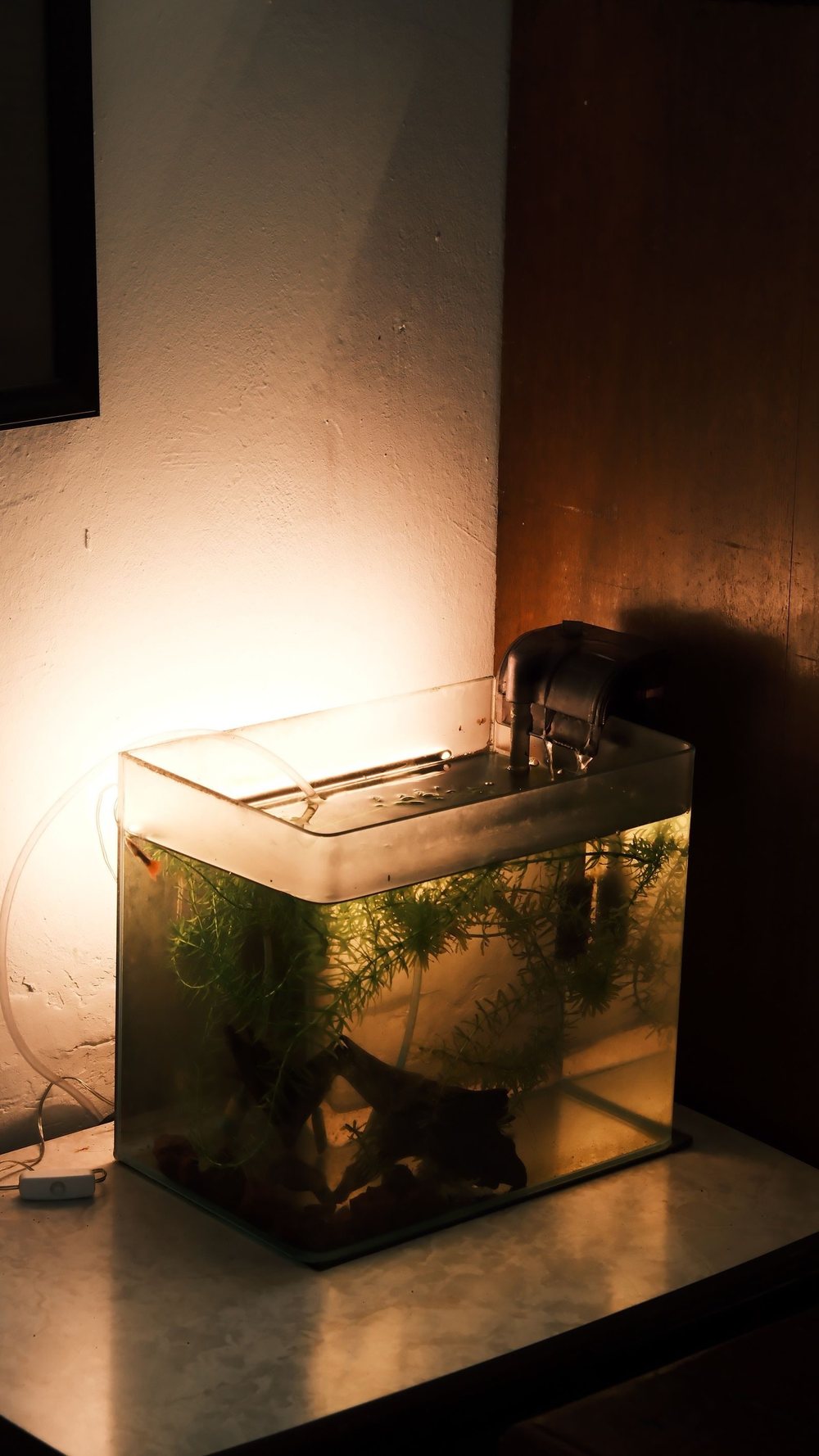
One to two inches on a standard tank, and the reason is not only the jump.
Drop the water and you get three things at once. The fish has a wall to clear rather than a step. The humid air layer that Seriously Fish says a betta needs forms in the space you left, instead of the fish gulping room air across a cold pane. And a lid that is not sitting in the water stays free of the mineral crust that eventually props it open.
Two situations change the number:
- A divided tank. The water goes below the top of the divider by a clear margin, or the divider becomes a ramp. That is covered in the divider setup build.
- Coming back from holiday. Evaporation on a heated nano runs faster than people plan for, so the level you left is not the level you return to. Top-ups are part of any vacation care plan, and a lid slows the loss substantially.
The trade-off to be aware of: a low water line in a tank with a hang-on-back filter increases the drop height of the outflow, which adds noise and surface turbulence a betta will not thank you for. Lower the line and adjust the filter, rather than raising the line to quiet the filter.
Does surface cover help?
Yes, and it is the cheapest item in this article.
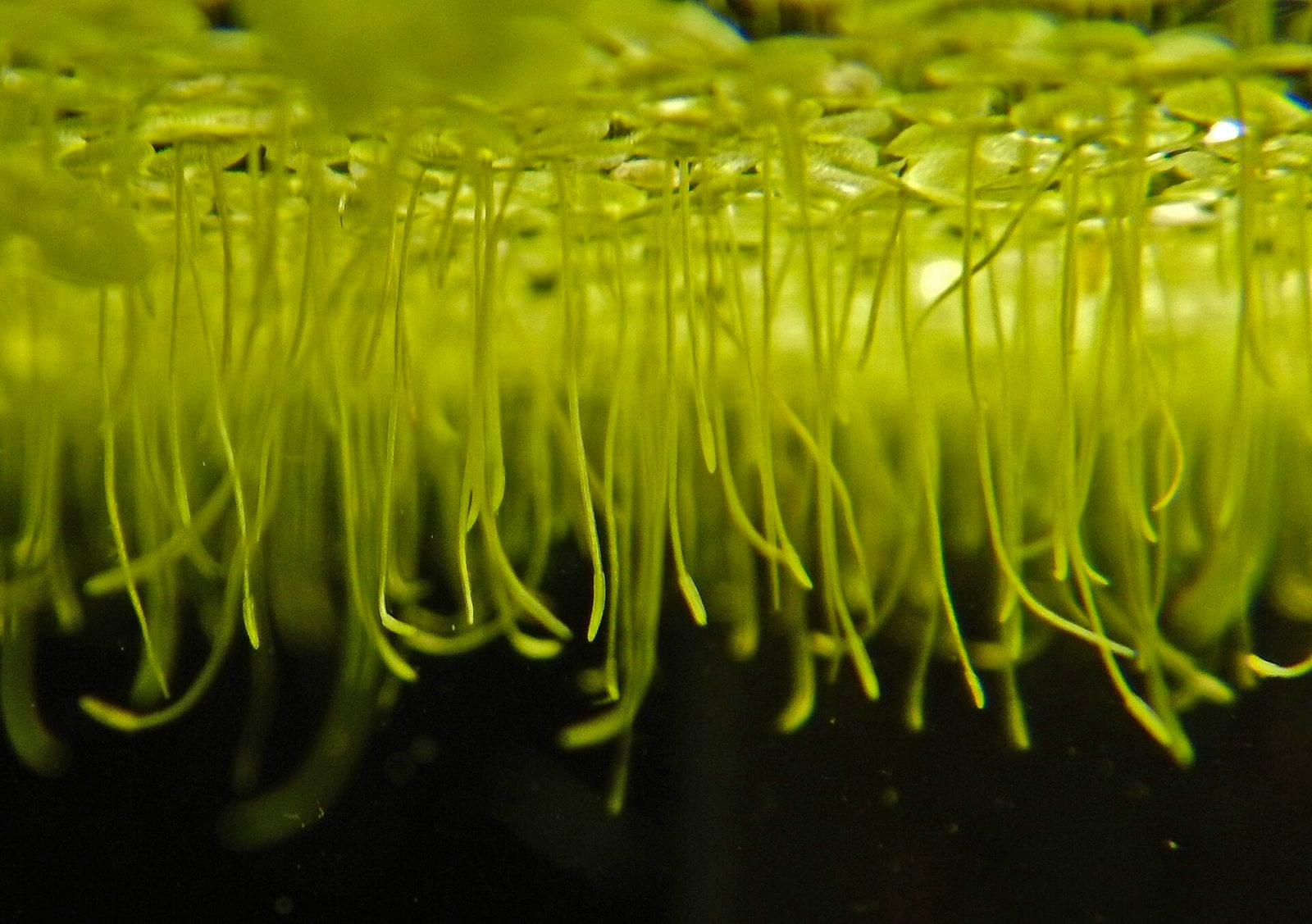
Floating plants change the surface from an open ceiling into a canopy. A betta under frogbit or salvinia rests in the roots rather than patrolling the open water below a bright light, and a surface that is physically occupied is a surface that is harder to launch from. There is a second benefit that has nothing to do with jumping: floating plants shade the tank, which is the whole argument on the lighting page, and they take up nitrate.
Which species, and the one caution:
- Frogbit and salvinia are the two to choose between. Both form a thick mat, both are easy to thin out, both have roots a betta will hold station in.
- Duckweed works and you will never remove it. Decide that deliberately.
- Do not let the mat go wall to wall. The fish still has to reach open air, and a surface sealed by 100 percent plant coverage in a tank with no gas exchange is its own problem. Thin it to roughly two thirds coverage and keep thinning.
Species that thrive under a low-output nano fixture are covered in best live plants.
He jumped. What do you do in the next five minutes?
Speed matters more than technique, and a betta found quickly often recovers completely.
- Get him back in the water. Wet your hand first so you do not strip slime coat, cup him rather than gripping, and put him in the tank he came from at the temperature he came from. Do not put him in a bowl of cold tap water.
- Support him at the surface if he cannot hold himself upright. A floating breeder box, or a leaf hammock, or a bare hospital container filled only three or four inches deep so he does not have to swim up to breathe.
- Do not feed for 24 hours. A stressed fish will not eat, and uneaten food in a hospital container fouls it fast.
- Watch for damage over the following week. Dry fin edges that go ragged, a scraped flank, a cloudy eye. Torn fins are an opening for fin rot, and the difference between fresh damage and infection is covered in fin damage vs fin rot.
- Then fix the lid, because a fish that has done it once has established that the route exists.
Two things not to do. Do not run him under the tap, and do not add aquarium salt reflexively, which has its own indications and its own limits on the aquarium salt page.
And the part nobody says out loud: a betta that dried out for an hour is usually not recoverable, and that is not a failure of first aid. It is the argument for the mesh, made after the fact.
Related on this site
- Betta Tank Setup: A 5-Gallon Minimum Build, Step by Step
- Betta Anatomy: What You’re Looking At When You Look at a Betta
- Betta Fish Water Parameters: The Complete Reference Table
- The Nitrogen Cycle: Why Uncycled Tanks Kill Bettas
- Betta Tank Divider Setup: Sizing, Flow, and Sightlines
- Betta Fish Light Schedule: Hours, Timers and Real Darkness
- Betta Fish Vacation Care: 1 Day, 1 Week, and 3 Weeks Away
- The Betta Vase Myth: Why Peace-Lily Setups Are Animal Cruelty