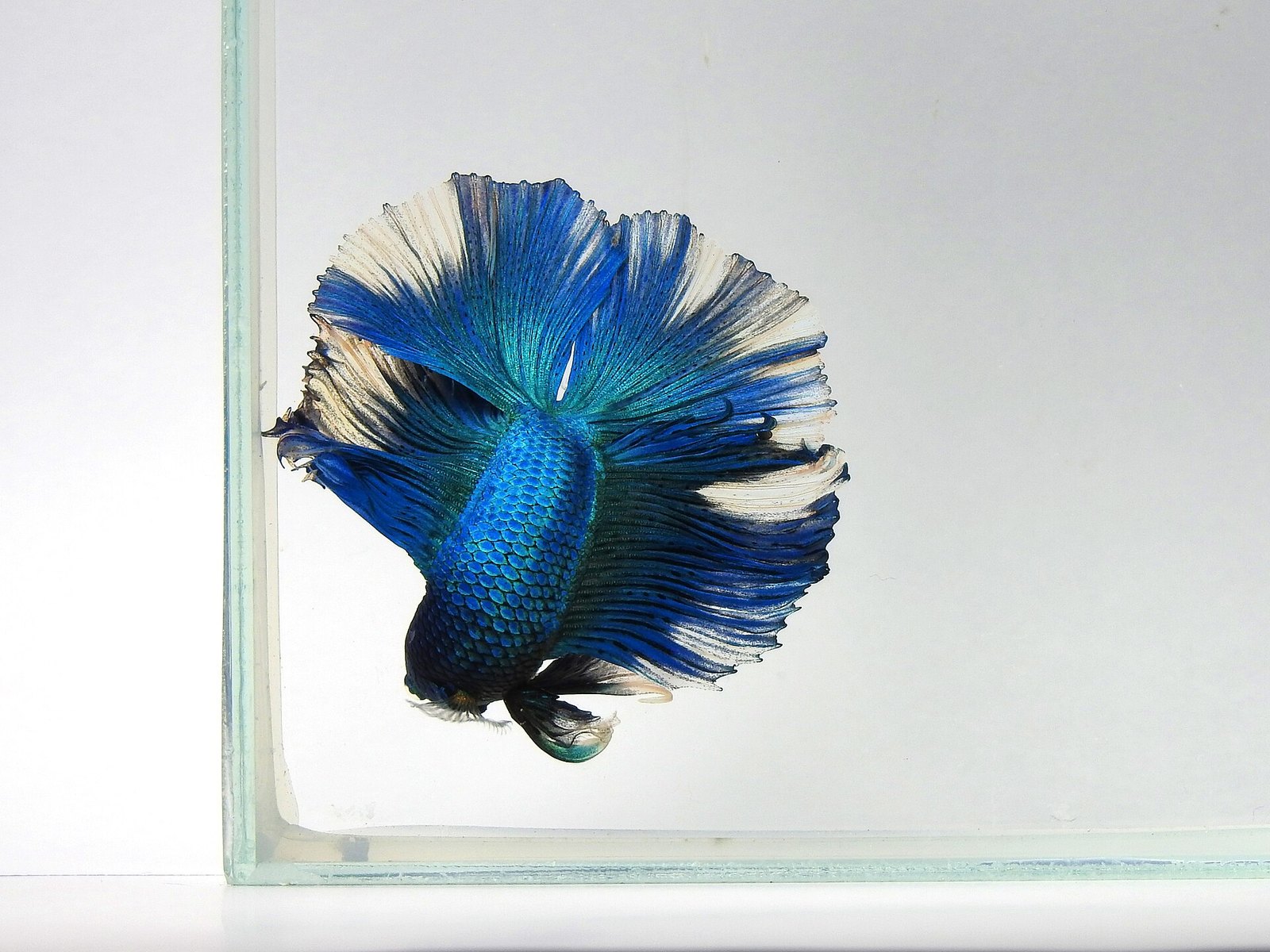
A halfmoon needs the same water as any betta plus a tank built around the weight of one fin. The caudal opens to a half-circle, it acts as a sail in any current, and it catches on anything with an edge. Air-driven filtration, footprint over height, resting spots at every level, and a weekly water change you never skip.
This page has affiliate links. As an Amazon Associate we earn from qualifying purchases. See our affiliate disclosure.
What does a 180-degree caudal actually change?
The load, and every care decision downstream of it.
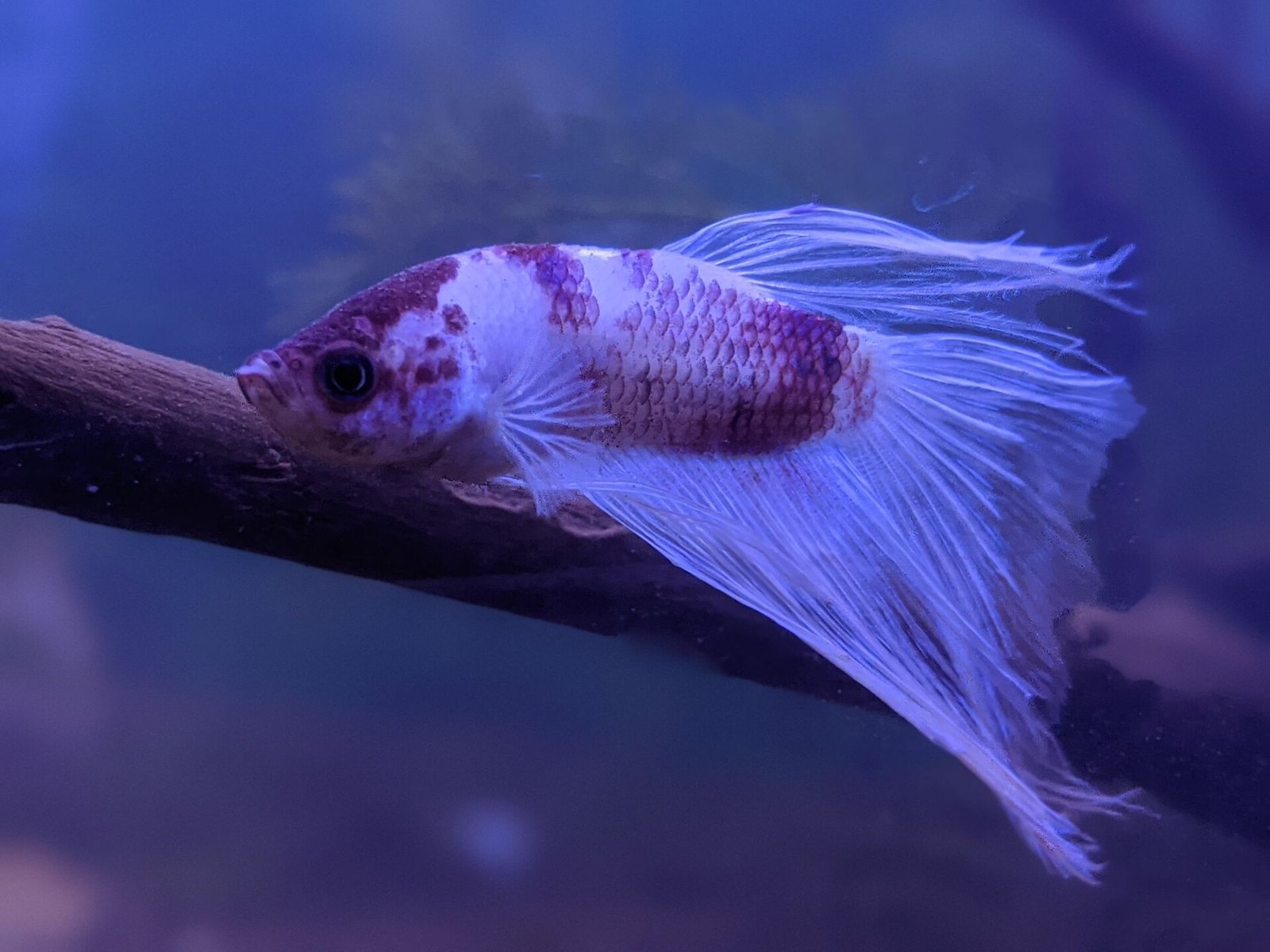
A veiltail drags its fin. A plakat barely has one. A halfmoon carries a caudal bred to open into a flat half-circle, top point to bottom point, with the dorsal and anal fins enlarged to fill the gaps on either side. What that geometry means for the genetics and the show ring is on the halfmoon form page. This page is the husbandry, and the husbandry starts from a physical fact: that fin has to be moved, held open, and hauled to the surface every few minutes for the rest of the fish’s life.
There is no controlled study of swimming cost in ornamental Betta splendens, and anyone quoting you a percentage has made it up. The nearest measured result comes from a different species. Wakamatsu and colleagues put adult zebrafish on a swim tunnel in 2019 and clipped the caudal fins of long-finned stock to a range of lengths, and their finding was that the fish reached high critical swimming speeds at a caudal between 3 and 10 mm, implying that long-finned zebrafish are unfavorable for fast swimming. Different fish, same physics. Fin past a certain length stops helping and starts costing.
Three consequences follow, and every recommendation below traces to one of them.
- The fin is a sail. Surface area that a plakat does not have, presented to whatever current your filter makes.
- The trailing edge is exposed and thin. It reaches places the body never goes, including behind decor and into filter slots.
- The fish tires. A halfmoon parks more than a plakat does, so where it parks matters.
| Care variable | Plakat | Halfmoon | Why |
|---|---|---|---|
| Filtration | Gentle | Gentle, air-driven by preference | The caudal catches current the body would ignore |
| Tank shape | Either | Wide base over tall column | Every surface trip costs more on a heavy fin |
| Decor | Nothing sharp | Nothing that catches a nylon stocking | Trailing edge reaches what the body avoids |
| Resting spots | Useful | Required, at several depths | A tired fish that cannot park hangs in open water |
| Water changes | Weekly | Weekly, non-negotiable | More surface area, more entry points for infection |
| Tail biting risk | Low | Elevated | The fin is within reach and it gets in the way |
| Temperature | 76 to 82 F, stable | Identical | The water is just water |
How much flow can a halfmoon take?
Less than a plakat, and much less than the number on a filter box.
Seriously Fish is unambiguous about the species: as it naturally inhabits sluggish environments, strong water movement should be avoided, with an air-powered sponge filter set to turn over gently adequate. That advice was written for the species, not for the fin form. On a halfmoon it stops being advice and becomes the specification.
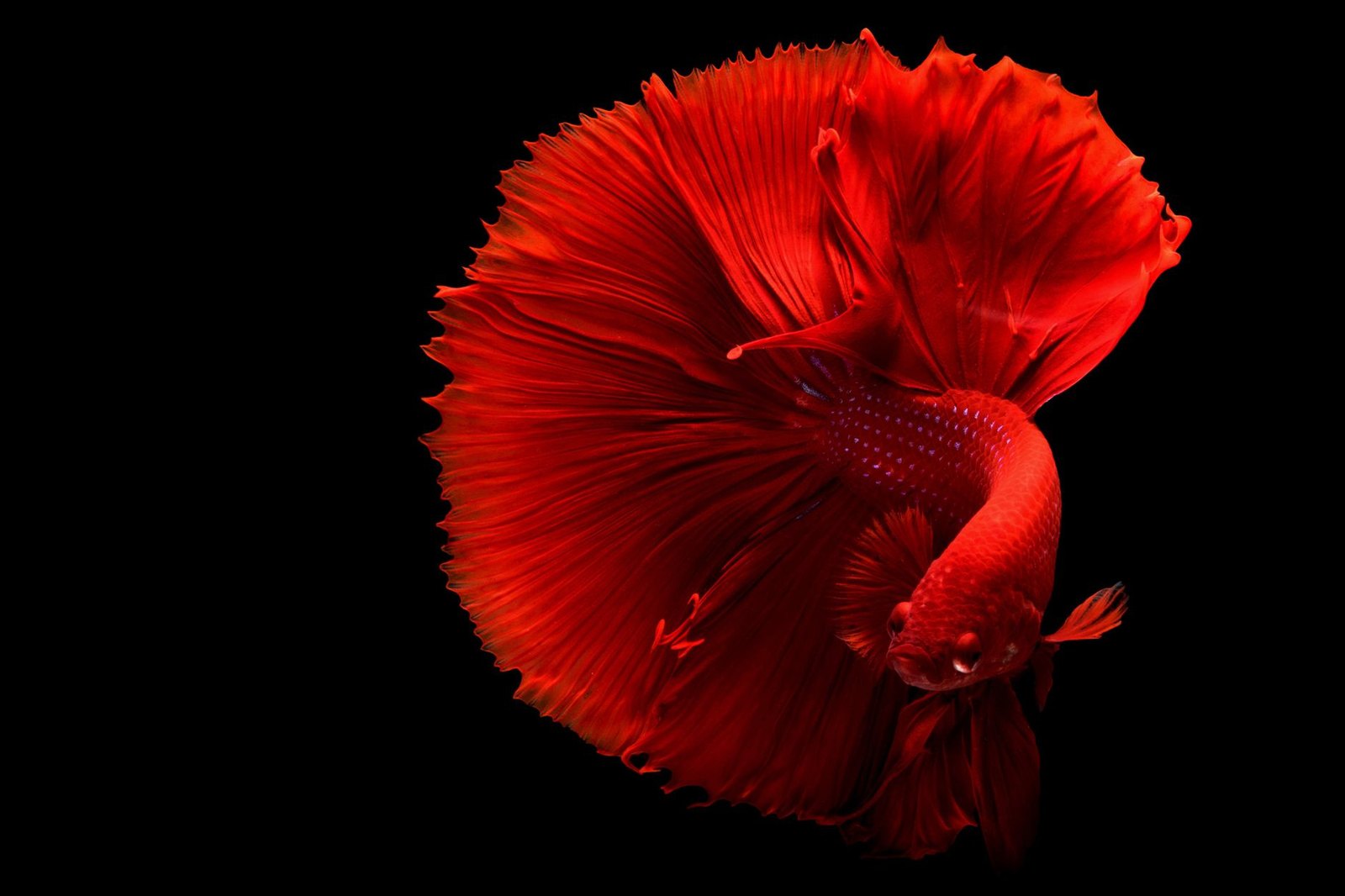
Watch what a current does to the fish rather than measuring it. A halfmoon fighting flow holds station with the caudal streaming behind it like a flag, corrects constantly with the pectorals, and stops using the open water entirely. Over weeks that produces split rays, a folded caudal that never fully reopens, and a fish that spends its life in one dead corner.
How to get the flow right:
- Air-driven sponge filtration on a small pump. Not a compromise, the default. Best filters works through why for this species generally.
- Baffle any hang-on-back you already own. A cut plastic bottle over the outflow, or filter foam wedged in the fall, kills the stream without cutting turnover.
- Read the plants. Foliage that drifts slowly and floating cover that stays roughly put means you are close. Waving stems mean the fish is working.
- Watch the evening. A halfmoon that has picked one corner and stays there by seven every night is telling you the other three corners are too busy.
Check the Aquarium Double Sponge Filter on Amazon Affiliate link. See our disclosure.
Why do halfmoons bite their own tails?
Because the fin is within reach, it gets in the way, and a bored fish has time to think about it.
Self-inflicted fin damage is common enough in long-finned bettas that it has its own page here, and tail biting covers the diagnosis and the response properly. What belongs on a halfmoon care page is the risk profile, because this fin form sits at the top of it.
The signature is unmistakable once you know it. A clean semicircular notch bitten out of the caudal, usually appearing overnight, usually symmetrical because the fish curls the same way each time. Fin rot advances between one day and the next and darkens at the margin. A bite is there in the morning and looks identical that evening. Fin damage versus fin rot is the differential if you are unsure.
What raises the risk on this form specifically:
- Fin mass relative to body. The most heavily finned individuals in a spawn are the ones that bite. Breeders have said so for decades and the pattern is consistent across keeper reports, though nobody has run the study.
- A bare tank. The welfare literature keeps landing in the same place. The 2022 laboratory husbandry review for this species states plainly that environmental enrichment may reduce abnormal fish behaviors, and biting one’s own fins is the textbook abnormal behavior in a betta.
- Space to move. Oldfield and Murphy tested eight males individually across a 0.5-litre bowl and 10, 38 and 208-litre aquaria in 2024 and found that fish spent significantly less time swimming in 0.5-L bowls than they did in the three larger aquaria, with enriched containers producing more swimming bouts than bare ones. Their conclusion for keepers is a floor of 10 litres, physically enriched, for full expression of swimming behaviour. A separate 2024 study from Culum Brown’s group at Macquarie, running 13 males across housing from 1.5-litre jars up to 19.3-litre aquaria, put the fish in larger tanks at 92 seconds more swimming per observation period and found they spent close to half their resting time using the furnishings rather than hanging in open water.
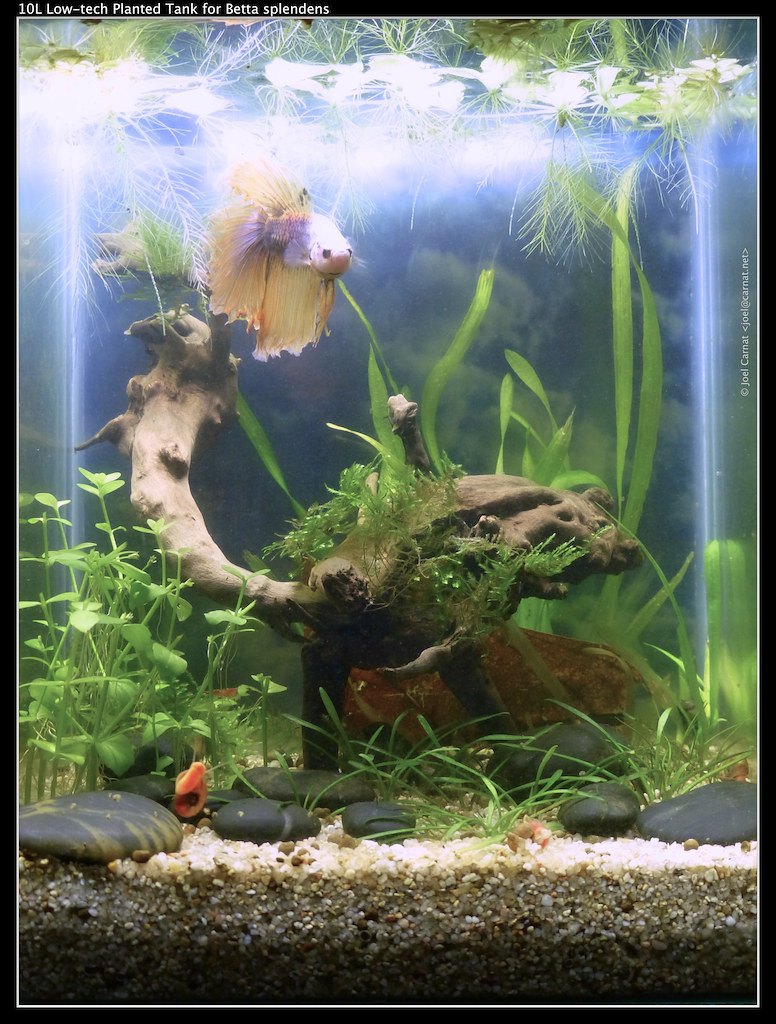
The practical read: a halfmoon in a bare five-gallon box has nothing to do all day except carry its own tail around. Plant it, give it caves and leaves and floating cover, and the biting frequently stops without any other intervention.
Check SunGrow catappa Indian almond leaves on Amazon Affiliate link. See our disclosure.
Which decor tears heavy finnage?
Anything that catches fabric, plus two categories nobody suspects until it happens.
The test is free and it takes five minutes. Drag a nylon stocking firmly over every surface going into the tank, including the undersides and the faces that will sit against the glass. If the fabric snags, pulls a thread, or squeaks to a halt, the trailing edge of a halfmoon caudal will do the same. Run it dry, before anything goes in the water.
The usual offenders:
- Moulded plastic plants. The seam where the two halves of the mould met runs the full length of every leaf, and it is the commonest source of torn fins in a betta tank. Silk is the standard swap.
- Ceramic and resin ornaments with hollow openings. Caves, wrecks, skulls and barrels all have unfinished interior edges, because nobody sands the inside of a thing nobody looks into.
- Filter intake slots. A grille will hold the caudal against itself while the pump keeps pulling.
- Cut driftwood ends and split cholla, which look soft and are not.
- Sharp gravel, for a fish that rests on the bottom, which halfmoons do more than plakats do.
The two nobody suspects. First, the underside of the lid and its cutouts: a betta going up for air at speed catches the moulded edge of a feeding hole, and on this fin form the caudal reaches the lid before the body does. That is also a jump risk, which is a worse problem than a torn fin and is covered on betta jumping. Second, narrow gaps between hardscape, a slot the body fits through and the open caudal does not. A halfmoon will swim into it anyway.
What to use instead: broad-leaf live plants, floating cover, smooth river stone, naturally worn wood, catappa leaves on the substrate. Best plants has the five that survive a low-light five-gallon with no CO2, and Indian almond leaves covers what leaf litter does and does not do.
Browse silk aquarium plants on Amazon Affiliate link. See our disclosure.
Does a halfmoon need different water?
No. It needs the same water, held more reliably.
The targets are the ones on the water parameters table for every Betta splendens: ammonia and nitrite at zero, nitrate held down by weekly changes, temperature steady in the 76 to 82 F band, pH wherever your tap sits inside the 6.0 to 8.0 range Seriously Fish gives for ornamental strains. The laboratory colony described in the 2022 husbandry review runs its systems at 28 C.
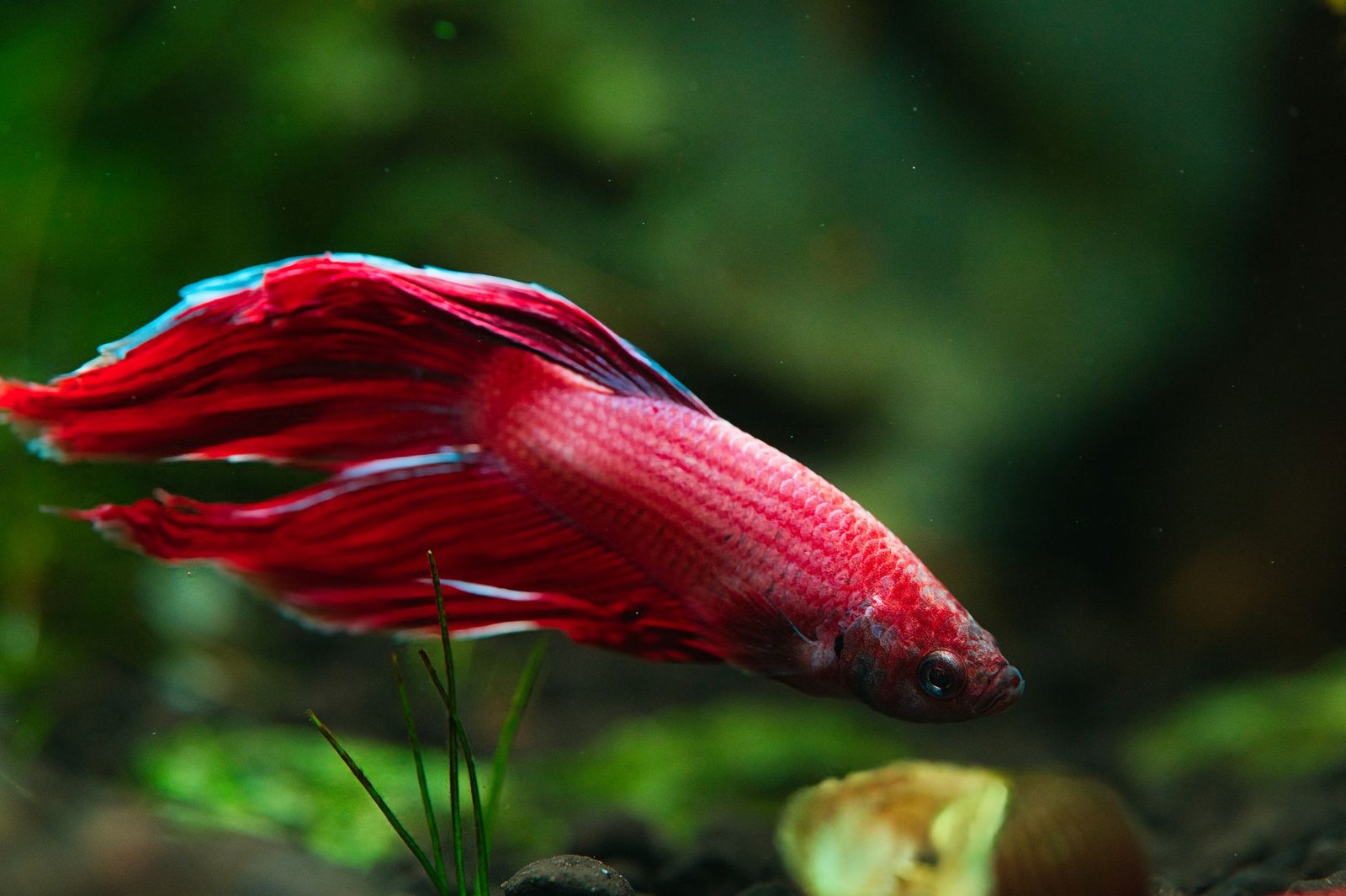
Where a halfmoon differs is in how little slack it gives you. More fin surface means more tissue exposed to whatever is in the water, and damaged fin edges are where opportunistic bacteria establish. Skip a fortnight on a plakat and usually nothing shows. Skip a fortnight on a heavily finned halfmoon and the trailing edge starts going ragged, at which point you are reading fin rot rather than a care page.
Two habits carry most of the load. Test rather than assume, because a fin problem with a clean test result is mechanical and a fin problem with ammonia on the kit is a water problem wearing a fin costume. And match the temperature of the refill, because a cold top-up suppresses immune function at the same moment it makes the bacteria more comfortable.
Check the API Freshwater Master Test Kit on Amazon Affiliate link. See our disclosure.
Check the Cobalt Aquatics Neo-Therm Pro 25W heater on Amazon Affiliate link. See our disclosure.
Tank shape, and why footprint beats height
Because every trip to the surface is work, and a tall tank makes the trip longer.
Bettas are obligate air breathers. The labyrinth organ means a halfmoon goes up for atmospheric air every few minutes whatever the dissolved oxygen is doing, and on this fin form each trip costs more than it does for a short-finned fish. A 10-gallon tall and a 10-gallon long hold the same water and present very different daily workloads.
Seriously Fish gives base measurements of 45 x 30 cm or equivalent as large enough for a single male or a pair, and base measurements is the operative phrase. Read the footprint, not the volume. Best 5-gallon tanks covers the sensible options at the small end, and if you have the space, a long 10-gallon is the better tank for this fin form by a wide margin.
Then furnish the water column. A halfmoon that has nowhere to park hangs in open water and works the whole time.
- Broad leaves within two inches of the surface. Anubias, a betta leaf hammock, or a large crypt reaching up. This is where the fish will spend most of its resting hours.
- Floating cover. Frogbit or salvinia over part of the surface, which also cuts the light and calms the fish down. Lighting covers the intensity question.
- One low, smooth cave. Not because a betta needs a hide, but because a tired heavy-finned fish should have a floor-level option that is not bare glass.
What to check before you buy one
Four things, and three of them are only visible while the fish is displaying.
The caudal opens flat. Get the fish to flare, at a mirror or at a neighbouring cup, and look side on. The outer edge should form a straight line from the top point to the bottom point. Most chain-store fish sold as halfmoon land somewhere between 150 and 180 degrees, which is a super delta and is not a fault so much as a naming convention. Fin types sorts out the vocabulary.
The edge is clean, not frilled. Excess ray branching is what fills a caudal out, and past a certain point it keeps going. Rosetail and feathertail fish carry so much branching that the fin folds over itself, gets heavier, and takes on a much higher rate of breakage and biting. If the edge already looks like crumpled tissue paper, you are buying a maintenance problem rather than a show fish.
The dorsal and anal fins are in proportion. IBC exhibition standards judge finnage as a balanced whole rather than scoring the caudal alone, and the practical version of that for a pet keeper is the same: a huge tail on a small dorsal swims worse.
There are no existing bites. Ask to see the fish flared. A semicircular notch on a shop fish means an established habit, and habits travel to the new tank with the fish.
The routine
- Weekly: 25 to 30 percent water change, temperature matched, dechlorinated. Test ammonia, nitrite and nitrate. Water change frequency has the reasoning.
- Weekly: look at the caudal outline in good light while the fish is active. You are looking for a change against last week, not for perfection.
- Monthly: one photograph at flare, side on, same spot, same light. A bite is obvious against a photo and invisible against memory.
- Monthly: run the stocking test over anything new, including a plant you moved or a piece of wood you rotated.
- After every filter service: check that flow has not gone up. A cleaned sponge moves more water than a clogged one, and the fish notices before you do.
Related on this site
- Halfmoon Betta: What the 180-Degree Caudal Spread Means
- Betta Fin Types: Halfmoon, Crowntail, Plakat, IBC Forms
- Crowntail Betta Care: Flow, Decor, Water and Ray Condition
- Betta Tail Biting: Why It Happens and How to Stop It
- Fin Damage vs. Fin Rot: How to Tell Them Apart and What Each Needs
- Best Filters for Betta Tanks in 2026: Sponge Filters Win, Here’s Why
- Betta Fish Water Parameters: The Complete Reference Table
- Best Live Plants for Betta Tanks in 2026
- Indian Almond Leaves for Betta Fish: What They Actually Do