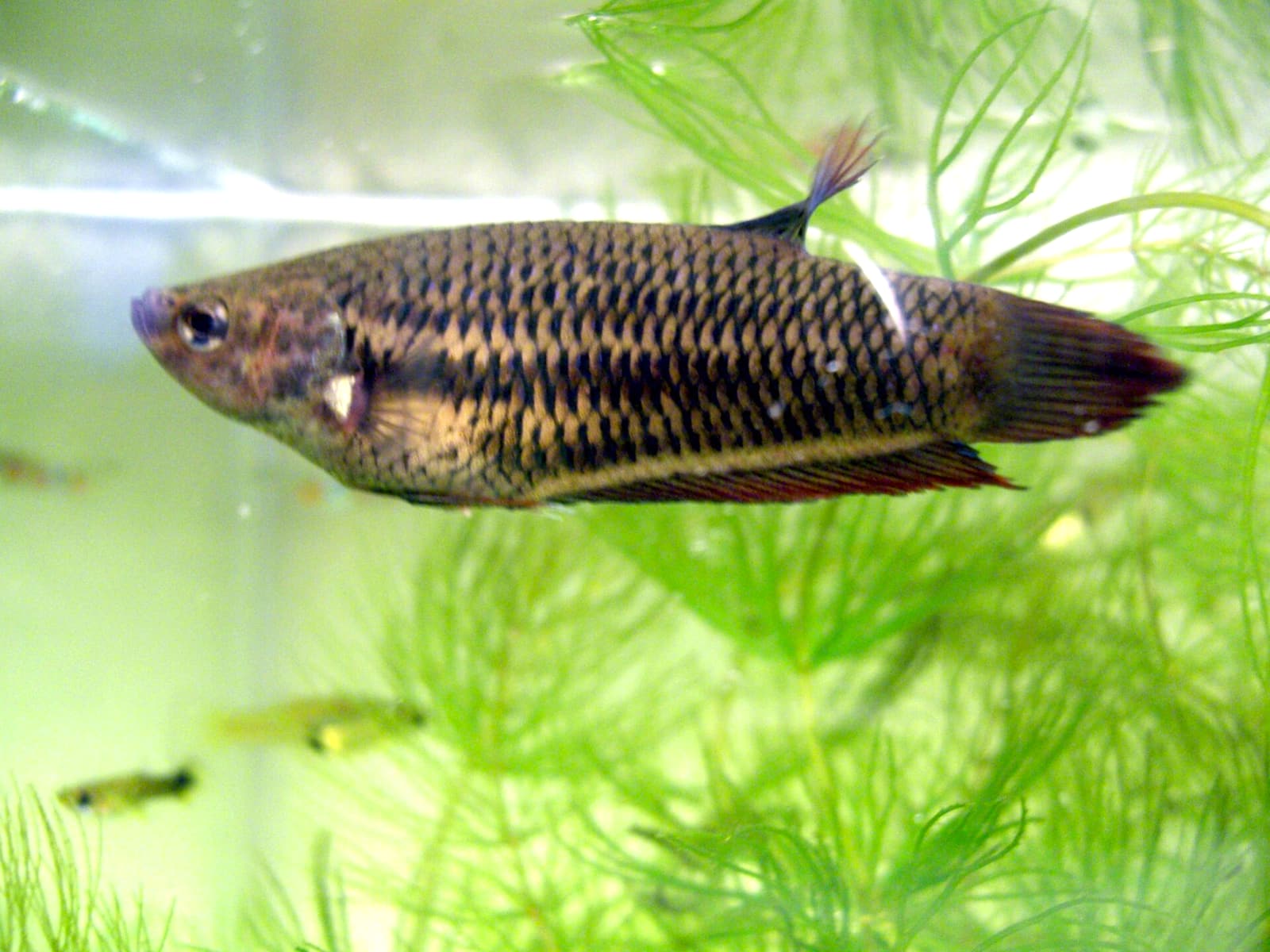
A betta sorority is a group of five or more female Betta splendens living in one heavily planted tank of 20 gallons or larger. Female bettas are territorial toward each other. They sort out a dominance hierarchy and then maintain it, so the standard failure mode is one subordinate fish harassed until she stops eating or dies. Sororities work for keepers who have the tank space, the planting, and a spare tank standing by. They are a poor first betta project.
That is the honest version. Below is what the evidence supports, what the setup requires, and what a failing sorority looks like six days before anyone usually notices.
Are female bettas actually peaceful?
No, and this is where most sorority attempts go wrong before the water is even in the tank.
The premise people arrive with is that females are the calm version of the species and males are the problem. Females do not flare and fight with the same theatrical intensity as two males in a bare tank, which is where the impression comes from. What they do instead is slower and harder to see: sustained low-level pressure on whoever ranks lowest, expressed as chasing away from food, blocking access to cover, and repeated nipping at the same fish.
Seriously Fish’s species profile takes the strictest reading of this and says so directly: ornamental strains “seem to be more aggressive than any other Betta species,” and “only a single individual can be kept per tank in most cases.” That is a real position from a serious source and it deserves to be stated rather than buried. A sorority is a departure from the safest possible husbandry, undertaken deliberately, with conditions attached.
The laboratory husbandry review for the species (Lichak et al., Comparative Medicine, 2022) lands in a different place. It houses adult females either individually or in groups at a density of 2 fish per litre, “if monitored carefully for excessive aggression.” Both things are true at once: group housing is achievable, and the achievement rests on the monitoring clause.
Note what that density means before importing it. Two fish per litre is a research facility with 15 percent of system volume exchanged daily and staff walking the racks. It is not a benchmark for a living-room tank, and copying the stocking number without copying the water management is how people end up with an ammonia problem on top of an aggression problem.
Does the fish’s history matter more than the tank?
This is the finding that reframes the whole question, and it rarely makes it into hobby guidance.
Iwata and colleagues (BMC Zoology, 2021) raised bettas under different conditions and measured aggression at adulthood. Fish kept continuously in enriched group environments, tanks with plants, rocks and shelters, grew up markedly less aggressive than fish moved into bare isolation, and their adult behaviour stayed closer to a juvenile profile. Both sexes could be group-housed as adults when raised that way from hatching.
Timing of removal shaped the result. Fish isolated at two months post-hatching showed more contact fighting as adults, tail slapping and biting. Fish isolated at four months showed more threat display, flaring and opercular spreading, and were the only group with elevated cortisol after a mirror test. Females responded to the rearing manipulation more strongly than males did, with the authors reporting that the influence of rearing conditions on behaviour was greater in females.
There is a cost attached, and honesty requires naming it: group housing suppressed sexual maturation in both sexes, with lower 11-ketotestosterone in group-raised males and a lower gonadosomatic index in group-raised females than in fish isolated at four months.
The practical takeaway is uncomfortable for anyone buying fish at a chain store. Almost every female betta on a retail shelf was raised in a small individual container, which is the rearing history associated with higher adult aggression. You are not starting from the condition that made group housing work in that study. A sorority stocked from a breeder who grow-out their females communally is a different proposition than one stocked from five cups on a shelf, and it is worth asking the question before you buy.
What tank size does a sorority need?
Twenty gallons is the working floor. Twenty-nine to forty gallons is where these get easier.
The reason is footprint rather than volume. A dominance hierarchy needs space for subordinate fish to hold territory that a dominant fish is not currently occupying, and a tall 20-gallon column gives you far less usable floor than a 20-long of the same volume. Given the choice, take the longer footprint.
Below 20 gallons the fish are in constant visual contact and there is no functional retreat. That is the setup where a hierarchy stops being a hierarchy and becomes one fish attacking one other fish continuously.
The same water quality standards apply as any betta tank, and a larger group of fish makes them harder rather than easier to hold. Temperature 76-82°F, ammonia and nitrite at zero, nitrate under 20 ppm. The full table is on the water parameters page, and the tank needs to be fully cycled before a single fish goes in. See how to cycle a tank.
How many females do you need?
Five at minimum. More is better up to the limit of your filtration and floor space.
The logic is aggression distribution. In a group of three, a dominant female has two possible targets and can concentrate on one of them relentlessly. In a group of eight, the same dominance behaviour gets spread across the group and no individual absorbs all of it. Small groups do not reduce fighting, they concentrate it.
Add every fish at once. A sorority that has settled into a stable hierarchy treats a newcomer as an intruder, and the re-establishment fighting after a late addition is usually worse than the initial sort-out. If you plan to keep eight, buy eight.
Size-match them as closely as the shop allows. One female noticeably larger than the rest is the most reliable predictor of a single dominant fish taking over the tank.
How do you set the tank up?
The hardware is ordinary. The planting is not.
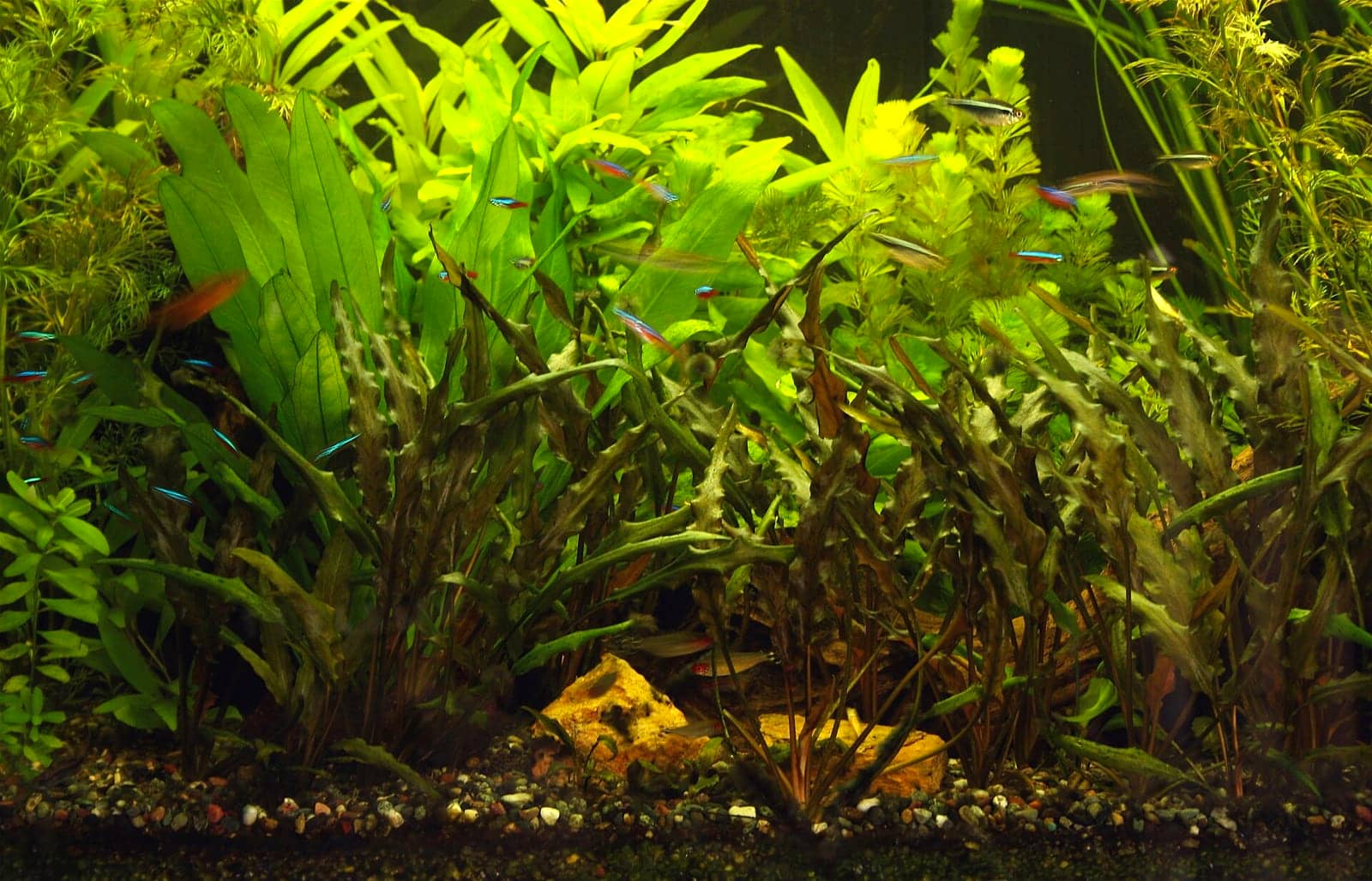
- Cover to the point of excess. Dense stem plants, broad-leaf plants, floating cover, driftwood and caves, arranged so that no vantage point in the tank sees the whole tank. If you can stand at the front glass and see every fish at once, there is not enough in there. Species and difficulty are covered on best live plants.
- Two or three feeding stations. A dominant female can control one feeding spot. She cannot control three at opposite ends. This single change fixes more subordinate-fish weight loss than anything else on this list.
- Gentle filtration. A sponge filter or a baffled hang-on-back. Long-finned females tire in current, and a tired fish loses access to cover. See best filters.
- A lid. Startled bettas jump, and a tank with chasing in it produces startled bettas. Betta jumping covers the failure and the fix.
- A quarantine tank you have already cycled. Not a bucket you will set up if something happens. A running, cycled tank with a heater in it, ready tonight. This is the piece people skip, and it is the piece that decides whether a targeted fish recovers or dies. See quarantine tank.
What does the first week look like?
Chasing, flaring, and some nipping. That part is expected and it is the hierarchy forming.
What you are watching for is whether it converges. Over roughly seven to fourteen days, a functioning group settles into a pattern where displays get shorter, the chases end quickly, and the fish spread out across the tank instead of clustering at one end. Aggression that has not visibly reduced by the end of the second week is not settling, it is the failure mode establishing itself.
Feed twice daily during this period rather than once. Well-fed fish contest food less, and it gives you two scheduled observation windows a day when every fish should appear.
What does a failing sorority look like?
The signals are individual, not group-wide. A tank in trouble looks fine at a glance because four fish out of five are fine.
- One fish with stress stripes while the others are colored up. Horizontal bars on a single female in a group of bright ones is the earliest readable sign.
- One fish with progressively shorter fins. Not the ragged, blackened margins of fin rot, but clean bite-shaped losses that get worse week over week. Fin damage versus fin rot covers telling them apart.
- One fish never at feeding. If you cannot account for every fish at both feedings, count again.
- One fish permanently in the same corner, or permanently behind the filter. Retreat is normal. Permanent retreat is a fish that has nowhere else it is allowed to be.
- Any fish visibly thinner than the others. By the time body condition is visible from the front glass, this has been running for weeks.
Rule out water quality before you conclude it is social. Lethargy and poor appetite are exactly what Merck lists for ammonia exposure, and a heavily stocked tank is a plausible place for a cycle to fall behind. Test first, then diagnose the group.
What do you do when it fails?
Remove the victim, not the aggressor. This trips people up because it feels backwards.
The dominant fish is behaving normally for the species. Pull her out and the group re-sorts, a new dominant emerges within days, and you have the same problem with a different cast plus the disruption of a hierarchy reset. Pull the targeted fish out and she starts eating, her fins begin regrowing, and the group carries on with a hierarchy that already works.
The removed fish goes to the cycled quarantine tank you set up beforehand. She can live there permanently. A single female in a planted 5-gallon is a fine outcome and a common one.
If a second fish becomes a target after the first is removed, the tank is not the problem and neither is any individual fish. Break it down. Some groups do not work, and continuing to run one that has produced two victims is a decision to lose fish slowly.
Is a sorority worth it?
Depends entirely on what you want from the tank.
If the appeal is watching multiple bettas interact in one display, and you have a 29-gallon, dense planting, a cycled backup tank, and the patience to observe daily rather than glance daily, a sorority delivers something a single-fish tank does not.
If the appeal is keeping more bettas in the space you have, a divided tank does that with none of the aggression management. One fish per section, opaque divider, no hierarchy to maintain, no victim to rescue. Tank divider setup has the build, and best tank dividers covers the hardware.
And if this is your first betta, keep one fish, learn what a healthy individual looks like across a year, and come back to this. The observational skill a sorority demands, spotting one fish slightly off among five that look fine, is built on knowing the baseline cold. Betta behavior is where that starts.